


The role of unit-dose child-resistant packaging in unintentional childhood exposures to buprenorphine-naloxone tablets
Supporting Files

-
Feruary 2020
-
File Language:
English
Details
-
Personal Author:
-
Corporate Authors:
-
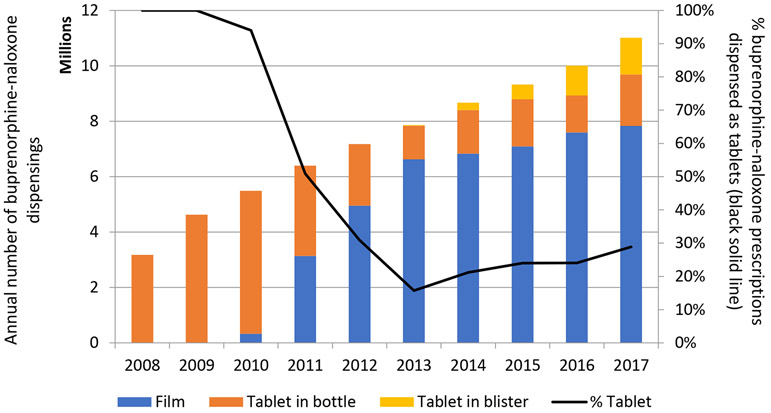
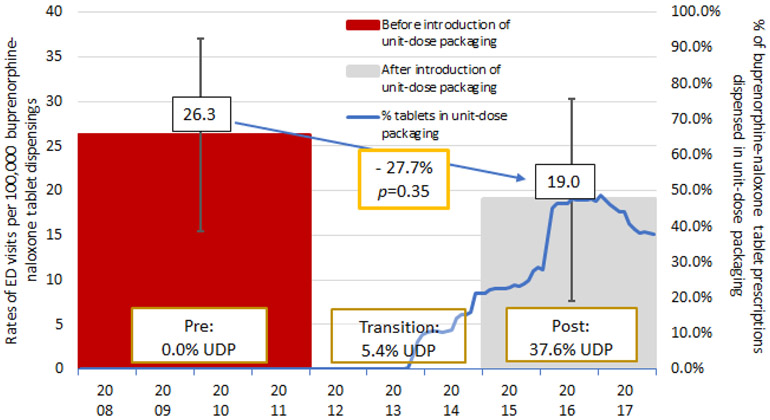
Description:Buprenorphine-naloxone was among the most commonly implicated exposures in pediatric emergency department (ED) visits for unsupervised oral prescription medication ingestions in 2007-2011, resulting in high hospitalization rates [1, 2] and several deaths.[3] Buprenorphine-naloxone products are available as sublingual tablets and, since 08/2010, as sublingual film dispensed in child-resistant unit-dose packaging (UDP). Buprenorphine-naloxone tablets are dispensed in multidose bottles, and, since 07/2013, also in UDP. Several studies have detected decreasing rates of childhood exposures for buprenorphine-naloxone products since the introduction of the film,[2, 4] and lower rates associated with the film compared to the tablet.[3] However, only one study distinguished between the effects of the dosage form and UDP.[4] Wang et al. detected a statistically significant decline in poison control calls for childhood exposures to buprenorphine-naloxone tablets with increasing UDP use; however, the extent of decline far exceeded the UDP dispensing rate. To further investigate the effects of UDP, we compared ED visit rates for pediatric ingestion of buprenorphine-naloxone tablets prior to the introduction of UDP (2008-2011) with rates after the introduction of UDP (2015-2017), excluding a transition period.
-
Subjects:
-
Pubmed ID:31745829
-
Pubmed Central ID:PMC10610465
-
Document Type:
-
Funding:
-
Volume:43
-
Issue:2
-
Collection(s):
-
Main Document Checksum:urn:sha256:996d9df8807b5ce7ee34a12ea8adfba0fb85726c40426ee5200b182866b634bc
-
Download URL:
-
File Type:
 [PDF
- 361.84 KB
]
[PDF
- 361.84 KB
]
Supporting Files


File Language:
English
ON THIS PAGE

CDC STACKS serves as an archival repository of CDC-published products including
scientific findings,
journal articles, guidelines, recommendations, or other public health information authored or
co-authored by CDC or funded partners.
As a repository, CDC STACKS retains documents in their original published format to ensure public access to scientific information.
As a repository, CDC STACKS retains documents in their original published format to ensure public access to scientific information.
You May Also Like
COLLECTION
CDC Public Access