



Seroprevalence of SARS-CoV-2 infection among U.S. blood donors by industry, May–December 2021
Supporting Files

-
2 2024 ; 2-2024
-
Available in CDC Stacks on 2024-02-05T00:00:00Z
File Language:
English
Details
-
Alternative Title:Am J Ind Med
-
Personal Author:Shi, Dallas S. ; McDonald, Emily ; Shah, Melisa ; Groenewold, Matthew R. ; Haynes, James M. ; Spencer, Bryan R. ; Stramer, Susan ; Feldstein, Leora R. ; Saydah, Sharon ; Jones, Jefferson ; Chiu, Sophia K. ; Rinsky, Jessica L.
-
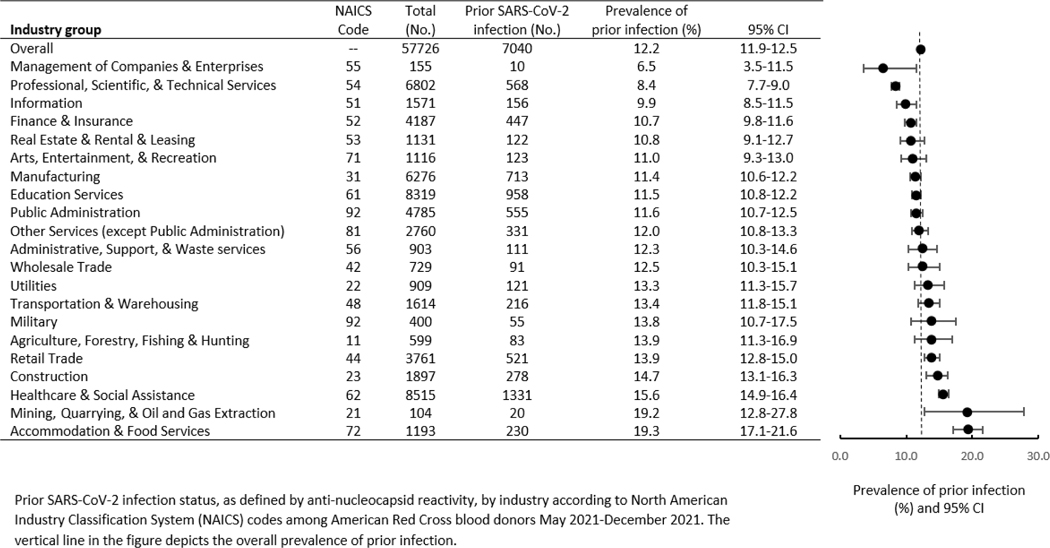
Description:Background. ; Work is a social determinant of health that is often overlooked. There are major work-related differences in the risk of SARS-CoV-2 infection and death, but there have been few analyses of infection rates across industry groups. To date, only one national assessment of SARS-CoV-2 infection prevalence by industry based on self-report has been completed. No study has looked at seroprevalence of COVID-19 by industry. ; Methods. ; During May–December 2021, blood donors with SARS-CoV-2 anti-nucleocapsid testing were sent an electronic survey about their work. Free-text industry responses were classified using the North American Industry Classification System. We estimated seroprevalence and 95% confidence intervals (CIs) of SARS-CoV-2 infection by industry. ; Results. ; Of 57,726 donors, 7,040 (12%, 95% CI: 11.9%, 12.5%) had prior SARS-CoV-2 infection. Seroprevalence was highest among Accommodation & Food Services (19.3%, 95% CI: 17.1%, 21.6%), Mining, Quarrying, and Oil and Gas Extraction (19.2%, 95% CI: 12.8%, 27.8%), Healthcare & Social Assistance (15.6%, 95% CI: 14.9%, 16.4%), and Construction (14.7%, 95% CI: 13.1%, 16.3%). Seroprevalence was lowest among Management of Companies & Enterprises (6.5%, 95% CI: 3.5%, 11.5%), Professional Scientific & Technical Services (8.4%, 95% CI: 7.7%, 9.0%), and Information (9.9%, 95% CI: 8.5%, 11.5%). ; Conclusions. ; While workers in all industries had serologic evidence of SARS-CoV-2 infection, certain sectors were disproportionately impacted. Disease surveillance systems should routinely collect work characteristics so public health and industry leaders can address health disparities using sector-specific policies.
-
Keywords:
-
Source:Am J Ind Med. 67(2):169-173
-
Pubmed ID:38047323
-
Pubmed Central ID:PMC10843782
-
Document Type:
-
Funding:
-
Volume:67
-
Issue:2
-
Download URL:
-
File Type:
 [PDF - 411.07 KB]
 -
Collection(s):
-
Main Document Checksum:urn:sha256:2e94f8e55ede378eea7328d7b91ab6c25f47391766d8bff34e82f742ca2b0613
Supporting Files


File Language:
English
 Was this page helpful?
 Found an issue?

CDC STACKS serves as an archival repository of CDC-published products including
scientific findings, journal articles, guidelines, recommendations, or other public health information authored or
co-authored by CDC or funded partners.
As a repository, CDC STACKS retains documents in their original published format to ensure public access to scientific information.
As a repository, CDC STACKS retains documents in their original published format to ensure public access to scientific information.
You May Also Like
COLLECTION
CDC Public Access