



Reference Susceptibility Testing and Genomic Surveillance of Clostridioides difficile, United States, 2012–17
Supporting Files

-
3 04 2023 ; 3-04-
-
Available in CDC Stacks on March 04, 2024, 12:00 AM
File Language:
English
Details
-
Alternative Title:Clin Infect Dis
-
Personal Author:Gargis, Amy S.
 ;
Karlsson, Maria
;
Paulick, Ashley L.
;
Anderson, Karen F.
;
Adamczyk, Michelle
;
Vlachos, Nicholas
;
Kent, Alyssa G.
;
McAllister, Gillian
;
McKay, Susannah L.
;
Halpin, Alison L.
;
Albrecht, Valerie
;
Campbell, Davina
;
Korhonen, Lauren C.
;
Elkins, Christopher A.
;
Rasheed, J. Kamile
;
Guh, Alice Y.
;
McDonald, L. Clifford
;
Lutgring, Joseph D.
;
Karlsson, Maria
;
Paulick, Ashley L.
;
Anderson, Karen F.
;
Adamczyk, Michelle
;
Vlachos, Nicholas
;
Kent, Alyssa G.
;
McAllister, Gillian
;
McKay, Susannah L.
;
Halpin, Alison L.
;
Albrecht, Valerie
;
Campbell, Davina
;
Korhonen, Lauren C.
;
Elkins, Christopher A.
;
Rasheed, J. Kamile
;
Guh, Alice Y.
;
McDonald, L. Clifford
;
Lutgring, Joseph D.
-
Corporate Authors:
-
Description:Background.
Antimicrobial susceptibility testing (AST) is not routinely performed for Clostridioides difficile and data evaluating minimum inhibitory concentrations (MICs) are limited. We performed AST and whole genome sequencing (WGS) for 593 C. difficile isolates collected between 2012 and 2017 through the Centers for Disease Control and Prevention’s Emerging Infections Program.
Methods.
MICs to 6 antimicrobial agents (ceftriaxone, clindamycin, meropenem, metronidazole, moxifloxacin, and vancomycin) were determined using the reference agar dilution method according to Clinical and Laboratory Standards Institute guidelines. Whole genome sequencing was performed on all isolates to detect the presence of genes or mutations previously associated with resistance.
Results.
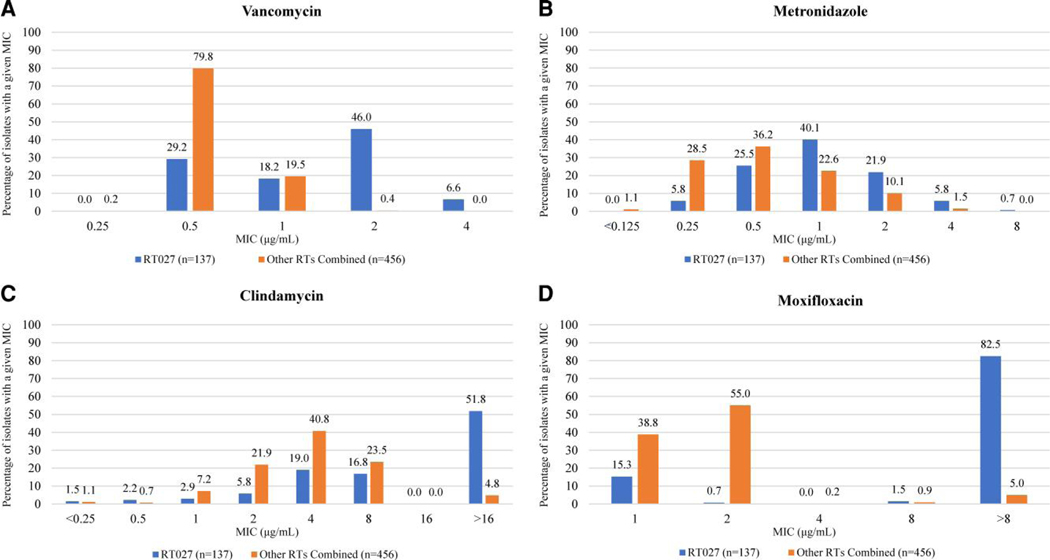
Among all isolates, 98.5% displayed a vancomycin MIC ≤2 μg/mL and 97.3% displayed a metronidazole MIC ≤2 μg/mL. Ribotype 027 (RT027) isolates displayed higher vancomycin MICs (MIC50: 2 μg/mL; MIC90: 2 μg/mL) than non-RT027 isolates (MIC50: 0.5 μg/mL; MIC90: 1 μg/mL) (P < .01). No vanA/B genes were detected. RT027 isolates also showed higher MICs to clindamycin and moxifloxacin and were more likely to harbor associated resistance genes or mutations.
Conclusions.
Elevated MICs to antibiotics used for treatment of C. difficile infection were rare, and there was no increase in MICs over time. The lack of vanA/B genes or mutations consistently associated with elevated vancomycin MICs suggests there are multifactorial mechanisms of resistance. Ongoing surveillance of C. difficile using reference AST and WGS to monitor MIC trends and the presence of antibiotic resistance mechanisms is essential. -
Keywords:
-
Source:Clin Infect Dis. 76(5):890-896
-
Pubmed ID:36208202
-
Pubmed Central ID:PMC10839785
-
Document Type:
-
Funding:
-
Volume:76
-
Issue:5
-
Download URL:
-
File Type:
 [PDF - 315.23 KB]
 -
Collection(s):
-
Main Document Checksum:urn:sha256:0ae5f26e157ea97c82fd9fda6652166688ff9742499160baef09148bf7f6b187


File Language:
English
 Was this page helpful?
 Found an issue?

CDC STACKS serves as an archival repository of CDC-published products including
scientific findings, journal articles, guidelines, recommendations, or other public health information authored or
co-authored by CDC or funded partners.
As a repository, CDC STACKS retains documents in their original published format to ensure public access to scientific information.
As a repository, CDC STACKS retains documents in their original published format to ensure public access to scientific information.
You May Also Like
COLLECTION
CDC Public Access