



Role of Anemia in Dementia Risk Among Veterans With Incident CKD
Supporting Files

-
12 2023
-
File Language:
English
Details
-
Alternative Title:Am J Kidney Dis
-
Personal Author:
-
Description:Rationale & Objective:
While some evidence exists of increased dementia risk from anemia, it is unclear if this association persists among adults with CKD. Anemia may be a key marker for dementia among adults with CKD. We therefore evaluated if anemia is associated with an increased risk of dementia among adults with CKD.
Study Design:
Retrospective cohort study.
Setting & Participants:
The study included 620,095 veterans aged ≥45 years with incident stage 3 CKD (estimated glomerular filtration rate [eGFR] <60 mL/min/1.73 m2) between January 2005 and December 2016 in the US Veterans Health Administration system and followed through December 31, 2018 for incident dementia, kidney failure or death.
Exposures:
Anemia was assessed based on the average of hemoglobin levels (g/L) during the two years prior to the date of incident CKD and categorized as normal, mild and moderate/severe anemia (≥12.0, 11.0–11.9, <11.0 g/dL, respectively for women and ≥13.0, 11.0–12.9, <11.0 g/dL for men).
Outcomes:
Dementia and the composite outcome of kidney failure or death.
Analytical Approach:
Adjusted cause-specific hazard ratios were estimated for each outcome.
Results:
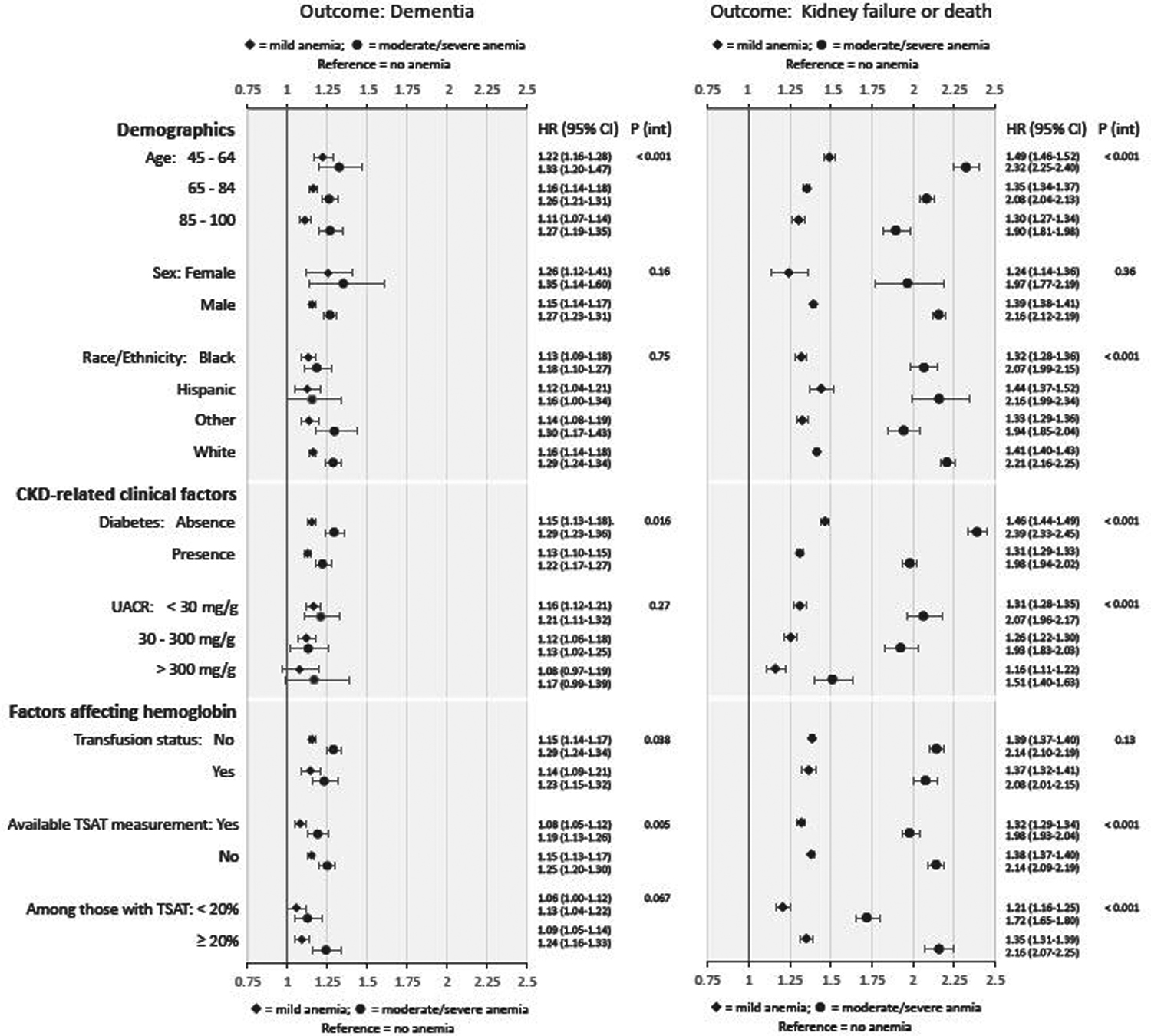
At the time of incident CKD, mean age was 72 years, 97% were male, and mean eGFR was 51 mL/min per 1.73 m2. Over a median 4.1 years of follow-up, 92,306 (15%) veterans developed dementia before kidney failure or death. Compared to veterans with CKD without anemia, multivariable-adjusted models showed a 16% (95% confidence interval [CI] 14% to 17%) significantly higher risk of dementia for those with mild anemia and a 27% (95% CI 23% to 31%) higher risk with moderate/severe anemia. Combined risk of kidney failure or death was higher at 39% (95% CI 37% to 40%) and 115% (95% CI 112% to 119%) for mild and moderate/severe anemia, respectively, compared to no anemia.
Limitations:
Residual confounding from the observational study design. Findings may not be generalizable to the broader U.S. population.
Conclusions:
Anemia was significantly associated with increased risk of dementia among veterans with incident CKD, underscoring the role of anemia as a predictor of dementia risk.
-
Subjects:
-
Keywords:
-
Source:Am J Kidney Dis. 82(6):706-714
-
Pubmed ID:37516301
-
Pubmed Central ID:PMC10822015
-
Document Type:
-
Funding:R01 DK112008/DK/NIDDK NIH HHSUnited States/ ; RES 13-457/RD/ORD VAUnited States/ ; SDR 02-237/HX/HSRD VAUnited States/ ; UL1 TR000124/TR/NCATS NIH HHSUnited States/ ; P30 AG021684/AG/NIA NIH HHSUnited States/ ; CC999999/ImCDC/Intramural CDC HHSUnited States/ ; UL1 TR001881/TR/NCATS NIH HHSUnited States/
-
Volume:82
-
Issue:6
-
Collection(s):
-
Main Document Checksum:urn:sha-512:7a143d2f5811adcfc97c148656d9057cfc3f1b55aa9caec56a196d59229f2a293696960a928dee0cba6038fcc78770e4c31a7ea5a6560c150c676b1b073982d8
-
Download URL:
-
File Type:
 [PDF
- 562.45 KB
]
[PDF
- 562.45 KB
]
Supporting Files


File Language:
English
 Was this page helpful?
 Found an issue?

CDC STACKS serves as an archival repository of CDC-published products including
scientific findings,
journal articles, guidelines, recommendations, or other public health information authored or
co-authored by CDC or funded partners.
As a repository, CDC STACKS retains documents in their original published format to ensure public access to scientific information.
As a repository, CDC STACKS retains documents in their original published format to ensure public access to scientific information.
You May Also Like
COLLECTION
CDC Public Access