



Binge Drinking Moderates Unprotected Sex Among HIV Sero-Similar Same Sex Male Couples: An Actor-Partner Interdependence Model
Supporting Files

-
6 2023 ; 6-2023
-
Available in CDC Stacks on June 01, 2024, 12:00 AM
File Language:
English
Details
-
Alternative Title:AIDS Behav
-
Personal Author:
-
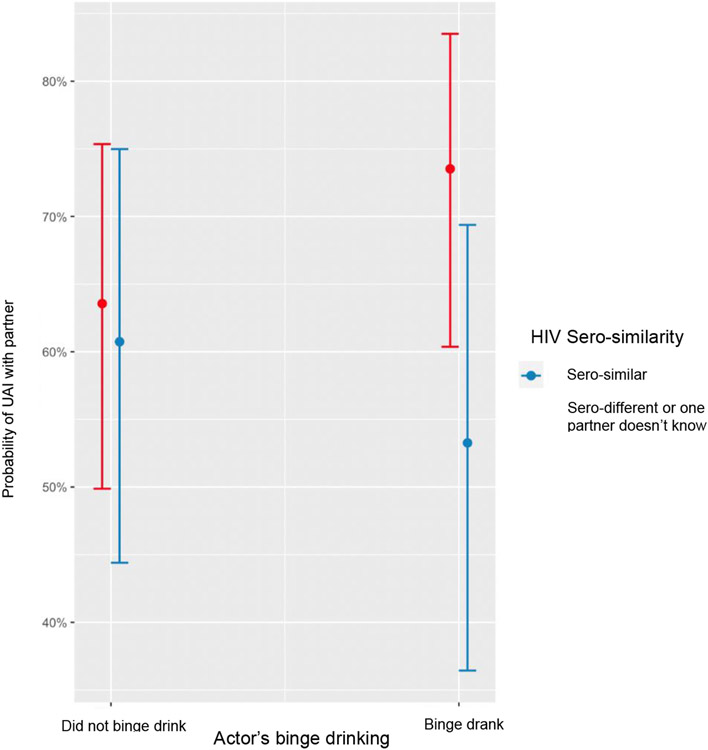
Description:Most new HIV diagnoses in the US occur among sexual minority men (SMM). The majority (69%) of new HIV diagnoses among US SMM are due to transmission from main sex partners. We identified multilevel correlates of unprotected anal intercourse (UAI; condomless anal intercourse while not using a biomedical strategy) among SMM couples using the Actor Partner Interdependence Model (APIM). Participants were US SMM over 18 years, with a primary male partner > 6 months. Couples were recruited online from April 2016 until June 2017 and interviewed using self-administered computer-assisted surveys. We used a series of APIM regressions to assess multilevel associations with UAI. We also tested the moderating role of an individual's binge drinking on the relationship between HIV status similarity and UAI. Among 798 participants (n = 411 couples), 61% reported UAI in the past 6 months. Binge drinking (52%) and physical intimate partner violence (IPV; 34%) were considerably high within our sample. Actor's binge drinking, reporting experiencing and/or perpetrating physical IPV, and partner's trust were positively associated with UAI. Actor having other sexual partner(s), using illegal drugs (not marijuana), and length of relationship were negatively associated with UAI. Binge drinking positively moderated UAI among HIV serostatus similar partners. HIV prevention programming should integrate components on IPV and binge drinking reduction- especially among HIV serostatus similar couples.
-
Subjects:
-
Keywords:
-
Source:AIDS Behav. 27(6):1824-1835
-
Pubmed ID:36441407
-
Pubmed Central ID:PMC10149586
-
Document Type:
-
Funding:R49 CE003094/CE/NCIPC CDC HHSUnited States/ ; K01 AA028199/AA/NIAAA NIH HHSUnited States/ ; R01DA054553/DA/NIDA NIH HHSUnited States/ ; T32DA031099/DA/NIDA NIH HHSUnited States/ ; F31 MD015988/MD/NIMHD NIH HHSUnited States/ ; R01 HD078131/HD/NICHD NIH HHSUnited States/ ; R25DA050687/DA/NIDA NIH HHSUnited States/ ; L60 DA054642/DA/NIDA NIH HHSUnited States/ ; P30DA011041/DA/NIDA NIH HHSUnited States/ ; P30 DA011041/DA/NIDA NIH HHSUnited States/ ; R01 DA054553/DA/NIDA NIH HHSUnited States/ ; R25 DA050687/DA/NIDA NIH HHSUnited States/ ; T32 AI114398/AI/NIAID NIH HHSUnited States/ ; R21 DA053156/DA/NIDA NIH HHSUnited States/ ; T32 DA031099/DA/NIDA NIH HHSUnited States/ ; R21DA053156/DA/NIDA NIH HHSUnited States/ ; K01AA028199/AA/NIAAA NIH HHSUnited States/
-
Volume:27
-
Issue:6
-
Download URL:
-
File Type:
 [PDF - 501.30 KB]
 -
Collection(s):
-
Main Document Checksum:urn:sha-512:368404459c7f83de39ec86c876ac37476026e675fee2c3ab01a9cabb4b2ebc28d2ada4e83d13e3bd446bca0d25b9e91cf58c204af0b9e9170feb7e7591245993
Supporting Files


File Language:
English
 Was this page helpful?
 Found an issue?

CDC STACKS serves as an archival repository of CDC-published products including
scientific findings, journal articles, guidelines, recommendations, or other public health information authored or
co-authored by CDC or funded partners.
As a repository, CDC STACKS retains documents in their original published format to ensure public access to scientific information.
As a repository, CDC STACKS retains documents in their original published format to ensure public access to scientific information.
You May Also Like
COLLECTION
CDC Public Access