



Use of weight loss medications in relation with prostate, colorectal and male breast cancers among older men: SEER-Medicare 2007–2015
Supporting Files

-
9 2023 ; 9-2023
-
Available in CDC Stacks on 2023-12-07T00:00:00Z

File Language:
English
Details
-
Alternative Title:J Cancer Res Clin Oncol
-
Personal Author:
-
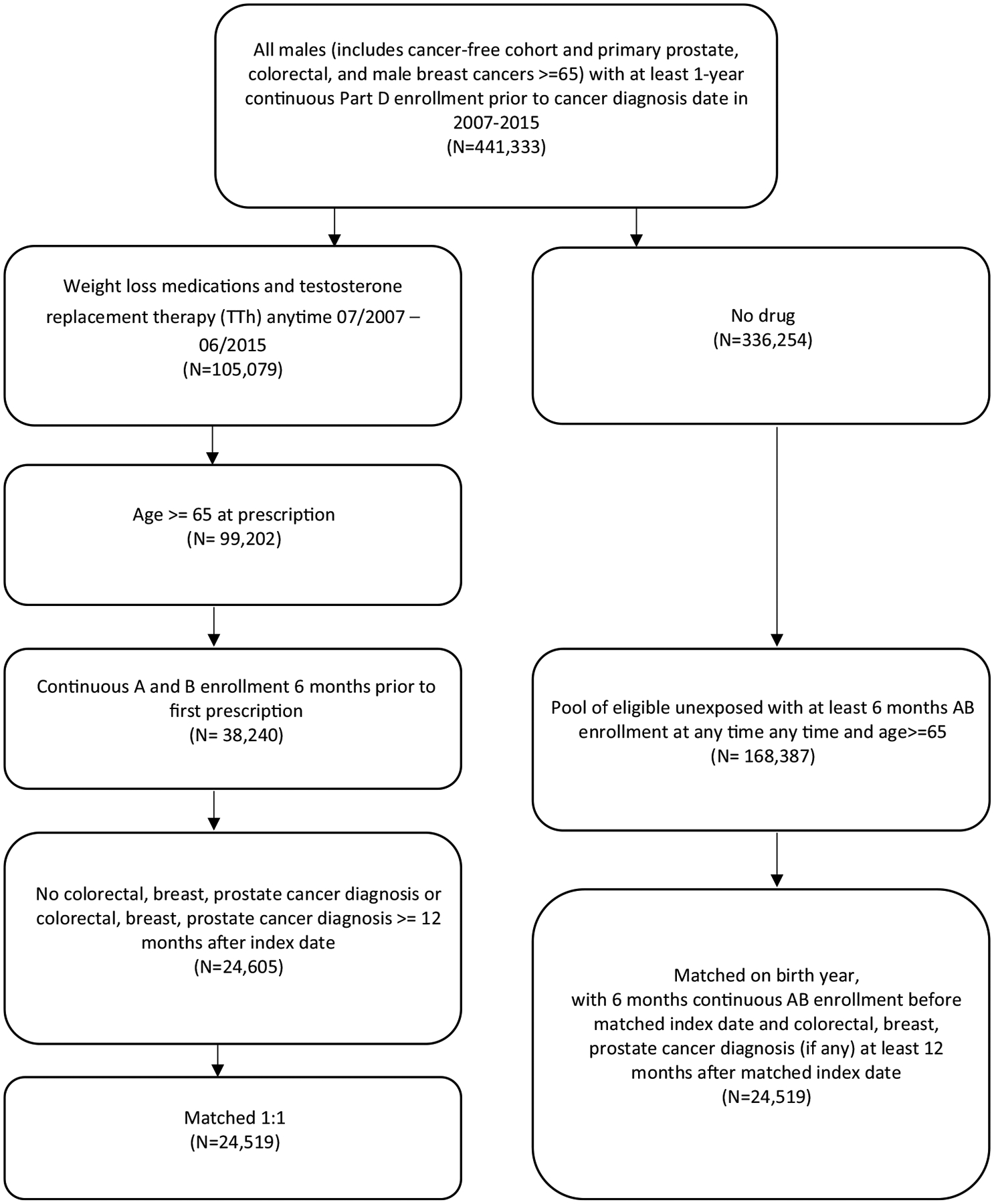
Description:Background ; The association of weight loss medications with prostate (PCa), colorectal (CRC) or male breast cancers, including assessment of these cancers combined (HRCs, hormone-associated cancers) remain poorly understood. Testosterone replacement therapy (TTh) is reported to be inversely associated with obesity, PCa and CRC, but it is unclear whether TTh modifies the association of weight loss medications with HRCs. ; Methods ; In 49,038 men (≥ 65 years) of SEER-Medicare, we identified 15,471 men diagnosed with PCa, 4836 with CRC, and 141 with male breast cancers. Pre-diagnostic prescription of weight loss medications and TTh was ascertained for this analysis. Weighted multivariable-adjusted conditional logistic and Cox proportional hazards (mortality) models were conducted. ; Results ; We found an inverse association between use of weight loss medications and incident PCa (OR 0.59, 95% CI 0.57–0.62), CRC (OR 0.86, 95% CI 0.80–0.92), and HRCs (OR 0.65, 95% CI 0.62–0.68). Similar associations were observed for advanced stage at diagnosis of PCa and CRC. Effects of weight loss medications on PCa and HRC remained significant irrespective of the use of TTh but were only suggestive with CRC with positive TTh use. No associations were observed with male breast cancer and HRCs mortality. ; Conclusion ; Pre-diagnostic use of weight loss medications reduced the incidence of PCa, CRC, and HRCs. These associations persisted in the same direction irrespective of the history of TTh use. Future studies are needed to confirm these findings and to identify underlying biological mechanisms of weight loss medications and TTh on the risk of cancer.
-
Subjects:
-
Keywords:
-
Source:J Cancer Res Clin Oncol. 149(11):8255-8265
-
Pubmed ID:37067547
-
Pubmed Central ID:PMC10702173
-
Document Type:
-
Funding:HHSN261201800032C/CA/NCI NIH HHSUnited States/ ; HHSN261201800009C/CA/NCI NIH HHSUnited States/ ; NU58DP006344/DP/NCCDPHP CDC HHSUnited States/ ; P30 AG059301/NH/NIH HHSUnited States/ ; HHSN261201800015I/CA/NCI NIH HHSUnited States/ ; L60 MD002942/MD/NIMHD NIH HHSUnited States/ ; P30 AG059301/AG/NIA NIH HHSUnited States/ ; HHSN261201800032I/CA/NCI NIH HHSUnited States/ ; HHSN261201800015C/CA/NCI NIH HHSUnited States/ ; HHSN261201800009I/CA/NCI NIH HHSUnited States/
-
Volume:149
-
Issue:11
-
Download URL:
-
File Type:
 [PDF - 560.89 KB]
 -
Collection(s):
-
Main Document Checksum:urn:sha-512:bdd80bcab05041edd368ea46080cee7c02d49fd2c38029fc9595f90e723161dd71e551b73349760a9838a4e91a5a90d1e438e5adb3bad4c4ea068c74d32fe6f9
Supporting Files


File Language:
English
 Was this page helpful?
 Found an issue?

CDC STACKS serves as an archival repository of CDC-published products including
scientific findings, journal articles, guidelines, recommendations, or other public health information authored or
co-authored by CDC or funded partners.
As a repository, CDC STACKS retains documents in their original published format to ensure public access to scientific information.
As a repository, CDC STACKS retains documents in their original published format to ensure public access to scientific information.
You May Also Like
COLLECTION
CDC Public Access