


LUMINEX®: a new technology for the simultaneous identification of five Entamoeba spp. commonly found in human stools
Supporting Files
Public Domain

-
Mar 15 2013
Details
-
Alternative Title:Parasit Vectors
-
Personal Author:
-
Description:Background
Six species of the genus Entamoeba, i.e., E. histolytica, E. dispar, E. moshkovskii, E. polecki, E. coli, and E. hartmanii can be found in human stools. Among these, only E. histolytica is considered to be pathogenic, causing intestinal and extra-intestinal disease, but it is morphologically identical to E. dispar and E. moshkovskii. In general, E. polecki, E. coli, and E. hartmanii can be differentiated morphologically from E. histolytica, but some of their diagnostic morphologic features may overlap creating issues for the differential diagnosis. Moreover, the previous inability to differentiate among Entamoeba species has limited epidemiologic information on E histolytica. The objective of this study was to develop a rapid, high-throughput screening method using Luminex technique for the simultaneous detection and differentiation of Entamoeba species.
Methods
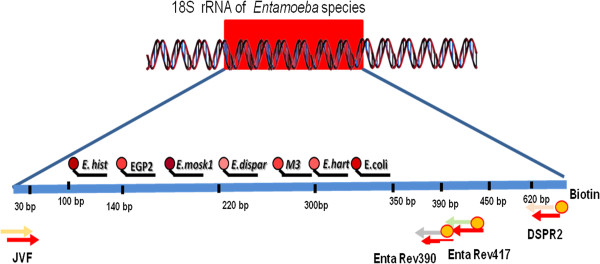
PCR amplification was performed with biotinylated Entamoeba sp 18S rRNA gene primers, designed to amplify a fragment ranging from 382 to 429 bp of the Entamoeba spp studied. Regions of this fragment that could differentiate among E. histolytica, E. moshkovskii, E. dispar, E. hartmanii and E. coli were selected to design hybridization probes to link to Luminex beads. The assay was standardized with cloned DNA samples of each species and evaluated with 24 DNA extracts from samples obtained from individuals diagnosed with these amebas in their stools.
Results
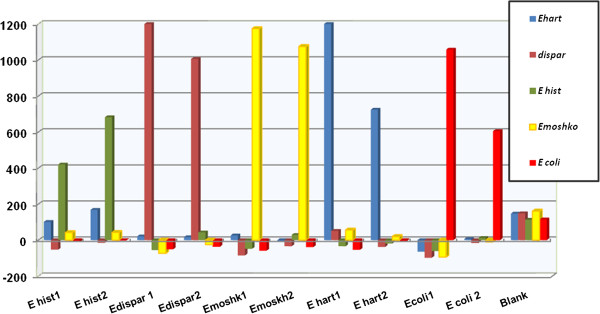
Using this approach we were able to correctly identify E. histoltyica, E. dispar, E hartmanni, E. coli and E. moshkovskii in all specimens studied. From twenty four samples tested by microscopy, PCR/DNA Sequencing and real-time PCR, 100% agreed with PCR-Luminex assay for identification of E. dispar, E. moshkovskii, E. hartmanni, E. histolytica, and E. coli.
Conclusion
These results show that this method could be used in the diagnostic detection of Entamoeba spp in fecal samples. This diagnostic test was useful to clearly distinguish E histolytica from other species and also to strengthen epidemiologic data on Entamoeba spp.
-
Subjects:
-
Source:Parasit Vectors. 2013; 6:69.
-
Document Type:
-
Volume:6
-
Collection(s):
-
Main Document Checksum:urn:sha256:0e948b0e775480db1697daa1d4ca7b9bc74a89e11e5be62afa10a641a5509461
-
Download URL:
-
File Type:
 [PDF
- 364.27 KB
]
[PDF
- 364.27 KB
]
Supporting Files


ON THIS PAGE

CDC STACKS serves as an archival repository of CDC-published products including
scientific findings,
journal articles, guidelines, recommendations, or other public health information authored or
co-authored by CDC or funded partners.
As a repository, CDC STACKS retains documents in their original published format to ensure public access to scientific information.
As a repository, CDC STACKS retains documents in their original published format to ensure public access to scientific information.
You May Also Like
COLLECTION
CDC Public Access