



Zika virus as a cause of birth defects: Were the teratogenic effects of Zika virus missed for decades?
Supporting Files

-
2023/02/01
-
Available in CDC Stacks on February 01, 2024, 12:00 AM
File Language:
English
Details
-
Alternative Title:Birth Defects Res
-
Personal Author:
-
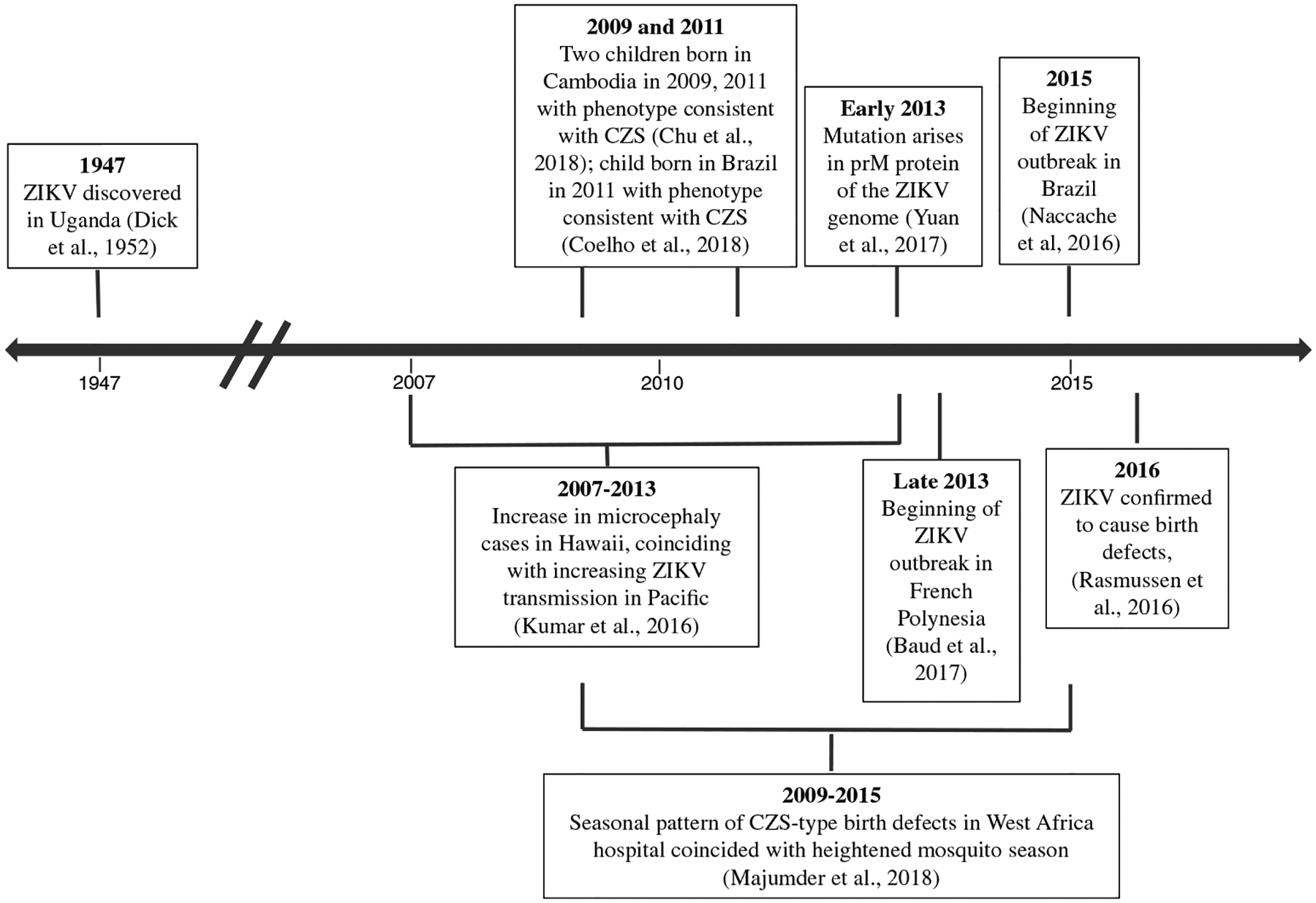
Description:Zika virus (ZIKV) was identified as a teratogen in 2016 when an increase in severe microcephaly and other brain defects was observed in fetuses and newborns following outbreaks in French Polynesia (2013-2014) and Brazil (2015-2016) and among travelers to other countries experiencing outbreaks. Some have questioned why ZIKV was not recognized as a teratogen before these outbreaks: whether novel genetic changes in ZIKV had increased its teratogenicity or whether its association with birth defects had previously been undetected. Here we examine the evidence for these two possibilities. We describe evidence for specific mutations that arose before the French Polynesia outbreak that might have increased ZIKV teratogenicity. We also present information on children born with findings consistent with congenital Zika syndrome (CZS) as early as 2009 and epidemiological evidence that suggests increases in CZS-type birth defects before 2013. We also explore reasons why a link between ZIKV and birth defects might have been missed, including issues with surveillance of ZIKV infections and of birth defects, challenges to ZIKV diagnostic testing, and the susceptibility of different populations to ZIKV infection at the time of pregnancy. Although it is not possible to prove definitively that ZIKV had teratogenic properties before 2013, several pieces of evidence support the hypothesis that its teratogenicity had been missed in the past. These findings emphasize the need for further investments in global surveillance for emerging infections and for birth defects so that infectious teratogens can be identified more expeditiously in the future.
-
Keywords:
-
Source:Birth Defects Res. 115(3):265-274
-
Pubmed ID:36513609
-
Pubmed Central ID:PMC10552063
-
Document Type:
-
Funding:
-
Genre:
-
Volume:115
-
Issue:3
-
Download URL:
-
File Type:
 [PDF - 258.30 KB]
 -
Collection(s):
-
Main Document Checksum:urn:sha-512:40a7c1c26103cfb25aa4c3875e77ca0c98e2cc507639aeb2618e3f456f951001a0a2373c23197bd0cbf4c3bdde99ad84b29e3dde6c54d81d7b70628bac9b3640

Supporting Files


File Language:
English
 Was this page helpful?
 Found an issue?

CDC STACKS serves as an archival repository of CDC-published products including
scientific findings, journal articles, guidelines, recommendations, or other public health information authored or
co-authored by CDC or funded partners.
As a repository, CDC STACKS retains documents in their original published format to ensure public access to scientific information.
As a repository, CDC STACKS retains documents in their original published format to ensure public access to scientific information.
You May Also Like
COLLECTION
CDC Public Access