


Impact of Hepatitis C Virus (HCV) Infection and Treatment on Mortality in the Country of Georgia, 2015–2020
Supporting Files

-
8 14 2023
-

File Language:
English
Details
-
Alternative Title:Clin Infect Dis
-
Personal Author:
-
Description:Background.
Mortality related to hepatitis C virus (HCV) infection is a key indicator for elimination. We assessed the impact of HCV infection and treatment on mortality in the country of Georgia during 2015–2020.
Methods.
We conducted a population-based cohort study using data from Georgia’s national HCV Elimination Program and death registry. We calculated all-cause mortality rates in 6 cohorts: (1) Negative for anti-HCV; (2) anti-HCV positive, unknown viremia status; (3) current HCV infection and untreated; (4) discontinued treatment; (5) completed treatment, no sustained virologic response (SVR) assessment; (6) completed treatment and achieved SVR. Cox proportional hazards models were used to calculate adjusted hazards ratios and confidence intervals. We calculated the cause-specific mortality rates attributable to liver-related causes.
Results.
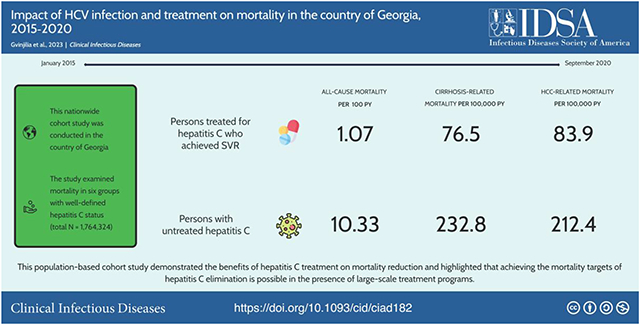
After a median follow-up of 743 days, 100 371 (5.7%) of 1 764 324 study participants died. The highest mortality rate was observed among HCV infected patients who discontinued treatment (10.62 deaths per 100 PY, 95% confidence interval [CI]: 9.65, 11.68), and untreated group (10.33 deaths per 100 PY, 95% CI: 9.96, 10.71). In adjusted Cox proportional hazards model, the untreated group had almost 6-times higher hazard of death compared to treated groups with or without documented SVR (adjusted hazard ratio [aHR] = 5.56, 95% CI: 4.89, 6.31). Those who achieved SVR had consistently lower liver-related mortality compared to cohorts with current or past exposure to HCV.
Conclusions.
This large population-based cohort study demonstrated the marked beneficial association between hepatitis C treatment and mortality. The high mortality rates observed among HCV infected and untreated persons highlights the need to prioritize linkage to care and treatment to achieve elimination goals.
-
Subjects:
-
Source:Clin Infect Dis. 77(3):405-413
-
Pubmed ID:37099136
-
Pubmed Central ID:PMC10527899
-
Document Type:
-
Funding:
-
Volume:77
-
Issue:3
-
Collection(s):
-
Main Document Checksum:urn:sha-512:3df56306967fcdaf4355f52839733bff5dd36823f5acdeb7a910627df399e3a177d3b0561192925b5bd4d266779ecad8fd76a0f535dad9f204f03c55dfbb4934
-
Download URL:
-
File Type:
 [PDF
- 393.13 KB
]
[PDF
- 393.13 KB
]

Supporting Files


File Language:
English
ON THIS PAGE


CDC STACKS serves as an archival repository of CDC-published products including
scientific findings,
journal articles, guidelines, recommendations, or other public health information authored or
co-authored by CDC or funded partners.
As a repository, CDC STACKS retains documents in their original published format to ensure public access to scientific information.
As a repository, CDC STACKS retains documents in their original published format to ensure public access to scientific information.
You May Also Like
COLLECTION
CDC Public Access