


Higher Prevalence of Health-Risk Factors Among US Adults With Unmet Health Care Needs Due to Cost, 2016
Supporting Files

-
2021
-
File Language:
English
Details
-
Alternative Title:J Public Health Manag Pract
-
Personal Author:
-
Description:Context:
Adults with unmet health care needs (UHCN) due to cost have fewer opportunities to receive behavioral counseling in clinical settings, which may be associated with a higher likelihood of having health-risk behaviors.
Objective:
This study assessed associations between UHCN and health-risk factors.
Design/Setting:
We used 2016 Behavioral Risk Factor Surveillance System data to calculate age-adjusted weighted prevalence of 5 health-risk factors by UHCN and insurance status and to assess the association of UHCN with these factors using multivariable logistic regression.
Participants:
US adults aged 18 to 64 years who participated in the survey (N = 301 035).
Main Outcome Measures:
Five health-risk factors: obesity, current cigarette smoking, excessive alcohol use, sleeping less than 7 hours per 24-hour period, and no leisure-time physical activity within the past month.
Results:
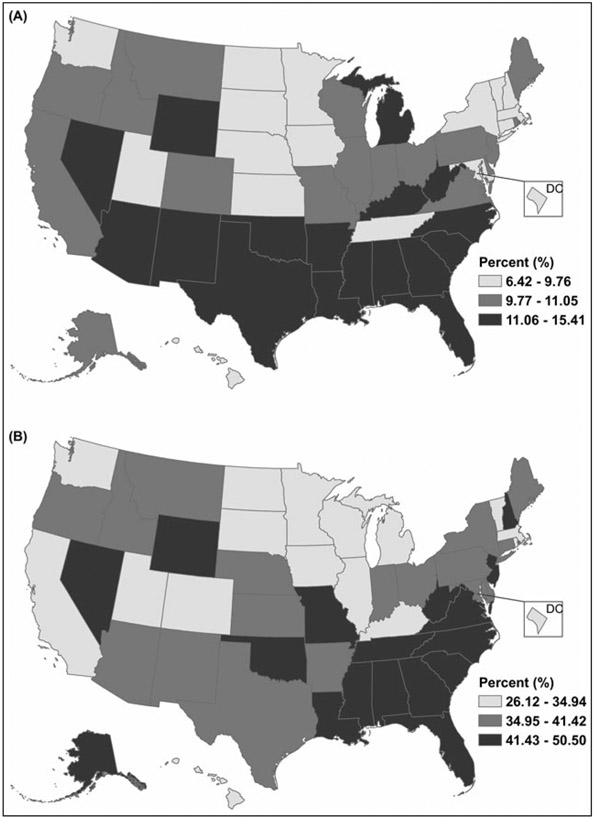
In 2016, among adults aged 18 to 64 years, 11.2% of those with insurance and 40.1% of those without insurance (both age-adjusted) had UHCN. In both study populations, compared with adults with no UHCN, adults reporting UHCN were more likely to be a current cigarette smoker, report excessive alcohol use, and sleep less than 7 hours per 24-hour period. The prevalence of 3 or more health-risk factors was higher among adults with UHCN than among adults without UHCN (adults with insurance: adjusted prevalence ratio = 1.40; 95% confidence interval = 1.33-1.48; adults without insurance: adjusted prevalence ratio = 1.39; 95% confidence interval = 1.27-1.53).
Conclusions:
Unmet health care needs was associated with more health-risk factors regardless of insurance status. Addressing cost barriers to behavioral counseling may be one approach to consider when seeking to reduce health-risk behaviors among high-risk populations.
-
Subjects:
-
Source:J Public Health Manag Pract. 27(1):E19-E27
-
Pubmed ID:31305323
-
Pubmed Central ID:PMC10498391
-
Document Type:
-
Funding:
-
Place as Subject:
-
Volume:27
-
Issue:1
-
Collection(s):
-
Main Document Checksum:urn:sha256:7b93b22c0247ad9b4a1c3c18734e93e882e14e06782844e3c958efa3f707bcf8
-
Download URL:
-
File Type:
 [PDF
- 253.10 KB
]
[PDF
- 253.10 KB
]
Supporting Files


File Language:
English
ON THIS PAGE

CDC STACKS serves as an archival repository of CDC-published products including
scientific findings,
journal articles, guidelines, recommendations, or other public health information authored or
co-authored by CDC or funded partners.
As a repository, CDC STACKS retains documents in their original published format to ensure public access to scientific information.
As a repository, CDC STACKS retains documents in their original published format to ensure public access to scientific information.
You May Also Like
COLLECTION
CDC Public Access