



Characterizing Observable COVID-19 Controls in Pacific Northwest Grocery Stores
Supporting Files
Peer Reviewed

-
2022/05/01
-
Available in CDC Stacks on September 07, 2023, 12:00 AM
File Language:
English
Details
-
Journal Article:Journal of Occupational and Environmental Hygiene
-
Personal Author:
-
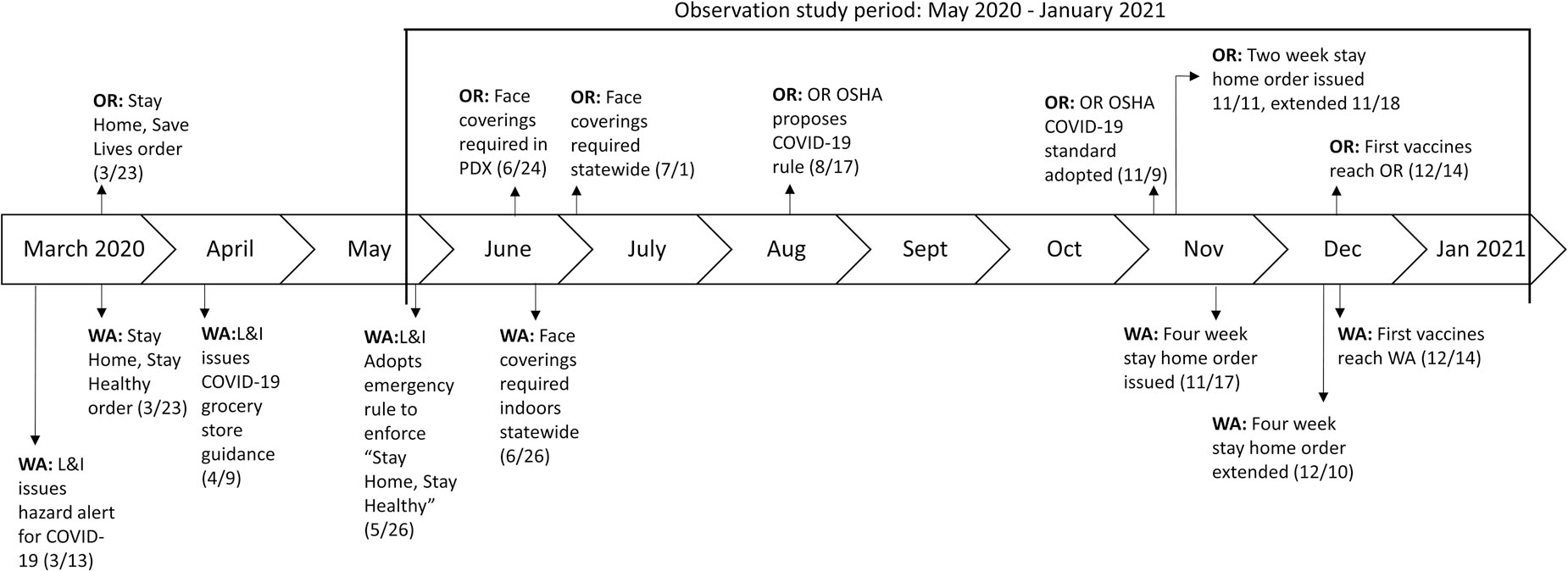
Description:Utilizing a longitudinal, observational study, grocery store health and safety controls implemented during the COVID-19 pandemic across stores in two cities were characterized. Sixteen stores between Seattle, WA (n = 9) and Portland, OR (n = 7) were visited monthly by the study team from May 2020 to January 2021, and observations of controls were recorded using a standardized checklist in REDCap. The checklist included questions on the presence or absence of controls such as physical barriers, social distancing markers, required masking of customers, cleaning of check-out stands, and closures of store areas. Descriptive analyses were conducted to determine the proportion of stores with a certain control each month. Mixed-effects logistic regression was used to explore how controls changed over time, and whether differences were observed between cities or by income of the area the store serves. Source control (e.g., mask requirements) and engineering controls (e.g., physical barriers at checkout) were the most common and consistent controls observed across stores and over the study period. Controls such as having special hours for vulnerable populations, demarcations on aisles for directionality, and cleaning check-out stands between customers varied significantly over time (p < 0.05 in the mixed-effects model). Having an employee present to clean baskets and carts, as well as physical barriers between self-checkouts, were significantly more common in stores in areas above the median income (p < 0.05 in the mixed-effects model). To best protect workers and shoppers from infectious agents, controls should be evidence-based, consistently implemented across grocery stores, and coupled with administrative practices and policies to promote worker wellbeing. Description provided by NIOSH
-
Subjects:
-
Keywords:
-
Source:J Occup Environ Hyg 2022 May; 19(5):237-245
-
ISSN:1545-9624
-
Pubmed ID:35254228
-
Pubmed Central ID:PMC10484155
-
Document Type:
-
Funding:
-
Genre:
-
Place as Subject:
-
CIO:
-
Topic:
-
Location:
-
Pages in Document:16 pdf pages
-
Volume:19
-
Issue:5
-
NIOSHTIC Number:nn:20065459
-
Contact Point Address:Marissa G. Baker, Department of Environmental & Occupational Health Sciences, University of Washington School of Public Health, Seattle, Washington
-
Email:bakermg@uw.edu
-
Federal Fiscal Year:2022
-
Performing Organization:
-
Peer Reviewed:True
-
Download URL:
-
File Type:
 [PDF - 235.15 KB]
 -
Collection(s):
-
Main Document Checksum:urn:sha-512:d09890811aba2281e9709c7fdca80b59c8d112f91208bf8f3b569dc2d842e98bf1af1a2d7fb36cf3e3aa9b066c72991ed2d30b6967169626bdb239cbe9f1c00d
Supporting Files


File Language:
English
 Was this page helpful?
 Found an issue?

CDC STACKS serves as an archival repository of CDC-published products including
scientific findings, journal articles, guidelines, recommendations, or other public health information authored or
co-authored by CDC or funded partners.
As a repository, CDC STACKS retains documents in their original published format to ensure public access to scientific information.
As a repository, CDC STACKS retains documents in their original published format to ensure public access to scientific information.
You May Also Like