



Identifying possible inaccuracy in reported birth head circumference measurements among infants in the US Zika Pregnancy and Infant Registry
Supporting Files

-
5 2022
-
File Language:
English
Details
-
Alternative Title:Birth Defects Res
-
Personal Author:Roth, Nicole M.
 ;
Woodworth, Kate R.
;
Godfred-Cato, Shana
;
Delaney, Augustina M.
;
Olson, Samantha M.
;
Nahabedian, John F.
;
Reynolds, Megan R.
;
Jones, Abbey M.
;
Neelam, Varsha
;
Valencia-Prado, Miguel
;
Delgado-López, Camille
;
Lee, Ellen H.
;
Ellis, Esther M.
;
Lake-Burger, Heather
;
Tonzel, Julius L.
;
Higgins, Cathleen A.
;
Chan, Ronna L.
;
Tong, Van T.
;
Gilboa, Suzanne M.
;
Cragan, Janet D.
;
Honein, Margaret A.
;
Moore, Cynthia A.
;
Woodworth, Kate R.
;
Godfred-Cato, Shana
;
Delaney, Augustina M.
;
Olson, Samantha M.
;
Nahabedian, John F.
;
Reynolds, Megan R.
;
Jones, Abbey M.
;
Neelam, Varsha
;
Valencia-Prado, Miguel
;
Delgado-López, Camille
;
Lee, Ellen H.
;
Ellis, Esther M.
;
Lake-Burger, Heather
;
Tonzel, Julius L.
;
Higgins, Cathleen A.
;
Chan, Ronna L.
;
Tong, Van T.
;
Gilboa, Suzanne M.
;
Cragan, Janet D.
;
Honein, Margaret A.
;
Moore, Cynthia A.
-
Description:Background:
The US Zika Pregnancy and Infant Registry (USZPIR) monitors infants born to mothers with confirmed or possible Zika virus infection during pregnancy. The surveillance case definition for Zika-associated birth defects includes microcephaly based on head circumference (HC).
Methods:
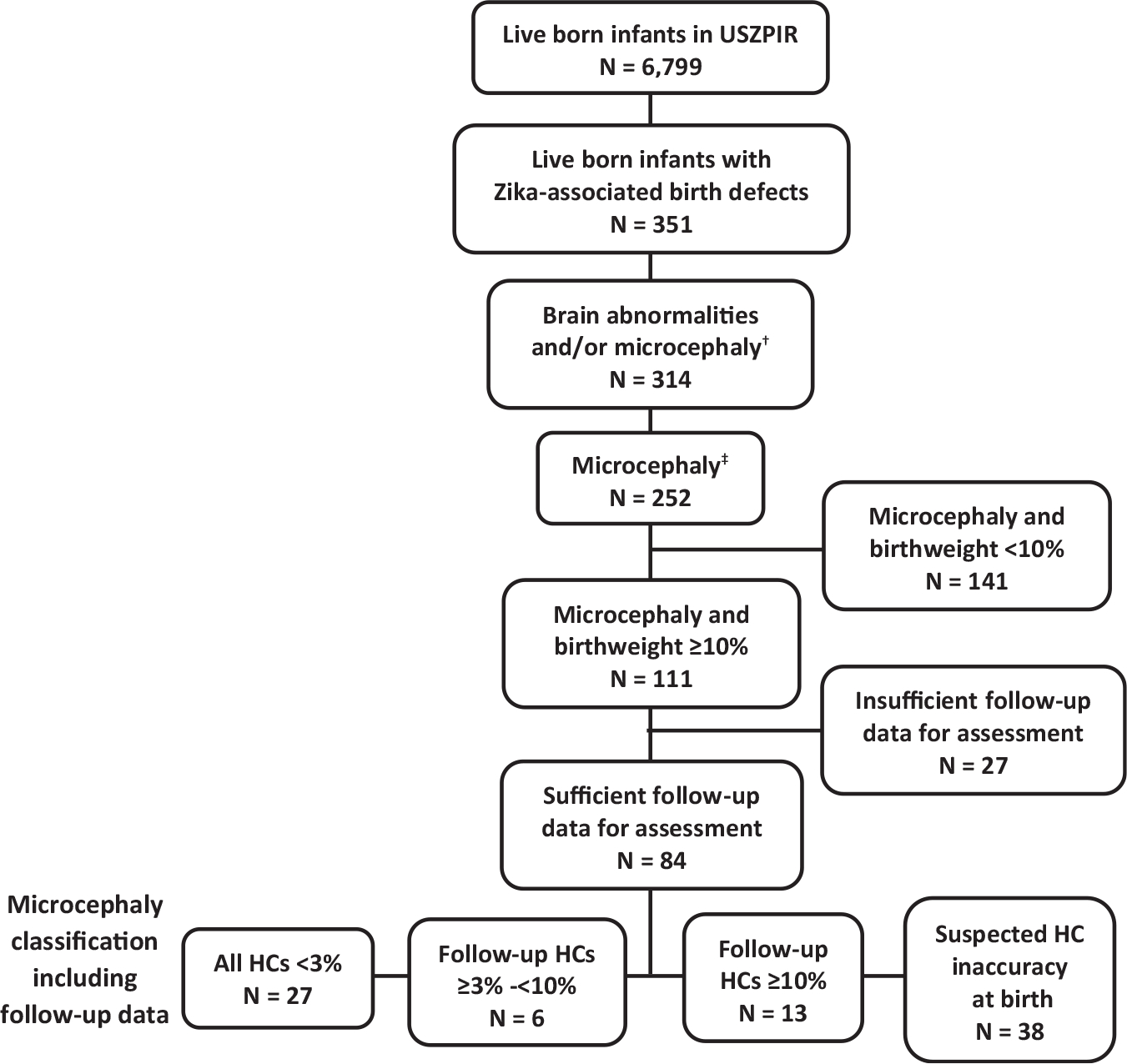
We assessed birth and follow-up data from infants with birth HC measurements <3rd percentile and birthweight ≥10th percentile to determine possible misclassification of microcephaly. We developed a schema informed by literature review and expert opinion to identify possible HC measurement inaccuracy using HC growth velocity and longitudinal HC measurements between 2 and 12 months of age. Two or more HC measurements were required for assessment. Inaccuracy in birth HC measurement was suspected if growth velocity was >3 cm/month in the first 3 months or HC was consistently >25th percentile during follow-up.
Results:
Of 6,799 liveborn infants in USZPIR, 351 (5.2%) had Zika-associated birth defects, of which 111 had birth HC measurements <3rd percentile and birthweight ≥10th percentile. Of 84/111 infants with sufficient follow-up, 38/84 (45%) were classified as having possible inaccuracy of birth HC measurement, 19/84 (23%) had HC ≥3rd percentile on follow-up without meeting criteria for possible inaccuracy, and 27/84 (32%) had continued HC <3rd percentile. After excluding possible inaccuracies, the proportion of infants with Zika-associated birth defects including microcephaly decreased from 5.2% to 4.6%.
Conclusions:
About one-third of infants in USZPIR with Zika-associated birth defects had only microcephaly, but indications of possible measurement inaccuracy were common. Implementation of this schema in longitudinal studies can reduce misclassification of microcephaly.
-
Subjects:
-
Source:Birth Defects Res. 114(8):314-318
-
Pubmed ID:35332688
-
Pubmed Central ID:PMC10391875
-
Document Type:
-
Funding:
-
Place as Subject:
-
Volume:114
-
Issue:8
-
Collection(s):
-
Main Document Checksum:urn:sha256:d6bd598a8af2a773c4742581eca6e8eae9b5a6d80b68ecc466479b985e08dc0f
-
Download URL:
-
File Type:
 [PDF
- 135.45 KB
]
[PDF
- 135.45 KB
]
Supporting Files


File Language:
English
 Was this page helpful?
 Found an issue?
CDC STACKS serves as an archival repository of CDC-published products including
scientific findings,
journal articles, guidelines, recommendations, or other public health information authored or
co-authored by CDC or funded partners.
As a repository, CDC STACKS retains documents in their original published format to ensure public access to scientific information.
As a repository, CDC STACKS retains documents in their original published format to ensure public access to scientific information.
You May Also Like
COLLECTION
CDC Public Access