


Systematic Review of Alternative HIV Pre-Exposure Prophylaxis (PrEP) Care Delivery Models to Improve PrEP Services
Supporting Files

-
8 01 2023
-
File Language:
English
Details
-
Alternative Title:AIDS
-
Personal Author:
-
Description:Background:
The US Food and Drug Administration approved the first daily oral HIV preexposure prophylaxis (PrEP) in 2012, yet only 25% of 1.2 million individuals eligible for PrEP were prescribed PrEP in 2020. To improve PrEP uptake, delivery of PrEP services outside of traditional care (i.e., alternative PrEP care delivery models) may be considered.
Objectives:
To identify types, evidence, and study gaps of alternative PrEP care delivery models in the published literature.
Search Methods:
We searched in the US Centers for Disease Control and Prevention (CDC) Prevention Research Synthesis (PRS) database through December 2022 (PROSPERO CRD42022311747)
Selection Criteria:
We included studies published in English that reported implementation of alternative PrEP care delivery models via alternative prescribers or care settings.
Data Collection Analysis:
Two reviewers independently reviewed the full text and extracted data by using standard forms. Risk of bias was assessed using the adapted Newcastle-Ottawa Quality Assessment Scale for observational studies. This review narratively synthesized the findings. Those that met our study criteria were evaluated for efficacy against CDC PRS PrEP Evidence-Based Intervention (EBI) or Evidence-Informed Intervention (EI) criteria or Health Resources and Services Administration (HRSA) HIV/AIDS Bureau (HAB) Emergency Strategy (ES) criteria, or for applicability by using an assessment based on the Reach, Effectiveness, Adoption, Implementation, and Maintenance (RE-AIM) framework.
Main Results:
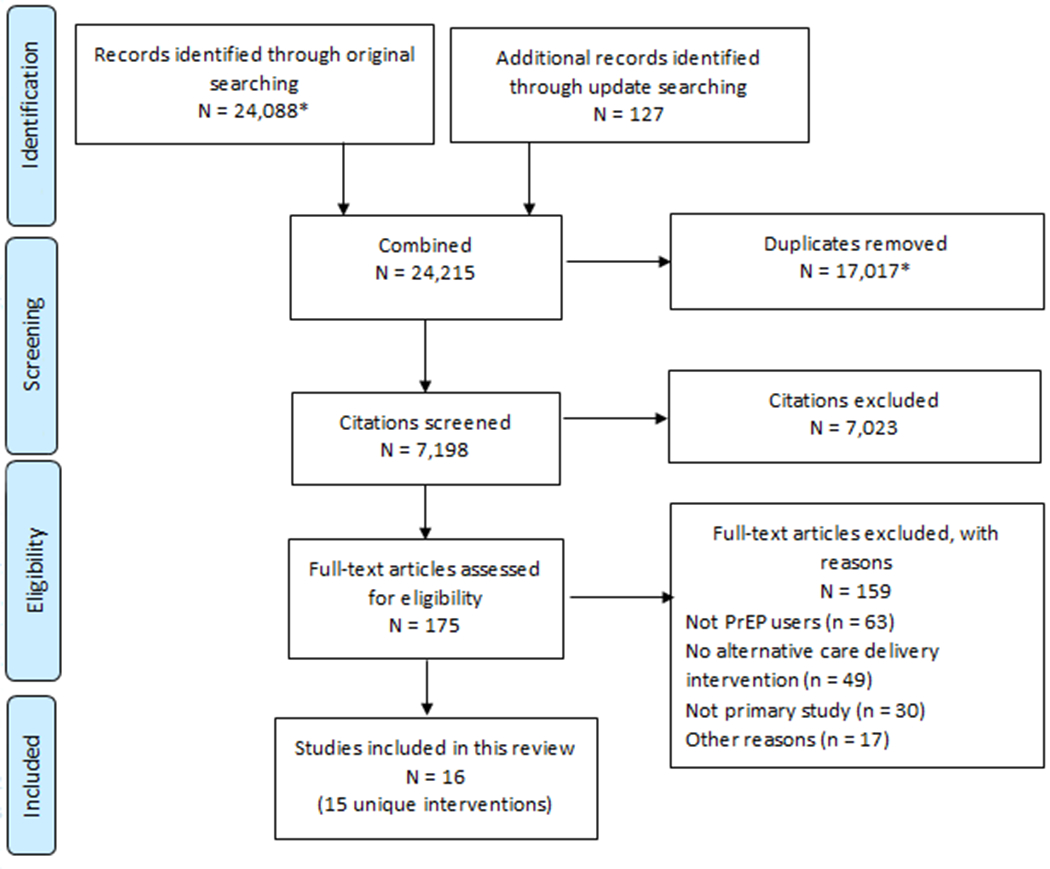
This review identified 16 studies published between 2018–2022 that implemented alternative prescriber (n=8), alternative setting for care (n=4), alternative setting for laboratory screening (n=1), or combination of alternative prescriber and setting for care with (n=1) or without alternative setting for laboratory screening (n=2). The majority of studies were US-based (n=12) with low risk of bias (n=11). None of the identified studies met EBI, EI, or ES criteria due to having no comparison group to evaluate efficacy. Promising applicability, per the RE-AIM framework, was found for pharmacists as alternative prescribers, telePrEP as an alternative care setting, and mail-in testing as an alternative approach to laboratory screening.
Author’s Conclusions:
Delivery of PrEP services outside of the traditional care system by expanding providers of PrEP care (e.g., pharmacist prescribers), as well as the settings of PrEP care (i.e., telePrEP) and laboratory screening (i.e., mail-in testing) may increase PrEP access and care delivery.
Public Health Implication:
Increasing innovation and scope of practice for PrEP services may minimize HIV stigma, facilitate access to PrEP care, and contribute to ending the HIV epidemic.
-
Subjects:
-
Source:AIDS. 37(10):1593-1602
-
Pubmed ID:37199602
-
Pubmed Central ID:PMC10366650
-
Document Type:
-
Funding:
-
Volume:37
-
Issue:10
-
Collection(s):
-
Main Document Checksum:urn:sha256:cf27af35afb8217affdaeaeee8b9aad3507027165149f7b5cca51f9d9c7dd759
-
Download URL:
-
File Type:
 [PDF
- 261.50 KB
]
[PDF
- 261.50 KB
]
Supporting Files


File Language:
English
ON THIS PAGE

CDC STACKS serves as an archival repository of CDC-published products including
scientific findings,
journal articles, guidelines, recommendations, or other public health information authored or
co-authored by CDC or funded partners.
As a repository, CDC STACKS retains documents in their original published format to ensure public access to scientific information.
As a repository, CDC STACKS retains documents in their original published format to ensure public access to scientific information.
You May Also Like
COLLECTION
CDC Public Access