



Testis-specific serine kinase 3 is required for sperm morphogenesis and male fertility
Supporting Files

-
7 2023
-

File Language:
English
Details
-
Alternative Title:Andrology
-
Personal Author:
-
Description:Background:
The importance of phosphorylation in sperm during spermatogenesis has not been pursued extensively. Testis-specific serine kinase 3 (Tssk3) is a conserved gene, but TSSK3 kinase functions and phosphorylation substrates of TSSK3 are not known.
Objective:
The goals of our studies were to understand the mechanism of action of TSSK3.
Materials and Methods:
We analyzed the localization of TSSK3 in sperm, used CRISPR/Cas9 to generate Tssk3 knockout (KO) mice in which nearly all of the Tssk3 open reading frame was deleted (ensuring it is a null mutation), analyzed the fertility of Tssk3 KO mice by breeding mice for four months, and conducted phosphoproteomics analysis of male testicular germ cells.
Results:
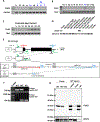
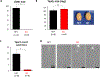
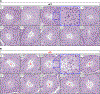
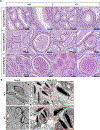
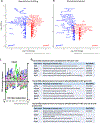
TSSK3 is expressed in elongating sperm and localizes to the sperm tail. To define the essential roles of TSSK3 in vivo, heterozygous (HET) or homozygous knockout (KO) male mice were mated with wild-type females, and fertility was assessed over four months; Tssk3 KO males are sterile, whereas HET males produced normal litter sizes. Absence of TSSK3 results in disorganization of all stages of testicular seminiferous epithelium and significantly increased vacuolization of germ cells, leading to dramatically reduced sperm counts and abnormal sperm morphology; despite these histologic changes, Tssk3 null mice have normal testis size. To elucidate the mechanisms causing the KO phenotype, we conducted phosphoproteomics using purified germ cells from Tssk3 HET and KO testes. We found that proteins implicated in male infertility, such as GAPDHS, ACTL7A, ACTL9, and REEP6, showed significantly reduced phosphorylation in KO testes compared to HET testes, despite unaltered total protein levels.
Conclusions:
We demonstrated that TSSK3 is essential for male fertility and crucial for phosphorylation of multiple infertility-related proteins. These studies and the pathways in which TSSK3 functions have implications for human male infertility and non-hormonal contraception.
-
Subjects:
-
Keywords:
-
Source:Andrology. 11(5):826-839
-
Pubmed ID:36306217
-
Pubmed Central ID:PMC10267670
-
Document Type:
-
Funding:
-
Volume:11
-
Issue:5
-
Collection(s):
-
Main Document Checksum:urn:sha-512:d11936179946420620a380e91980aa66ddb3fd3ae841b427be7d05ac4ad200a0c50fe5b474f07fa35d7469c20083d9eb0089ddce81ea852eeed3946e910f4712
-
Download URL:
-
File Type:
 [PDF
- 2.99 MB
]
[PDF
- 2.99 MB
]
Supporting Files


File Language:
English
 Was this page helpful?
 Found an issue?





CDC STACKS serves as an archival repository of CDC-published products including
scientific findings,
journal articles, guidelines, recommendations, or other public health information authored or
co-authored by CDC or funded partners.
As a repository, CDC STACKS retains documents in their original published format to ensure public access to scientific information.
As a repository, CDC STACKS retains documents in their original published format to ensure public access to scientific information.
You May Also Like
COLLECTION
CDC Public Access