


Protecting Healthcare Personnel in Outpatient Settings: The Influence of Mandatory Versus Nonmandatory Influenza Vaccination Policies on Workplace Absenteeism During Multiple Respiratory Virus Seasons
Supporting Files

-
4 2018
-
File Language:
English
Details
-
Alternative Title:Infect Control Hosp Epidemiol
-
Personal Author:Frederick, John ; Brown, Alexandria C. ; Cummings, Derek A. ; Gaydos, Charlotte A. ; Gibert, Cynthia L. ; Gorse, Geoffrey J. ; Los, Jenna G. ; Nyquist, Ann-Christine ; Perl, Trish M. ; Price, Connie S. ; Radonovich, Lewis J. ; Reich, Nicholas G. ; Rodriguez-Barradas, Maria C. ; Bessesen, Mary T. ; Simberkoff, Michael S.
-
Corporate Authors:
-
Description:OBJECTIVE.
To determine the effect of mandatory and nonmandatory influenza vaccination policies on vaccination rates and symptomatic absenteeism among healthcare personnel (HCP).
DESIGN.
Retrospective observational cohort study.
SETTING.
This study took place at 3 university medical centers with mandatory influenza vaccination policies and 4 Veterans Affairs (VA) healthcare systems with nonmandatory influenza vaccination policies.
PARTICIPANTS.
The study included 2,304 outpatient HCP at mandatory vaccination sites and 1,759 outpatient HCP at nonmandatory vaccination sites.
METHODS.
To determine the incidence and duration of absenteeism in outpatient settings, HCP participating in the Respiratory Protection Effectiveness Clinical Trial at both mandatory and nonmandatory vaccination sites over 3 viral respiratory illness (VRI) seasons (2012–2015) reported their influenza vaccination status and symptomatic days absent from work weekly throughout a 12-week period during the peak VRI season each year. The adjusted effects of vaccination and other modulating factors on absenteeism rates were estimated using multivariable regression models.
RESULTS.
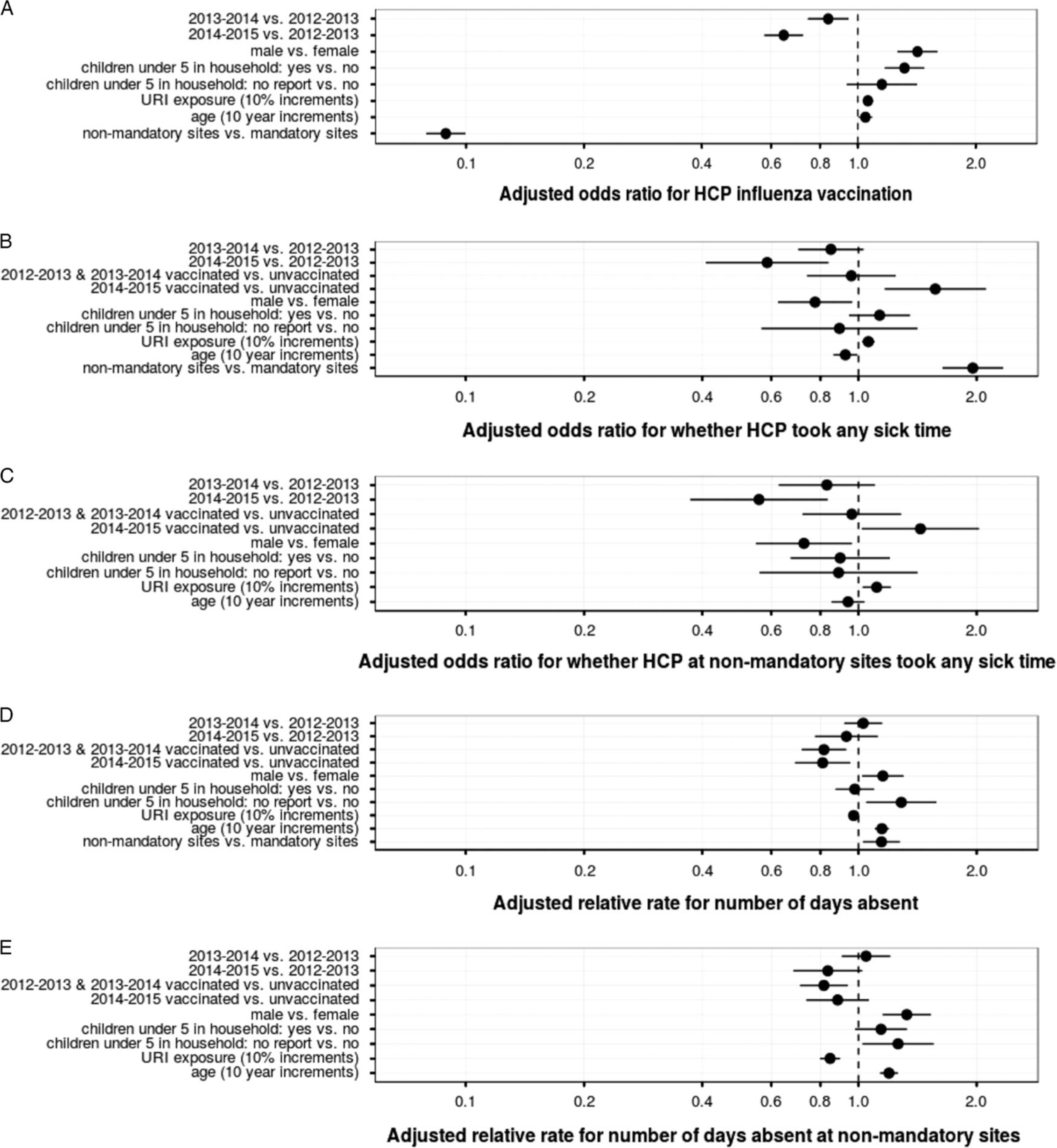
The proportion of participants who received influenza vaccination was lower each year at nonmandatory than at mandatory vaccination sites (odds ratio [OR], 0.09; 95% confidence interval [CI], 0.07–0.11). Among HCP who reported at least 1 sick day, vaccinated HCP had lower symptomatic days absent compared to unvaccinated HCP (OR for 2012–2013 and 2013–2014, 0.82; 95% CI, 0.72–0.93; OR for 2014–2015, 0.81; 95% CI, 0.69–0.95).
CONCLUSIONS.
These data suggest that mandatory HCP influenza vaccination policies increase influenza vaccination rates and that HCP symptomatic absenteeism diminishes as rates of influenza vaccination increase. These findings should be considered in formulating HCP influenza vaccination policies.
-
Subjects:
-
Source:Infect Control Hosp Epidemiol. 39(4):452-461
-
Pubmed ID:29514719
-
Pubmed Central ID:PMC10241003
-
Document Type:
-
Funding:
-
Volume:39
-
Issue:4
-
Collection(s):
-
Main Document Checksum:urn:sha256:54e9b573623788604e729bb74ae1bfc2b52be7a78212db176762c6d7650f827b
-
Download URL:
-
File Type:
 [PDF
- 921.63 KB
]
[PDF
- 921.63 KB
]
Supporting Files


File Language:
English
ON THIS PAGE

CDC STACKS serves as an archival repository of CDC-published products including
scientific findings,
journal articles, guidelines, recommendations, or other public health information authored or
co-authored by CDC or funded partners.
As a repository, CDC STACKS retains documents in their original published format to ensure public access to scientific information.
As a repository, CDC STACKS retains documents in their original published format to ensure public access to scientific information.
You May Also Like
COLLECTION
CDC Public Access