



Perceptions of Water Safety and Tap Water Taste and Their Associations With Beverage Intake Among U.S. Adults
Supporting Files

-
6 2023
-
Available in CDC Stacks on June 04, 2023, 12:00 AM

File Language:
English
Details
-
Alternative Title:Am J Health Promot
-
Personal Author:
-
Description:Objectives:
Examine differences in perceptions of tap water (TW) and bottled water (BW) safety and TW taste and their associations with plain water (PW) and sugar-sweetened beverage (SSB) intake.
Design:
Quantitative, cross-sectional study.
Setting:
United States.
Subjects:
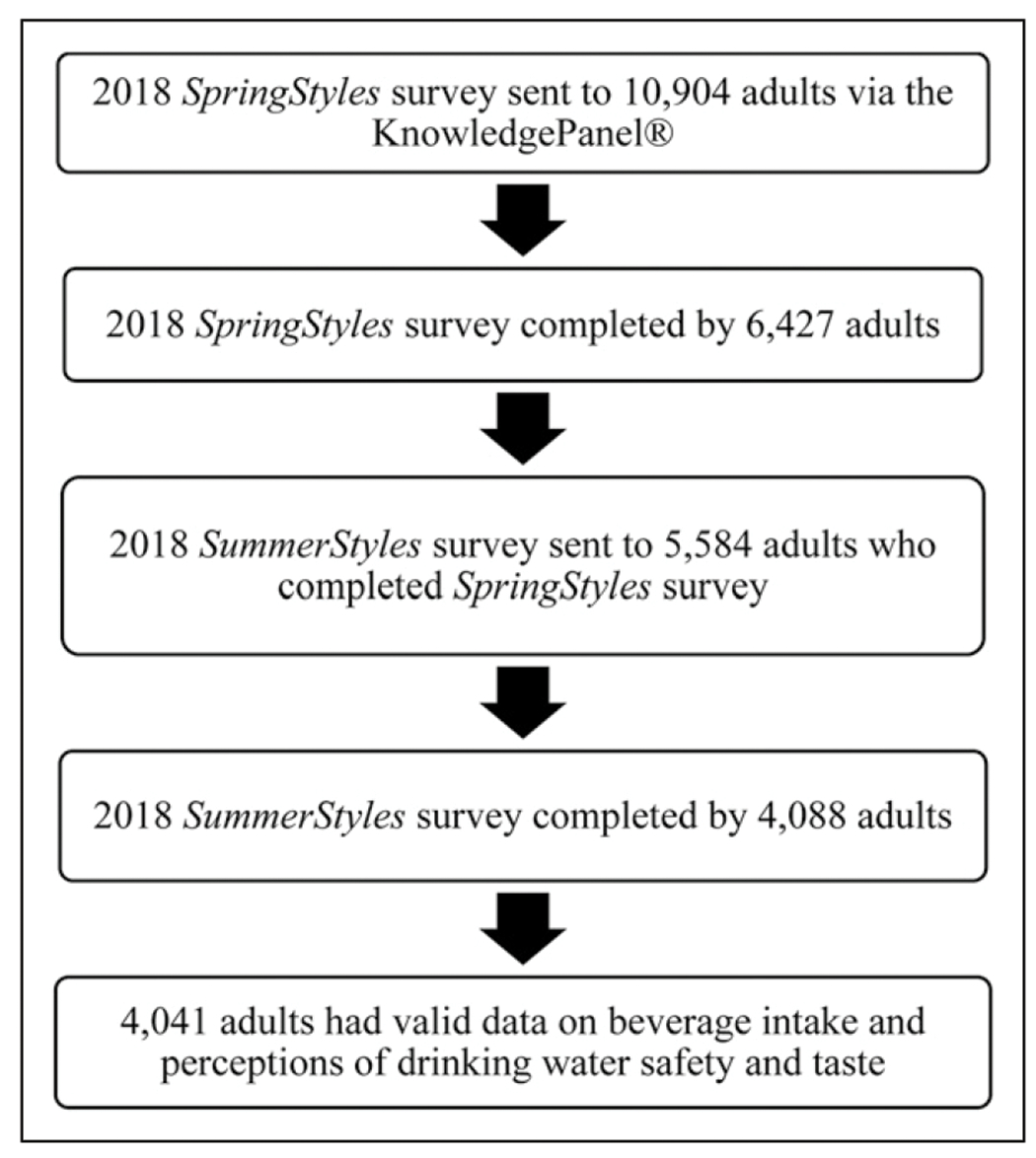
4,041 U.S. adults (≥18 years) in the 2018 SummerStyles survey data.
Measures:
Outcomes were intake of TW, BW, PW (tap and bottled water), and SSB. Exposures were perceptions of TW and BW safety and TW taste (disagree, neutral, or agree). Covariates included sociodemographics.
Analysis:
We used chi-square analysis to examine sociodemographic differences in perceptions and multivariable logistic regressions to estimate adjusted odds ratios (AOR) for consuming TW ≤ 1 cup/day, BW > 1 cup/day, PW ≤ 3 cups/day, and SSB ≥ 1 time/day by water perceptions.
Results:
One in 7 (15.1%) of adults did not think their home TW was safe to drink, 39.0% thought BW was safer than TW, and 25.9% did not think their local TW tasted good. Adults who did not think local TW was safe to drink had higher odds of drinking TW ≤ 1 cup/day (AOR = 3.12) and BW >1 cup/day (AOR = 2.69). Adults who thought BW was safer than TW had higher odds of drinking TW ≤1 cup/day (AOR = 2.38), BW > 1 cup/day (AOR = 5.80), and SSB ≥ 1 time/day (AOR = 1.39). Adults who did not think TW tasted good had higher odds of drinking TW ≤ 1 cup/day (AOR = 4.39) and BW > 1 cup/day (AOR = 2.91).
Conclusions:
Negative perceptions of TW safety and taste and a belief BW is safer than TW were common and associated with low TW intake. Perceiving BW is safer than TW increased the likelihood of daily SSB intake. These findings can guide programs and services to support water quality to improve perceptions of TW safety and taste, which might increase TW intake and decrease SSB intake. -
Subjects:
-
Source:Am J Health Promot. 37(5):625-637
-
Pubmed ID:36609168
-
Pubmed Central ID:PMC10239313
-
Document Type:
-
Funding:
-
Place as Subject:
-
Volume:37
-
Issue:5
-
Download URL:
-
File Type:
 [PDF - 605.62 KB]
 -
Collection(s):
-
Main Document Checksum:urn:sha256:6c2e465aa5912a2af6ff551c4455861a0eefbe0eac7af7221f314b300f745214
Supporting Files


File Language:
English
 Was this page helpful?
 Found an issue?

CDC STACKS serves as an archival repository of CDC-published products including
scientific findings, journal articles, guidelines, recommendations, or other public health information authored or
co-authored by CDC or funded partners.
As a repository, CDC STACKS retains documents in their original published format to ensure public access to scientific information.
As a repository, CDC STACKS retains documents in their original published format to ensure public access to scientific information.
You May Also Like
COLLECTION
CDC Public Access