



Maternal hypertension, antihypertensive medication use, and small for gestational age births in the National Birth Defects Prevention Study, 1997-2011
Supporting Files

-
2 2018 ; 2-2018
-
Available in CDC Stacks on April 03, 2023, 12:00 AM
File Language:
English
Details
-
Alternative Title:Matern Child Health J
-
Personal Author:
-
Corporate Authors:
-
Description:Background:
Small for gestational age (SGA) birth is associated with poor long-term health outcomes. It is unclear whether maternal antihypertensive medication increases risk of SGA independently of maternal hypertension.
Methods:
We analyzed associations between maternal hypertension and antihypertensive medication use and SGA among non-malformed singleton controls in the National Birth Defects Prevention Study. We defined SGA as birthweight<10th percentile for a given gestational age, sex, race/ethnicity, and parity. We included 1,045 SGA and 10,019 non-SGA births. We used logistic regression to calculate adjusted odds ratios (AORs) and 95% confidence intervals (CIs). We assessed interaction between hypertension, antihypertensive medication use, and maternal race/ethnicity and age.
Results:
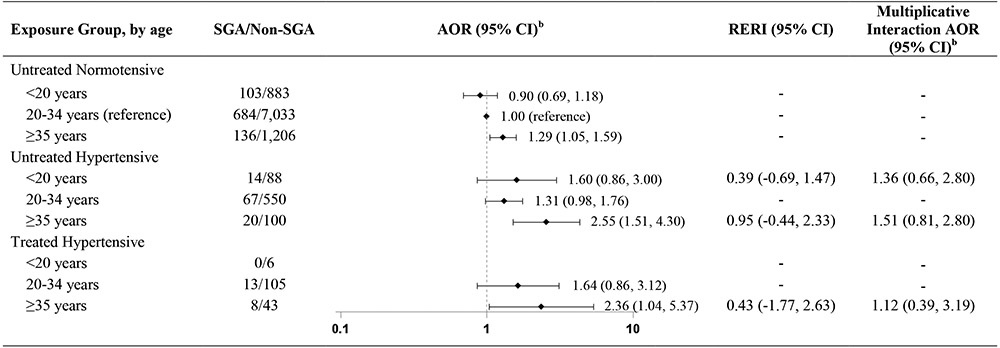
Overall, 122 (11.7%) SGA and 892 (8.9%) non-SGA mothers reported hypertension and 21 (2.0%) SGA and 154 (1.5%) non-SGA mothers reported antihypertensive medication use. The most commonly reported medications were centrally-acting antiadrenergics, β-blockers, calcium channel blockers, and diuretics. Compared to normotensive pregnancies, maternal hypertension, regardless of treatment (AOR, 1.49 95% CI, 1.20, 1.86), and untreated maternal hypertension (AOR, 1.46 95% CI, 1.15, 1.86) were associated with SGA. We observed a positive, but not significant, association between antihypertensive medication use and SGA. SGA risk varied by maternal race/ethnicity, being highest among Hispanic mothers, and age, being highest among mothers ≥35 years, but statistical tests for interaction were not significant.
Conclusions:
Consistent with the literature, our findings suggest that maternal hypertension slightly increases SGA risk. We did not find an appreciably increased SGA risk associated with antihypertensive medication use beyond that of the underlying maternal hypertension. -
Subjects:
- Adult
- Antihypertensive Agents
- Case-Control Studies
- Female
- Gestational Age
- Humans
- Hypertension
- Hypertension, Pregnancy-Induced
- Infant, Newborn
- Infant, Small for Gestational Age
- Maternal Age
- Mothers
- Pre-Eclampsia
- Pregnancy
- Pregnancy Outcome
- Retrospective Studies
- Socioeconomic Factors
- Treatment Outcome
-
Keywords:
-
Source:Matern Child Health J. 22(2):237-246
-
Pubmed ID:29124624
-
Pubmed Central ID:PMC10068427
-
Document Type:
-
Funding:
-
Volume:22
-
Issue:2
-
Download URL:
-
File Type:
 [PDF - 424.73 KB]
 -
Collection(s):
-
Main Document Checksum:urn:sha-512:3aeb2ce39f76a4bb13b050eea2fe74222899b0925ca4cdc765066b34403ee7bd0a50868209c310b6a48f1a12cc2b6ec55f459dd4296c5e678f65171d98c3493b
Supporting Files


File Language:
English
 Was this page helpful?
 Found an issue?


CDC STACKS serves as an archival repository of CDC-published products including
scientific findings, journal articles, guidelines, recommendations, or other public health information authored or
co-authored by CDC or funded partners.
As a repository, CDC STACKS retains documents in their original published format to ensure public access to scientific information.
As a repository, CDC STACKS retains documents in their original published format to ensure public access to scientific information.
You May Also Like
COLLECTION
CDC Public Access