


Fluconazole use and birth defects in the National Birth Defects Prevention Study
Supporting Files

-
5 2016
-
File Language:
English
Details
-
Alternative Title:Am J Obstet Gynecol
-
Personal Author:
-
Description:Background:
Low-dose fluconazole is commonly used to treat vulvovaginal candidiasis, a condition occurring frequently during pregnancy. Conflicting information exists on the association between low-dose fluconazole use among pregnant women and risk of major birth defects.
Objective:
We used data from the National Birth Defects Prevention Study to examine this association.
Study Design:
The National Birth Defects Prevention Study is a multisite, population-based, case-control study that includes pregnancies with estimated delivery dates from 1997–2011. Information on early pregnancy fluconazole use was collected by self-report from 31,645 mothers of birth defect cases and 11,612 mothers of unaffected controls. Adjusted odds ratios and 95% confidence intervals were estimated for birth defects with 5 or more exposed cases; crude odds ratios and exact 95% confidence intervals were estimated for birth defects with 3–4 exposed cases.
Results:
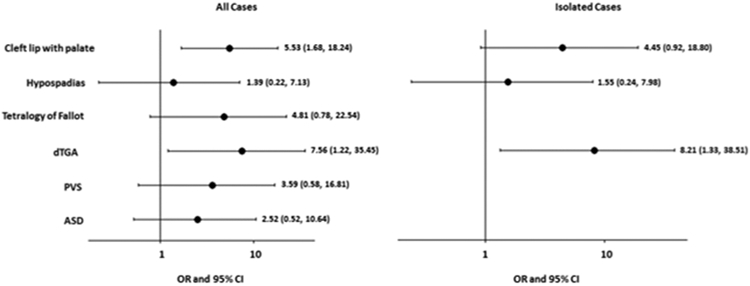
Of the 43,257 mothers analyzed, 44 case mothers and 6 control mothers reported using fluconazole. Six exposed infants had cleft lip with cleft palate, four had an atrial septal defect, and each of the following defects had three exposed cases: hypospadias, tetralogy of Fallot, d-transposition of the great arteries, and pulmonary valve stenosis. Fluconazole use was associated with cleft lip with cleft palate (odds ratio=5.53; confidence interval=1.68–18.24) and d-transposition of the great arteries (odds ratio =7.56; confidence interval =1.22–35.45).
Conclusions:
The associations between fluconazole and both cleft lip with cleft palate and d-transposition of the great arteries are consistent with earlier published case reports, but not recent epidemiologic studies. Despite the larger sample size of the National Birth Defects Prevention Study, fluconazole use was rare. Further investigation is needed in large studies, with particular emphasis on oral clefts and conotruncal heart defects.
-
Subjects:
-
Source:Am J Obstet Gynecol. 214(5):657.e1-657.e6579
-
Pubmed ID:26640069
-
Pubmed Central ID:PMC10041360
-
Document Type:
-
Funding:
-
Place as Subject:
-
Volume:214
-
Issue:5
-
Collection(s):
-
Main Document Checksum:urn:sha256:76f677e2e8a8b4e4f90b2f5ca06eede6361997fa3939b37158a124e3b2b7e47f
-
Download URL:
-
File Type:
 [PDF
- 130.76 KB
]
[PDF
- 130.76 KB
]
Supporting Files


File Language:
English
ON THIS PAGE

CDC STACKS serves as an archival repository of CDC-published products including
scientific findings,
journal articles, guidelines, recommendations, or other public health information authored or
co-authored by CDC or funded partners.
As a repository, CDC STACKS retains documents in their original published format to ensure public access to scientific information.
As a repository, CDC STACKS retains documents in their original published format to ensure public access to scientific information.
You May Also Like
COLLECTION
CDC Public Access