


Mortality following workplace injury: Quantitative bias analysis
Supporting Files

-
12 2021
-
File Language:
English
Details
-
Alternative Title:Ann Epidemiol
-
Personal Author:
-
Description:Purpose:
Recent studies have shown increased all-cause mortality among workers following disabling workplace injury. These studies did not account for 2 potentially important confounders, smoking and obesity. We estimated injury-related mortality accounting for these factors.
Methods:
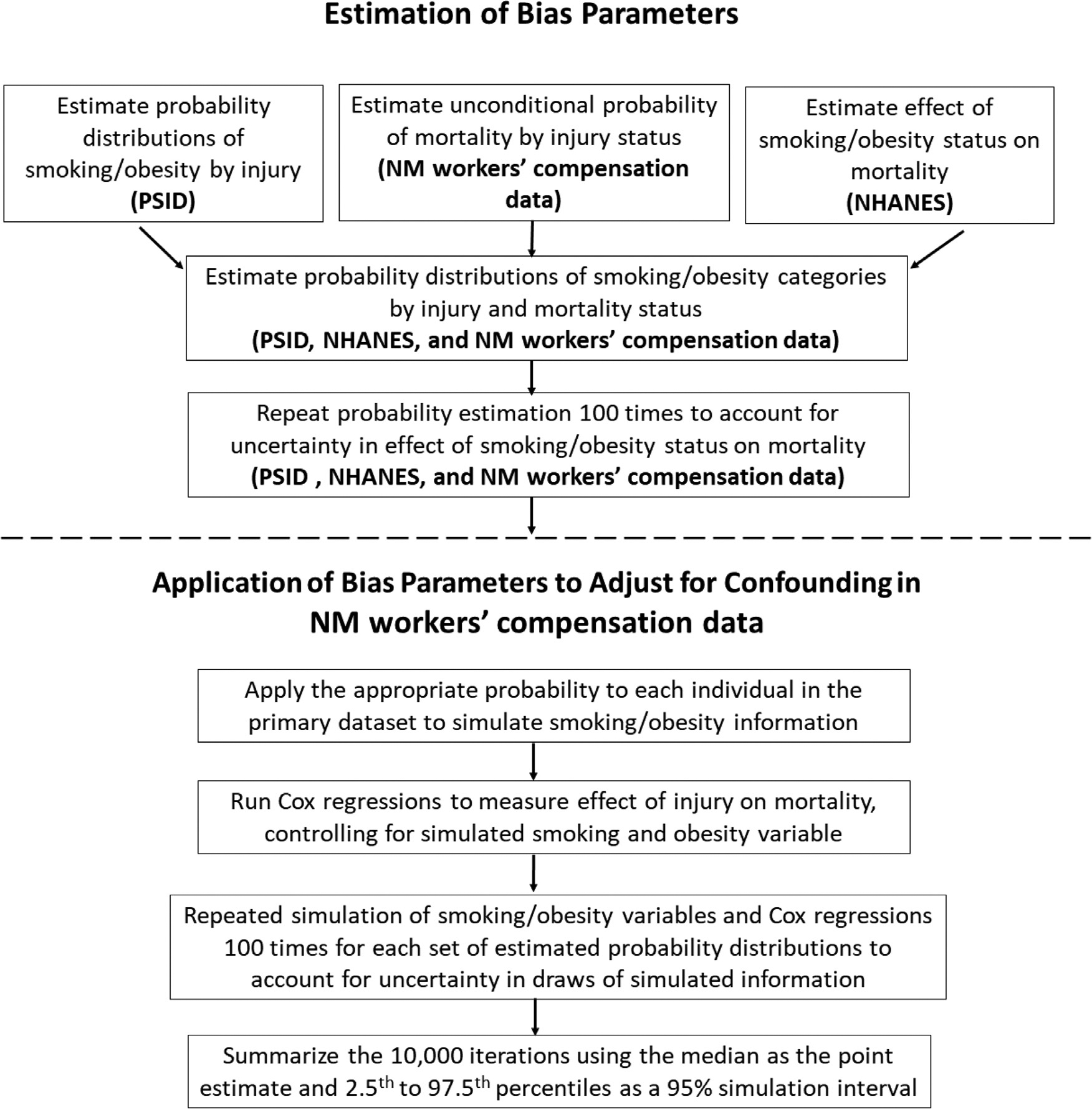
We followed workers receiving New Mexico workers’ compensation benefits (1994–2000) through 2013. Using data from the Panel Study of Income Dynamics, we derived the joint distribution of smoking status and obesity for workers with and without lost-time injuries. We conducted a quantitative bias analysis (QBA) to determine the adjusted relationship of injury and mortality.
Results:
We observed hazard ratios after adjusting for smoking and obesity of 1.13 for women (95% simulation interval (SI) 0.97 to 1.31) and 1.12 for men (95% SI 1.00 to 1.27). The estimated fully adjusted excess hazard was about half the estimates not adjusted for these factors.
Conclusions:
Using QBA to adjust for smoking and obesity reduced the estimated mortality hazard from lost-time injuries and widened the simulation interval. The adjusted estimate still showed more than a 10 percent increase for both women and men. The change in estimates reveals the importance of accounting for these confounders. Of course, the results depend on the methods and assumptions used.
-
Subjects:
-
Source:Ann Epidemiol. 64:155-160
-
Pubmed ID:34607011
-
Pubmed Central ID:PMC10026009
-
Document Type:
-
Funding:
-
Volume:64
-
Collection(s):
-
Main Document Checksum:urn:sha256:d756eeae7efa8d3437848a03673357cc51c0aa435358b3f72a4872752f0c7b26
-
Download URL:
-
File Type:
 [PDF
- 402.62 KB
]
[PDF
- 402.62 KB
]
Supporting Files


File Language:
English
ON THIS PAGE


CDC STACKS serves as an archival repository of CDC-published products including
scientific findings,
journal articles, guidelines, recommendations, or other public health information authored or
co-authored by CDC or funded partners.
As a repository, CDC STACKS retains documents in their original published format to ensure public access to scientific information.
As a repository, CDC STACKS retains documents in their original published format to ensure public access to scientific information.
You May Also Like
COLLECTION
CDC Public Access