


Accuracy of body mass index in categorizing weight status in children with intellectual and developmental disabilities
Supporting Files

-
2021
-
File Language:
English
Details
-
Alternative Title:J Pediatr Rehabil Med
-
Personal Author:
-
Description:PURPOSE:
To identify the accuracy of Body Mass Index (BMI) to categorize body weight in a sample of children with spina bifida and Down syndrome as compared to typically developing peers.
METHODS:
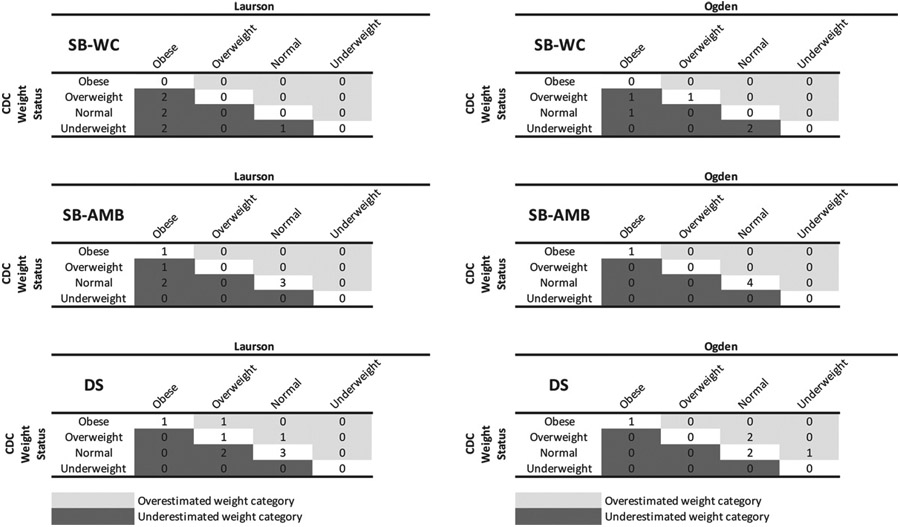
A secondary analysis of 32 children with spina bifida, Down syndrome or no chronic illness. A calculated BMI was plotted on the Centers for Disease Control and Prevention age- and sex-specific BMI growth charts to determine each child’s weight status. Percentage of body fat, obtained by labeled water, was plotted on two different body fat percentile reference curves, one derived from a whole body measure (DXA) of body fat and one by skin-fold measure. Differences in weight categories between calculated BMI and body fat percentile curves were reported.
RESULTS:
The calculated BMI for children with a disability had significant misclassifications as a screening tool for body fat when compared to children without a disability. Misclassifications were increased with the body fat percentile reference curve derived from skin-fold measures and for children who primarily used a wheelchair.
CONCLUSION:
The current recommendation to use BMI to categorize weight status is not useful for many children with disabilities. Further research to identify an alternative pragmatic strategy is necessary.
-
Subjects:
-
Source:J Pediatr Rehabil Med. 14(4):621-629
-
Pubmed ID:34542044
-
Pubmed Central ID:PMC9105647
-
Document Type:
-
Funding:
-
Volume:14
-
Issue:4
-
Collection(s):
-
Main Document Checksum:urn:sha256:a7d46788d3fc7a7d46539a2ec2f4353abb7a174eff93c7f1b551a68483358d4f
-
Download URL:
-
File Type:
 [PDF
- 389.95 KB
]
[PDF
- 389.95 KB
]
Supporting Files


File Language:
English
ON THIS PAGE

CDC STACKS serves as an archival repository of CDC-published products including
scientific findings,
journal articles, guidelines, recommendations, or other public health information authored or
co-authored by CDC or funded partners.
As a repository, CDC STACKS retains documents in their original published format to ensure public access to scientific information.
As a repository, CDC STACKS retains documents in their original published format to ensure public access to scientific information.
You May Also Like
COLLECTION
CDC Public Access