


Using global positioning system methods to explore mobility patterns and exposure to high HIV prevalence neighbourhoods among transgender women in New York City
Supporting Files

-
11 12 2019
-
File Language:
English
Details
-
Alternative Title:Geospat Health
-
Personal Author:
-
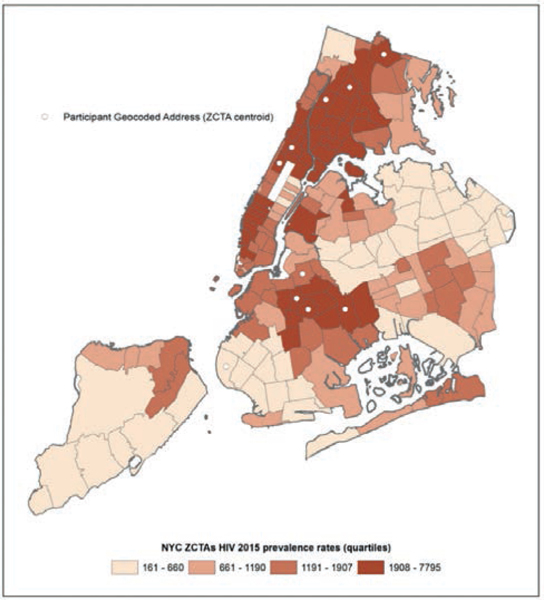
Description:The aim of this study was to assess mobility patterns among a sample of transgender women (n=14) in New York City via survey and Global Positioning System (GPS) monitoring. We found varying levels of concordance between the residential neighbourhood and each of the non-residential contexts: 64.3% considered the neighbourhood that they socialised in most often to be different from their residential neighbourhood. While participants' residences represented 10 zone improvement plan code tabulation areas (ZCTAs), GPS data were recorded in 124 of 263 ZCTAs (47.1%). Overall, 58.2% (n=373,262) were recorded in ZCTAs in the highest quartile of human immunodeficiency virus (HIV) prevalence. The association between place, community HIV prevalence, mobility, and factors that increase the vulnerability of transgender women to HIV infection are worthy of future investigation in reducing the burden of the HIV epidemic in these communities.
-
Subjects:
-
Source:Geospat Health. 14(2)
-
Pubmed ID:31724385
-
Pubmed Central ID:PMC9897014
-
Document Type:
-
Funding:
-
Place as Subject:
-
Volume:14
-
Issue:2
-
Collection(s):
-
Main Document Checksum:urn:sha256:4ff20120e98a948d1e2f2a249bc79b904e608fee27153ba0e46165970d90979c
-
Download URL:
-
File Type:
 [PDF
- 446.22 KB
]
[PDF
- 446.22 KB
]
Supporting Files


File Language:
English
ON THIS PAGE


CDC STACKS serves as an archival repository of CDC-published products including
scientific findings,
journal articles, guidelines, recommendations, or other public health information authored or
co-authored by CDC or funded partners.
As a repository, CDC STACKS retains documents in their original published format to ensure public access to scientific information.
As a repository, CDC STACKS retains documents in their original published format to ensure public access to scientific information.
You May Also Like
COLLECTION
CDC Public Access