



Observational Cohort Study of Evolving Epidemiologic, Clinical, and Virologic Features of Monkeypox in Southern France
Supporting Files
Public Domain

-
12 2022
File Language:
English
Details
-
Alternative Title:Emerg Infect Dis
-
Personal Author:Cassir, Nadim ; Cardona, Florian ; Tissot-Dupont, Hervé ; Bruel, Christiane ; Doudier, Barbara ; Lahouel, Salima ; Bendamardji, Karim ; Boschi, Céline ; Aherfi, Sarah ; Edouard, Sophie ; Lagier, Jean-Christophe ; Colson, Philippe ; Gautret, Philippe ; Fournier, Pierre-Edouard ; Parola, Philippe ; Brouqui, Philippe ; La-Scola, Bernard ; Million, Matthieu
-
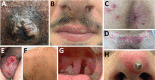
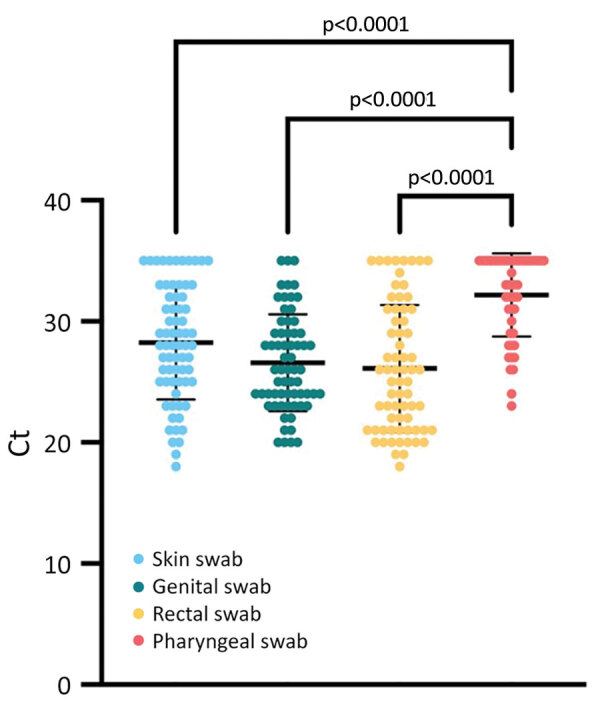
Description:We enrolled 136 patients with laboratory-confirmed monkeypox during June 4-August 31, 2022, at the University Hospital Institute Méditerranée Infection in Marseille, France. The median patient age was 36 years (interquartile range 31-42 years). Of 136 patients, 125 (92%) were men who have sex with men, 15 (11%) reported previous smallpox vaccinations, and 21 (15.5%) were HIV-positive. The most frequent lesion locations were the genitals (68 patients, 53%), perianal region (65 patients, 49%), and oral/perioral area (22 patients, 17%). Lesion locations largely corresponded with the route of contamination. Most (68%) patients had isolated anal, genital, or oral lesions when they were first seen, including 56 (61%) who had >1 positive site without a visible lesion. Concurrent sexually transmitted infections were diagnosed in 19 (15%) patients, and 7 patients (5%) were asymptomatic. We recommend vaccination campaigns, intensified testing for sexually transmitted infections, and increased contact tracing to control the ongoing monkeypox outbreak.
-
Subjects:
-
Source:Emerg Infect Dis. 2022; 28(12):2409-2415
-
Pubmed ID:36241422
-
Pubmed Central ID:PMC9707593
-
Document Type:
-
Place as Subject:
-
Volume:28
-
Issue:12
-
Download URL:
-
File Type:
 [PDF - 1.10 MB]
 -
Collection(s):
-
Main Document Checksum:urn:sha256:911dcd76c497fc7c31b829018f69f8efea1d8be50b11dd101d4013fb6b2d812d
Supporting Files


File Language:
English
 Was this page helpful?
 Found an issue?



CDC STACKS serves as an archival repository of CDC-published products including
scientific findings, journal articles, guidelines, recommendations, or other public health information authored or
co-authored by CDC or funded partners.
As a repository, CDC STACKS retains documents in their original published format to ensure public access to scientific information.
As a repository, CDC STACKS retains documents in their original published format to ensure public access to scientific information.
You May Also Like
COLLECTION
Emerging Infectious Diseases