


Minnesota Electronic Health Record Consortium COVID-19 Project: Informing Pandemic Response Through Statewide Collaboration Using Observational Data
Supporting Files
Public Domain

-
1 21 2022
-

File Language:
English
Details
-
Alternative Title:Public Health Rep
-
Personal Author:Winkelman, Tyler N. A.
 ;
Margolis, Karen L.
;
Waring, Stephen
;
Bodurtha, Peter J.
;
Khazanchi, Rohan
;
Gildemeister, Stefan
;
Mink, Pamela J.
;
DeSilva, Malini
;
Murray, Anne M.
;
Rai, Nayanjot
;
Sonier, Julie
;
Neely, Claire
;
Johnson, Steven G.
;
Chamberlain, Alanna M.
;
Yu, Yue
;
McFarling, Lynn M.
;
Dudley, R. Adams
;
Drawz, Paul E.
;
Margolis, Karen L.
;
Waring, Stephen
;
Bodurtha, Peter J.
;
Khazanchi, Rohan
;
Gildemeister, Stefan
;
Mink, Pamela J.
;
DeSilva, Malini
;
Murray, Anne M.
;
Rai, Nayanjot
;
Sonier, Julie
;
Neely, Claire
;
Johnson, Steven G.
;
Chamberlain, Alanna M.
;
Yu, Yue
;
McFarling, Lynn M.
;
Dudley, R. Adams
;
Drawz, Paul E.
-
Description:Objective:
Robust disease and syndromic surveillance tools are underdeveloped in the United States, as evidenced by limitations and heterogeneity in sociodemographic data collection throughout the COVID-19 pandemic. To monitor the COVID-19 pandemic in Minnesota, we developed a federated data network in March 2020 using electronic health record (EHR) data from 8 multispecialty health systems.
Materials and Methods:
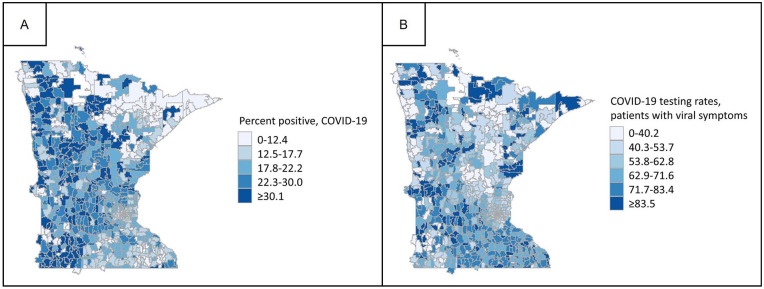
In this serial cross-sectional study, we examined patients of all ages who received a COVID-19 polymerase chain reaction test, had symptoms of a viral illness, or received an influenza test from January 3, 2016, through November 7, 2020. We evaluated COVID-19 testing rates among patients with symptoms of viral illness and percentage positivity among all patients tested, in aggregate and by zip code. We stratified results by patient and area-level characteristics.
Results:
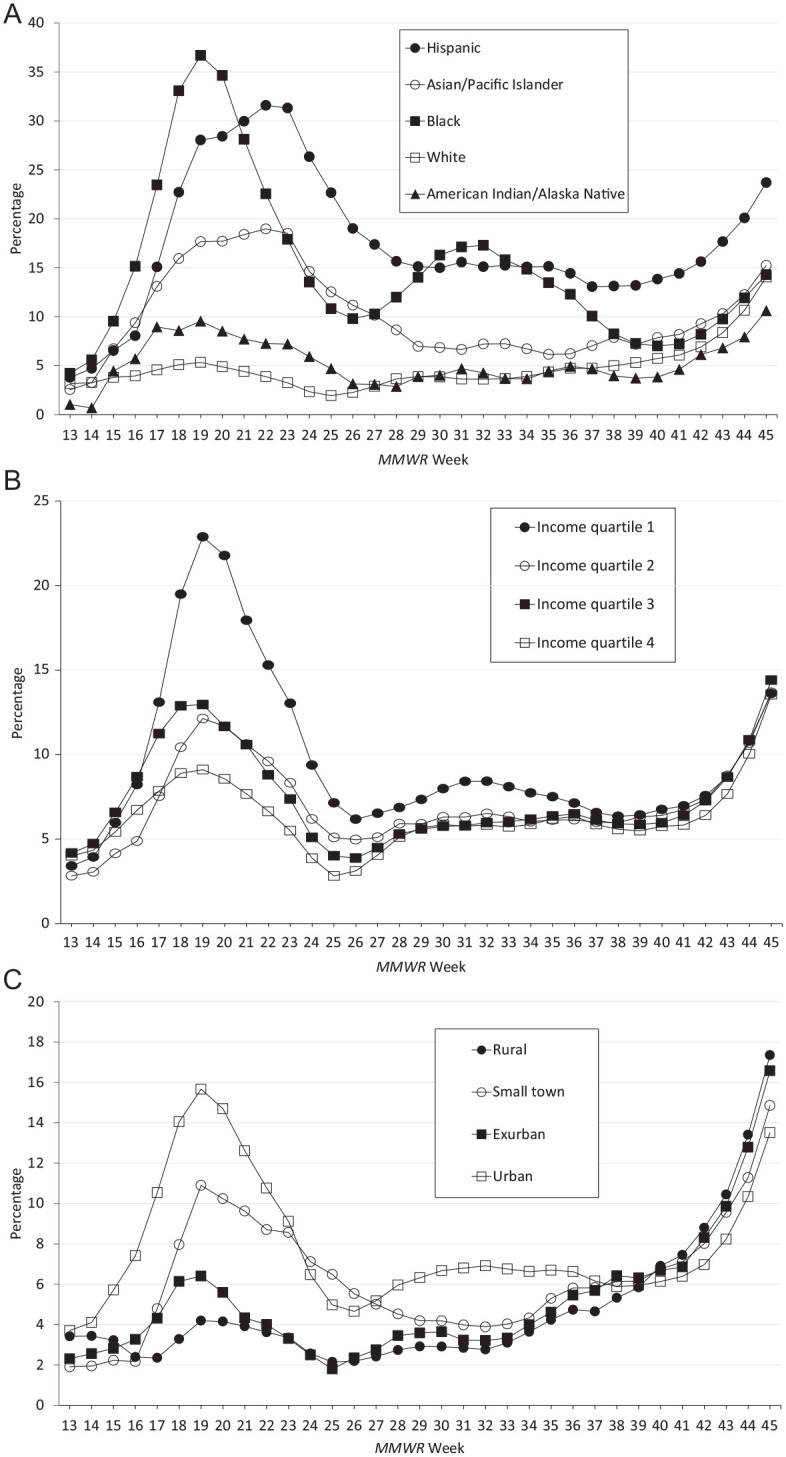
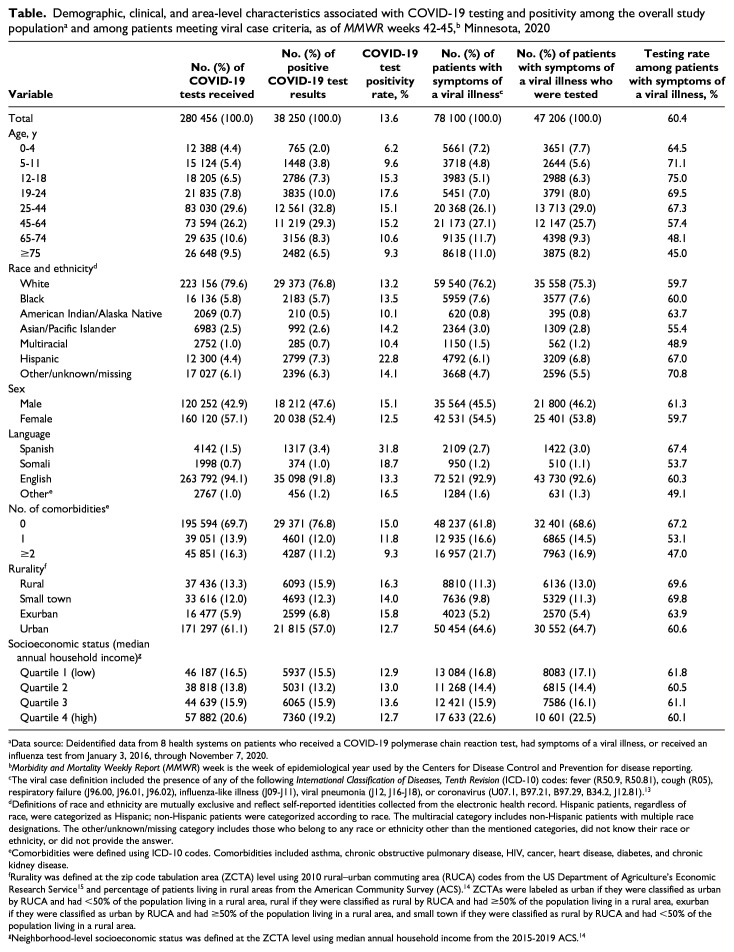
Cumulative COVID-19 positivity rates were similar for people aged 12-64 years (range, 15.1%-17.6%) but lower for adults aged ≥65 years (range, 9.3%-10.7%). We found notable racial and ethnic disparities in positivity rates early in the pandemic, whereas COVID-19 positivity was similarly elevated across most racial and ethnic groups by the end of 2020. Positivity rates remained substantially higher among Hispanic patients compared with other racial and ethnic groups throughout the study period. We found similar trends across area-level income and rurality, with disparities early in the pandemic converging over time.
Practice Implications:
We rapidly developed a distributed data network across Minnesota to monitor the COVID-19 pandemic. Our findings highlight the utility of using EHR data to monitor the current pandemic as well as future public health priorities. Building partnerships with public health agencies can help ensure data streams are flexible and tailored to meet the changing needs of decision makers.
-
Subjects:
-
Source:Public Health Rep. 2022; 137(2):263-271
-
Pubmed ID:35060411
-
Pubmed Central ID:PMC8900228
-
Document Type:
-
Place as Subject:
-
Volume:137
-
Issue:2
-
Collection(s):
-
Main Document Checksum:urn:sha256:4062f8a13203b972d41f2ffec70dc015aa37ff4c58096e22b9840a73d63450e7
-
Download URL:
-
File Type:
 [PDF
- 691.64 KB
]
[PDF
- 691.64 KB
]
Supporting Files


File Language:
English
ON THIS PAGE



CDC STACKS serves as an archival repository of CDC-published products including
scientific findings,
journal articles, guidelines, recommendations, or other public health information authored or
co-authored by CDC or funded partners.
As a repository, CDC STACKS retains documents in their original published format to ensure public access to scientific information.
As a repository, CDC STACKS retains documents in their original published format to ensure public access to scientific information.
You May Also Like
COLLECTION
CDC Public Access