



A prevalent alpha-proteobacterium Paracoccus sp. in a population of the Cayenne ticks (Amblyomma cajennense) from Rio de Janeiro, Brazil
Supporting Files
Public Domain

-
Oct 16 2012
Details
-
Alternative Title:Genet Mol Biol
-
Personal Author:
-
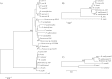
Description:As Rocky Mountain Spotted Fever is the most common tick-borne disease in South America, the presence of Rickettsia sp. in Amblyomma ticks is a possible indication of its endemicity in certain geographic regions. In the present work, bacterial DNA sequences related to Rickettsia amblyommii genes in A. dubitatum ticks, collected in the Brazilian state of Mato Grosso, were discovered. Simultaneously, Paracoccus sp. was detected in aproximately 77% of A. cajennense specimens collected in Rio de Janeiro, Brazil. This is the first report of Paracoccus sp. infection in a specific tick population, and raises the possibility of these bacteria being maintained and/or transmitted by ticks. Whether Paracoccus sp. represents another group of pathogenic Rhodobacteraceae or simply plays a role in A. cajennense physiology, is unknown. The data also demonstrate that the rickettsial 16S rRNA specific primers used forRickettsia spp. screening can also detect Paracoccus alpha-proteobacteria infection in biological samples. Hence, a PCR-RFLP strategy is presented to distinguish between these two groups of bacteria.
-
Subjects:
-
Source:Genet Mol Biol. 2012; 35(4):862-867.
-
Document Type:
-
Volume:35
-
Issue:4
-
Download URL:
-
File Type:
 [PDF - 695.90 KB]
 -
Collection(s):
-
Main Document Checksum:urn:sha256:6042cc67ac26cb4010d4f10082d9ab65feec2a74654834b22df99ab4938a51da
Supporting Files


 Was this page helpful?
 Found an issue?



CDC STACKS serves as an archival repository of CDC-published products including
scientific findings, journal articles, guidelines, recommendations, or other public health information authored or
co-authored by CDC or funded partners.
As a repository, CDC STACKS retains documents in their original published format to ensure public access to scientific information.
As a repository, CDC STACKS retains documents in their original published format to ensure public access to scientific information.
You May Also Like
COLLECTION
CDC Public Access