


The implementation of Integrated Disease Surveillance and Response in Uganda: a review of progress and challenges between 2001 and 2007
Supporting Files
Public Domain

-
Jun 04 2012
-
File Language:
English
Details
-
Alternative Title:Health Policy Plan
-
Personal Author:
-
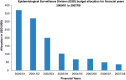
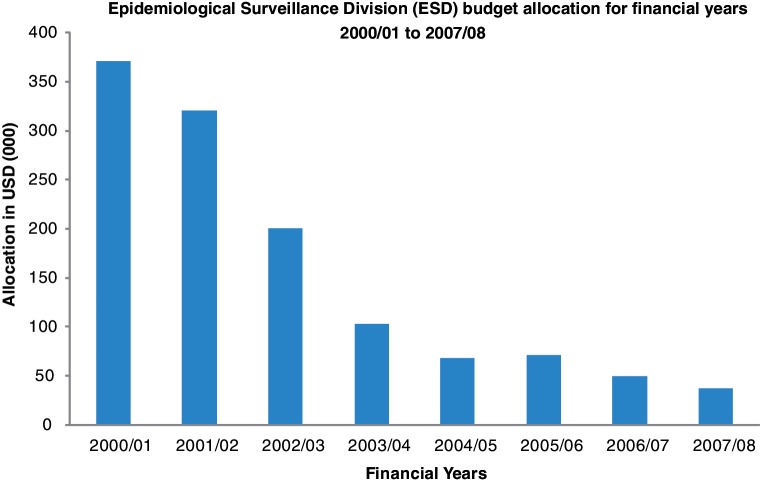
Description:In 2000 Uganda adopted the Integrated Disease Surveillance and Response (IDSR) strategy, which aims to create a co-ordinated approach to the collection, analysis, interpretation, use and dissemination of surveillance data for guiding decision making on public health actions.|We used a monitoring framework recommended by World Health Organization (WHO) and Centers for Disease Control and Prevention (CDC)-Atlanta to evaluate performance of the IDSR core indicators at the national level from 2001 to 2007. To determine the performance of IDSR at district and health facility levels over a 5-year period, we compared the evaluation results of a 2004 surveillance survey with findings from a baseline assessment in 2000. We also examined national-level funding for IDSR implementation during 2000-07.|Our findings show improvements in the performance of IDSR, including: (1) improved reporting at the district level (49% in 2001; 85% in 2007); (2) an increase and then decrease in timeliness of reporting from districts to central level; and (3) an increase in analysed data at the local level (from 10% to 47% analysing at least one target disease, P < 0.01). The case fatality rate (CFR) for two target priority diseases (cholera and meningococcal meningitis) decreased during IDSR implementation (cholera: from 7% to 2%; meningitis: from 16% to 4%), most likely due to improved outbreak response. A comparison before and after implementation showed increased funding for IDSR from government and development partners. However, funding support decreased ten-fold from the government budget of 2000/01 through to 2007/08. Per capita input for disease surveillance activities increased from US$0.0046 in 1996-99 to US$0.0215 in 2000-07.|Implementation of IDSR was associated with improved surveillance and response efforts. However, decreased budgetary support from the government may be eroding these gains. Renewed efforts from government and other stakeholders are necessary to sustain and expand progress achieved through implementation of IDSR.
-
Subjects:
-
Source:Health Policy Plan. 2012; 28(1):30-40.
-
Document Type:
-
Place as Subject:
-
Volume:28
-
Issue:1
-
Collection(s):
-
Main Document Checksum:urn:sha256:100b17879b74706e437f0ca8df5c3241a538465806a722be0204d6751e4b8533
-
Download URL:
-
File Type:
 [PDF
- 278.79 KB
]
[PDF
- 278.79 KB
]
Supporting Files


File Language:
English
ON THIS PAGE


CDC STACKS serves as an archival repository of CDC-published products including
scientific findings,
journal articles, guidelines, recommendations, or other public health information authored or
co-authored by CDC or funded partners.
As a repository, CDC STACKS retains documents in their original published format to ensure public access to scientific information.
As a repository, CDC STACKS retains documents in their original published format to ensure public access to scientific information.
You May Also Like
COLLECTION
CDC Public Access