


Interventions to Improve Follow-Up of Laboratory Test Results Pending at Discharge: A Systematic Review
Supporting Files

-
9 2018
-
File Language:
English
Details
-
Alternative Title:J Hosp Med
-
Personal Author:
-
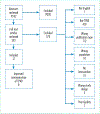
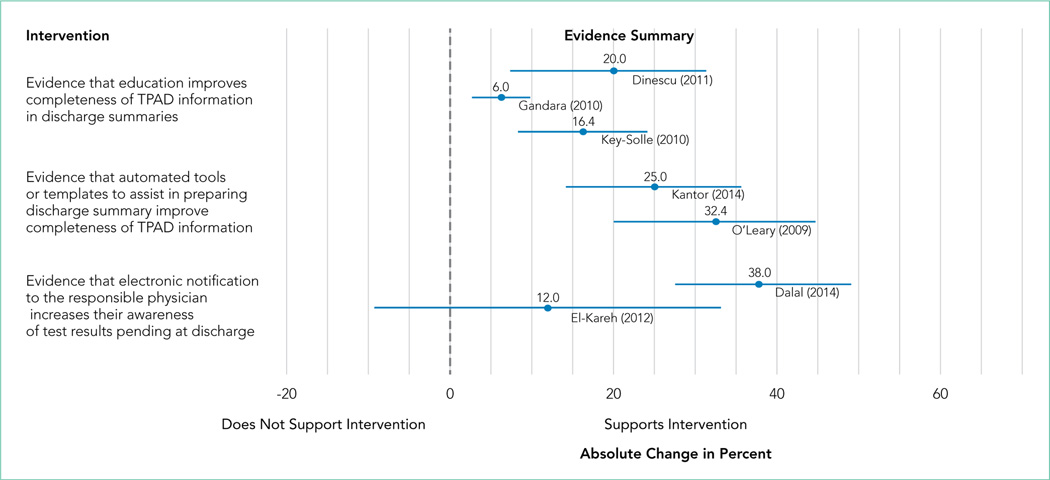
Description:Failure to follow up test results pending at discharge (TPAD) from hospitals or emergency departments is a major patient safety concern. The purpose of this review is to systematically evaluate the effectiveness of interventions to improve follow-up of laboratory TPAD. We conducted literature searches in PubMed, CINAHL, Cochrane, and EMBASE using search terms for relevant health care settings, transition of patient care, laboratory tests, communication, and pending or missed tests. We solicited unpublished studies from the clinical laboratory community and excluded articles that did not address transitions between settings, did not include an intervention, or were not related to laboratory TPAD. We also excluded letters, editorials, commentaries, abstracts, case reports, and case series. Of the 9,592 abstracts retrieved, eight met the inclusion criteria and reported the successful communication of TPAD. A team member abstracted predetermined data elements from each study, and a senior scientist reviewed the abstraction. Two experienced reviewers independently appraised the quality of each study using published Laboratory Medicine Best Practices (LMBP™) A-6 scoring criteria. We assessed the body of evidence using the A-6 methodology, and the evidence suggested that electronic tools or one-on-one education increased documentation of pending tests in discharge summaries. We also found that automated notifications improved awareness of TPAD. The interventions were supported by suggestive evidence; this type of evidence is below the level of evidence required for LMBP™ recommendations. We encourage additional research into the impact of these interventions on key processes and health outcomes.
-
Subjects:
-
Source:J Hosp Med. 13(9):631-636
-
Pubmed ID:29489926
-
Pubmed Central ID:PMC9491200
-
Document Type:
-
Funding:
-
Volume:13
-
Issue:9
-
Collection(s):
-
Main Document Checksum:urn:sha256:e7aca37afa49e7910aab113ce47360d5867c180db9606677be3fac30199fe49e
-
Download URL:
-
File Type:
 [PDF
- 362.92 KB
]
[PDF
- 362.92 KB
]
Supporting Files


File Language:
English
ON THIS PAGE


CDC STACKS serves as an archival repository of CDC-published products including
scientific findings,
journal articles, guidelines, recommendations, or other public health information authored or
co-authored by CDC or funded partners.
As a repository, CDC STACKS retains documents in their original published format to ensure public access to scientific information.
As a repository, CDC STACKS retains documents in their original published format to ensure public access to scientific information.
You May Also Like
COLLECTION
CDC Public Access