



Safety Monitoring of COVID-19 mRNA Vaccine Second Booster Doses Among Adults Aged ≥50 Years — United States, March 29, 2022–July 10, 2022
Supporting Files
Public Domain

-
7 29 2022
File Language:
English
Details
-
Journal Article:Morbidity and Mortality Weekly Report (MMWR)
-
Personal Author:Hause, Anne M. ; Baggs, James ; Marquez, Paige ; Abara, Winston E. ; Baumblatt, Jane ; Blanc, Phillip G. ; Su, John R. ; Hugueley, Brandon ; Parker, Casey ; Myers, Tanya R. ; Gee, Julianne ; Shimabukuro, Tom T. ; Shay, David K.
-
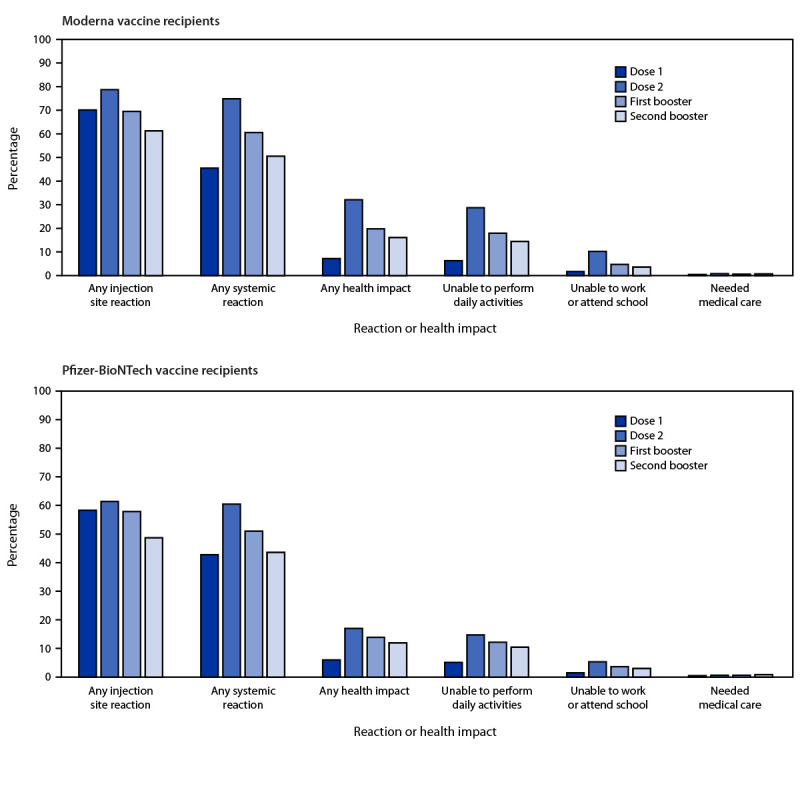
Description:The Advisory Committee on Immunization Practices (ACIP) recommends that all persons aged ≥5 years receive 1 booster dose of a COVID-19 vaccine after completion of their primary series.* On March 29, 2022, the Food and Drug Administration (FDA) authorized a second mRNA booster dose ≥4 months after receipt of a first booster dose for adults aged ≥50 years and persons aged ≥12 years with moderate to severe immunocompromise (1,2). To characterize the safety of a second mRNA booster dose among persons aged ≥50 years, CDC reviewed adverse events and health impact assessments reported to v-safe and the Vaccine Adverse Event Reporting System (VAERS) after receipt of a second mRNA booster dose during March 29-July 10, 2022. V-safe is a voluntary smartphone-based U.S. active surveillance system that monitors adverse events occurring after COVID-19 vaccination. VAERS is a U.S. passive surveillance system for monitoring adverse events after vaccination, managed by CDC and FDA (3). During March 29-July 10, 2022, approximately 16.8 million persons in the United States aged ≥50 years received a fourth dose.| Among 286,380 v-safe registrants aged ≥50 years who reported receiving a second booster of an mRNA vaccine, 86.9% received vaccines from the same manufacturer for all 4 doses (i.e., homologous vaccination). Among registrants who reported homologous vaccination, injection site and systemic reactions were less frequent after the second booster dose than after the first booster dose. VAERS received 8,515 reports of adverse events after second mRNA booster doses among adults aged ≥50 years, including 8,073 (94.8%) nonserious and 442 (5.1%) serious events. CDC recommends that health care providers and patients be advised that local and systemic reactions are expected after a second booster dose, and that serious adverse events are uncommon.
-
Subjects:
-
Source:MMWR Morbidity Mortal Weekly Rep. 71(30):971-976
-
Series:
-
DOI:
-
ISSN:0149-2195 (print) ; 1545-861X (digital)
-
Pubmed ID:35900925
-
Pubmed Central ID:PMC9345177
-
Document Type:
-
Pages in Document:6 pdf pages
-
Volume:71
-
Issue:30
-
Download URL:
-
File Type:
 [PDF - 310.63 KB]
 -
Collection(s):
-
Main Document Checksum:urn:sha-512:426adb6c80d44ebedc60338b2c926cfda1db9d0f7125e67890fae6048a9a82e83d0465d7611e2ee525c8d2c6f497e9ef82b452bdf32aff1232771a20fbff62aa
Supporting Files


File Language:
English
 Was this page helpful?
 Found an issue?

CDC STACKS serves as an archival repository of CDC-published products including
scientific findings, journal articles, guidelines, recommendations, or other public health information authored or
co-authored by CDC or funded partners.
As a repository, CDC STACKS retains documents in their original published format to ensure public access to scientific information.
As a repository, CDC STACKS retains documents in their original published format to ensure public access to scientific information.
You May Also Like
COLLECTION
Morbidity and Mortality Weekly Report (MMWR)