


Characteristics and outcomes for secondary breast cancer in children, adolescent and young adult cancer survivors treated with radiation
Supporting Files

-
9 2020
-
File Language:
English
Details
-
Alternative Title:Cancer Epidemiol Biomarkers Prev
-
Personal Author:
-
Description:Background:
Radiation therapy (RT) is used to treat many adolescent and young adult (AYA) and childhood cancer patients and is a risk factor for secondary breast cancer (BC). While premenopausal BC is inherently more aggressive, no studies to date have evaluated the characteristics and breast cancer specific survival (BCSS) of premenopausal secondary BC after RT in AYA and childhood cancer survivors.
Methods:
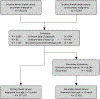
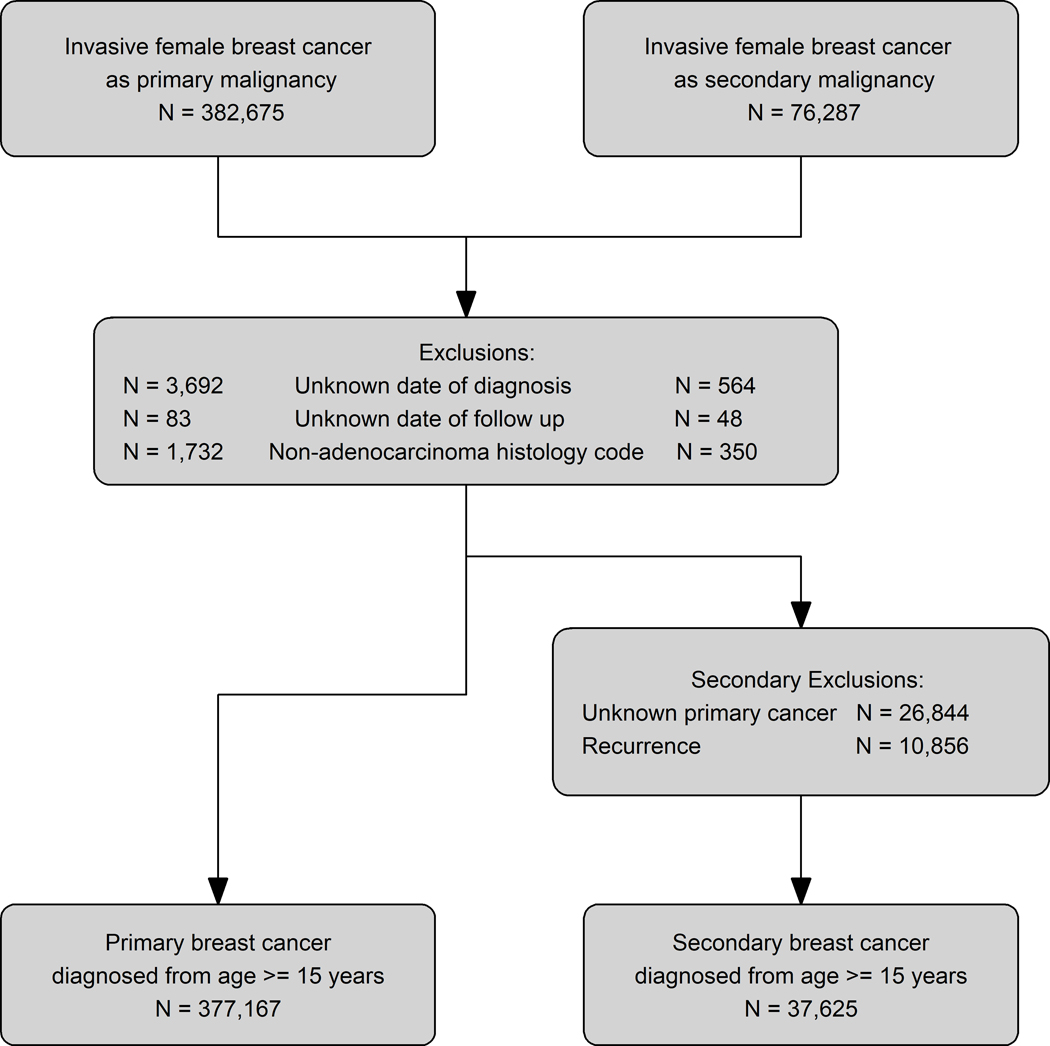
Female patients ages 12–50 diagnosed with primary BC during 1988–2014 (n=107,751) were obtained from the California Cancer Registry and compared with similar aged secondary BC patients who were treated with RT for their primary tumor (n=1,147) from ages 12–39. We examined BCSS using multivariable Cox proportional hazards regression.
Results:
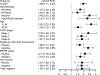
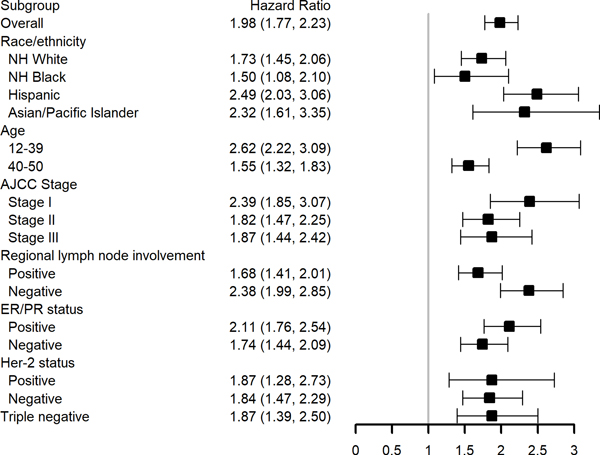
The secondary BC cohort was more likely to be Hispanic or Black, 35–45 years of age, have earlier stage tumors, be higher grade, have no lymph node (LN) involvement, and hormone-receptor negative. All women showed worse BCSS for large tumor size, LN involvement, and hormone-receptor negative status. BCSS was worse for women with secondary BC both overall (HR: 1.98; 95% CI 1.77–2.23) and in all subgroups considered. Associations were most pronounced in Hispanics, Asian/Pacific Islanders, and younger women as well as those with earlier stage, lymph node negative, and hormone-receptor positive disease.
Conclusions:
BCSS is significantly decreased among all survivors of childhood and AYA cancer treated with RT that develop a secondary BC, including women with good prognostic features.
Impact:
Therefore, we may need to consider alternative and even more aggressive treatment in what were considered low risk populations previously.
-
Subjects:
-
Source:Cancer Epidemiol Biomarkers Prev. 29(9):1767-1774
-
Pubmed ID:32847936
-
Pubmed Central ID:PMC9377811
-
Document Type:
-
Funding:HHSN261201800009C/CA/NCI NIH HHSUnited States/ ; NU58DP006344/DP/NCCDPHP CDC HHSUnited States/ ; HHSN261201800015I/CA/NCI NIH HHSUnited States/ ; HHSN261201800032I/CA/NCI NIH HHSUnited States/ ; HHSN261201800015C/CA/NCI NIH HHSUnited States/ ; HHSN261201800009I/CA/NCI NIH HHSUnited States/ ; HHSN261201800032C/CA/NCI NIH HHSUnited States/ ; P30 CA093373/CA/NCI NIH HHSUnited States/
-
Volume:29
-
Issue:9
-
Collection(s):
-
Main Document Checksum:urn:sha256:a309723c8f13c5f99eaaef1356a295abac197c35285df6a262ec6d5b84185462
-
Download URL:
-
File Type:
 [PDF
- 572.70 KB
]
[PDF
- 572.70 KB
]
Supporting Files


File Language:
English
ON THIS PAGE

CDC STACKS serves as an archival repository of CDC-published products including
scientific findings,
journal articles, guidelines, recommendations, or other public health information authored or
co-authored by CDC or funded partners.
As a repository, CDC STACKS retains documents in their original published format to ensure public access to scientific information.
As a repository, CDC STACKS retains documents in their original published format to ensure public access to scientific information.
You May Also Like
COLLECTION
CDC Public Access