



Incidence and mortality of cancers of the biliary tract, gallbladder, and liver by sex, age, race/ethnicity, and stage at diagnosis-United States, 2013-2017
Supporting Files

-
2021/09/01
-
Available in CDC Stacks on August 04, 2022, 12:00 AM
File Language:
English
Details
-
Alternative Title:Cancer Epidemiol Biomarkers Prev
-
Personal Author:
-
Description:Background:
Few population-based studies have examined incidence and mortality of cancers of the biliary tract, including intrahepatic bile duct, extrahepatic bile duct, ampulla of Vater, and overlapping or other lesion of the biliary tract in one study.
Methods:
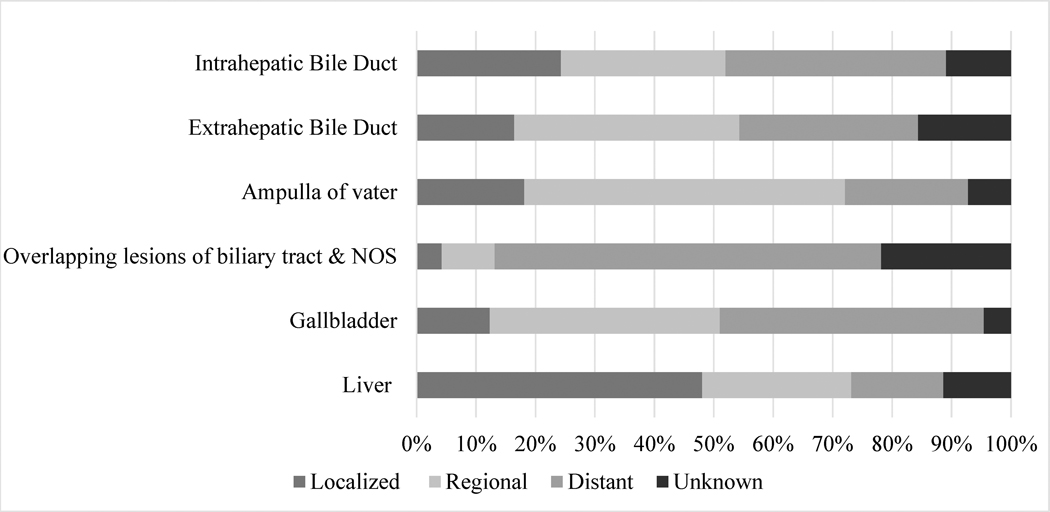
To further the understanding of recent rates of biliary tract cancers, we used population-based data, to examine incidence and mortality during 2013-2017. We examined how rates varied by sex, age, race/ethnicity, U.S. census region, and stage at diagnosis.
Results:
Intrahepatic bile duct was the most common biliary tract cancer with an incidence rate of 1.49 per 100,000 persons. Cancer incidence rates per 100,000 persons were 0.96 for extrahepatic bile duct, 0.45 for ampulla of Vater, and 0.24 for overlapping or other lesion of the biliary tract. Cancer death rates per 100,000 persons were 1.66 for intrahepatic bile duct and 0.45 for other biliary tract. Intrahepatic bile duct incidence and death rates were higher among males than females, higher among Hispanic and Asian and Pacific Islander persons compared to non-Hispanic Whites, and higher in the Northeast and in urban counties.
Conclusion:
This report provides national estimates of these rare biliary tract cancers.
Impact:
Key interventions targeted to high-risk populations may help reduce incidence and mortality of cancers of the biliary tract by improving primary prevention through strategies to reduce tobacco and alcohol use, control overweight and obesity, and promote hepatitis B vaccination and use of syringe service programs meant to curb the transmission of infectious diseases such as viral hepatitis. -
Subjects:
-
Source:Cancer Epidemiol Biomarkers Prev. 30(9):1607-1614
-
Pubmed ID:34244156
-
Pubmed Central ID:PMC9351546
-
Document Type:
-
Funding:
-
Genre:
-
Place as Subject:
-
Volume:30
-
Issue:9
-
Download URL:
-
File Type:
 [PDF - 689.50 KB]
 -
Collection(s):
-
Main Document Checksum:urn:sha-512:c13976ca1e0b303c56ed0b2f8670d9885ef95255b475663902fb7f8b0f7a695b1765ab2c602a5885bed9c8e756738130d29a41172c7681272eb825b0a6b6e95d
Supporting Files


File Language:
English
 Was this page helpful?
 Found an issue?

CDC STACKS serves as an archival repository of CDC-published products including
scientific findings, journal articles, guidelines, recommendations, or other public health information authored or
co-authored by CDC or funded partners.
As a repository, CDC STACKS retains documents in their original published format to ensure public access to scientific information.
As a repository, CDC STACKS retains documents in their original published format to ensure public access to scientific information.
You May Also Like
COLLECTION
CDC Public Access