



Evaluation of non-continuous temperature monitoring practices for vaccine storage units: A Monte Carlo simulation study
Supporting Files

-
3 22 2020
-
File Language:
English
Details
-
Alternative Title:J Public Health (Bangkok)
-
Personal Author:
-
Description:Objectives:
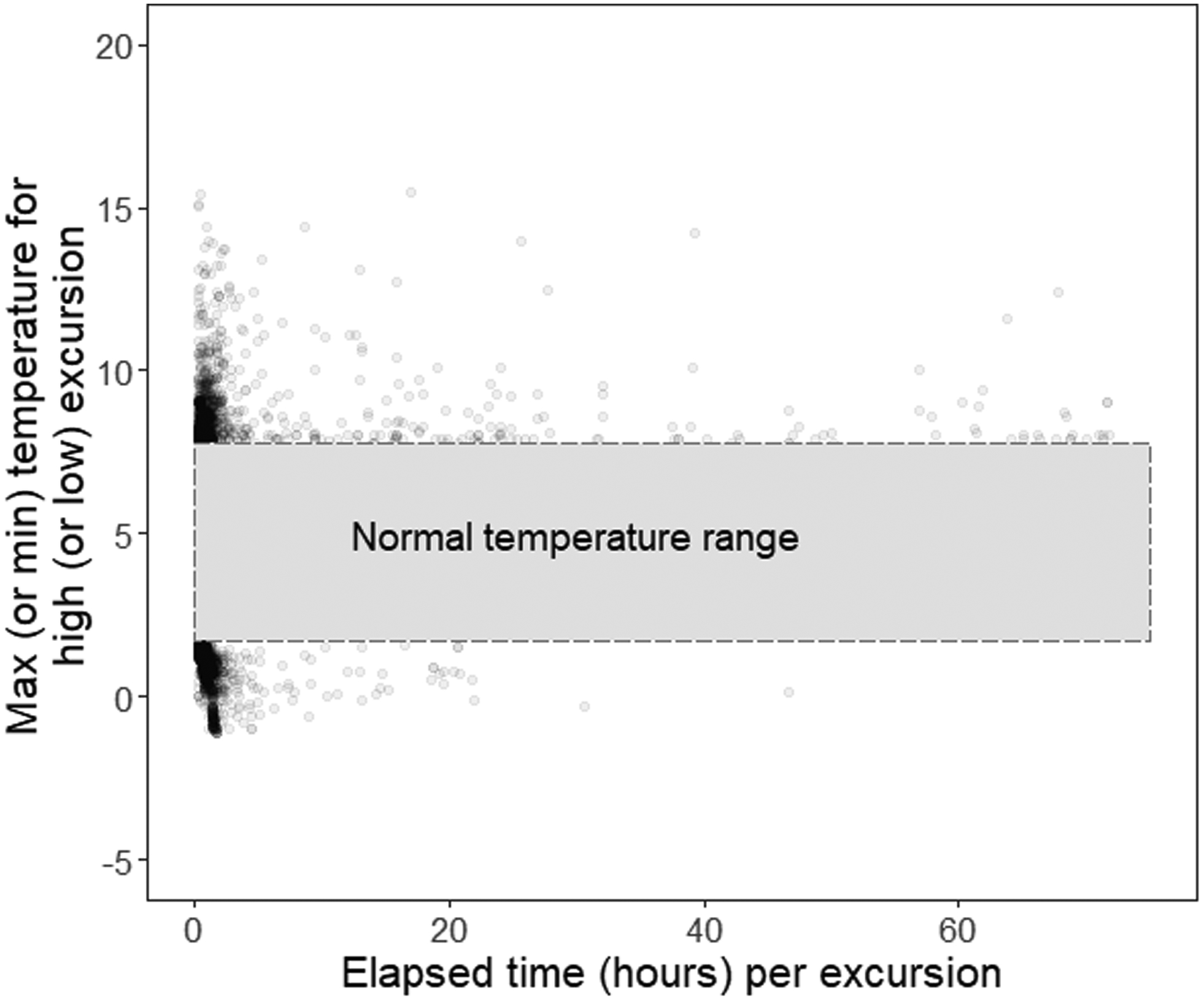
Evaluate different non-continuous temperature monitoring practices for detection of out-of-range temperatures (above or below the recommended temperature range of 2–8°C for refrigeration units), which are called excursions, within vaccine storage units.
Methods:
Simulations based on temperature data collected by 243 digital data loggers operated in vaccine storage units at health care providers who participated in a CDC-sponsored continuous temperature monitoring pilot project, from 2012 to 2015. In the primary analysis, we evaluate: (1) twice-daily current temperature readings without minimum and maximum readings (min/max), (2) twice-daily current temperature readings with once-daily min/max, and (3) twice-daily current temperature readings with twice-daily min/max.
Results:
Recording current temperature twice-daily without min/max resulted in the detection of 4.8—6.4% of the total number of temperature excursions. When min/max readings were introduced, the percentage of detected temperature excursions increased to 27.8—96.6% with once-daily min/max and to 34.8—96.7% with twice-daily min/max.
Conclusions:
Including min/max readings improves the ability of a temperature monitoring practice to detect temperature excursions. No combination of the non-continuous temperature monitoring practices were able to consistently detect all simulated temperature excursions.
-
Subjects:
-
Source:J Public Health (Bangkok). 29(6):1253-1260
-
Pubmed ID:35923301
-
Pubmed Central ID:PMC9345596
-
Document Type:
-
Funding:
-
Volume:29
-
Issue:6
-
Collection(s):
-
Main Document Checksum:urn:sha256:ea9a6892c3473d101cb2985e8984cfee8671c03f04e70bf01eface157eaa8633
-
Download URL:
-
File Type:
 [PDF
- 585.71 KB
]
[PDF
- 585.71 KB
]
Supporting Files


File Language:
English
 Was this page helpful?
 Found an issue?




CDC STACKS serves as an archival repository of CDC-published products including
scientific findings,
journal articles, guidelines, recommendations, or other public health information authored or
co-authored by CDC or funded partners.
As a repository, CDC STACKS retains documents in their original published format to ensure public access to scientific information.
As a repository, CDC STACKS retains documents in their original published format to ensure public access to scientific information.
You May Also Like
COLLECTION
CDC Public Access