



Factors Associated with Geographic Patterns of Poor Sustained Viral Suppression in Miami-Dade County Florida, 2017
Supporting Files

-
2 2023
-
File Language:
English
Details
-
Alternative Title:J Racial Ethn Health Disparities
-
Personal Author:
-
Description:Background:
Identifying geographic locations most affected by the HIV epidemic is essential to addressing disparities that impact people living with HIV. This study sought to identify individual and neighborhood level factors that are associated with residing in geographic hotspots of poor sustained HIV viral suppression.
Methods:
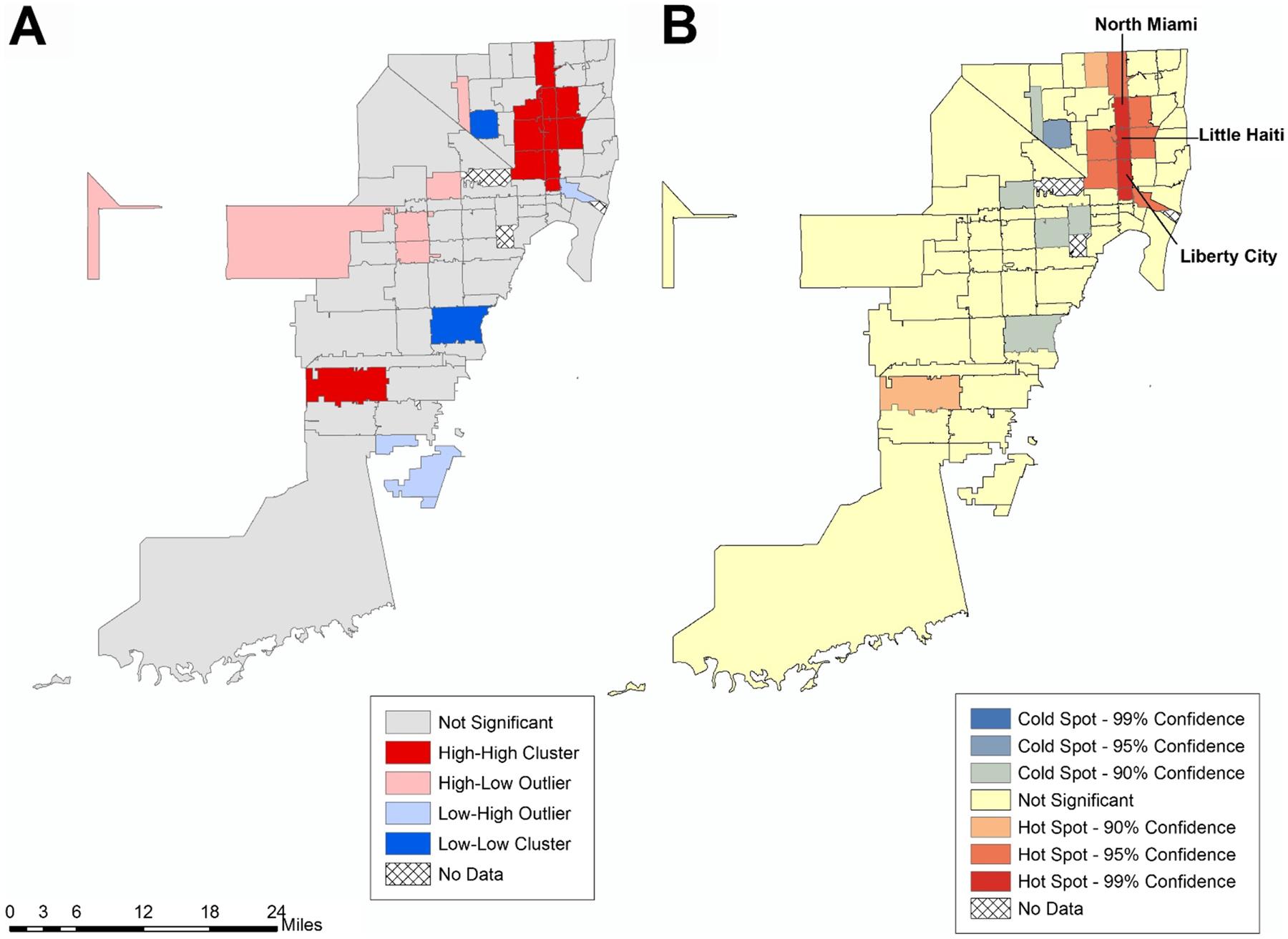
Using data from the Miami-Dade County Ryan White HIV/AIDS program, spatial autocorrelation of poor sustained viral suppression (at least 1 laboratory test ≥200 copies/ml in 2017) was investigated using Global Moran’s I followed by Local Moran’s I and Getis Ord Gi* statistics by ZIP code tabulation areas (ZCTAs). Subsequently, multivariable logistic regression analysis was conducted to identify factors associated with residing in geographic hotspots of poor sustained viral suppression.
Results:
Several ZCTAs in the northern part of the county, accounting for 1/3 of the Ryan White program clients, had significantly higher clustering of poor sustained viral suppression. Client-level sociodemographic characteristics such as race/ethnicity, age, and poverty, and neighborhood-level characteristics (socioeconomic disadvantage index, residential instability index, and racial/language homogeneity index) were significantly associated with living in a hotspot of poor sustained viral suppression.
Conclusion:
These findings highlight that spatial variation in sustained viral suppression exists within the county. Targeted strategies that address structural factors and the needs of people with HIV living in specified geographic areas may improve their HIV health outcomes, and contribute towards local, regional, and national goals of ending the HIV epidemic.
-
Keywords:
-
Source:J Racial Ethn Health Disparities. 10(1):357-366
-
Pubmed ID:35099764
-
Pubmed Central ID:PMC9339030
-
Document Type:
-
Funding:R01MD012421/MD/NIMHD NIH HHSUnited States/ ; U54MD012393/MD/NIMHD NIH HHSUnited States/ ; U54 MD012393/MD/NIMHD NIH HHSUnited States/ ; R01MD013563/MD/NIMHD NIH HHSUnited States/ ; R01 MH112406/MH/NIMH NIH HHSUnited States/ ; R01MD013554/MD/NIMHD NIH HHSUnited States/ ; F31MD015234/MD/NIMHD NIH HHSUnited States/ ; R01 MD012421/MD/NIMHD NIH HHSUnited States/ ; U01 PS005202/PS/NCHHSTP CDC HHSUnited States/ ; U01PS005202/CC/CDC HHSUnited States/ ; F31 MD015234/MD/NIMHD NIH HHSUnited States/ ; R01 MD013554/MD/NIMHD NIH HHSUnited States/ ; K01MD013770/MD/NIMHD NIH HHSUnited States/ ; R01 MD013563/MD/NIMHD NIH HHSUnited States/ ; K01 MD013770/MD/NIMHD NIH HHSUnited States/ ; R01MH112406/MH/NIMH NIH HHSUnited States/ ; T32 AI102623/AI/NIAID NIH HHSUnited States/
-
Volume:10
-
Issue:1
-
Collection(s):
-
Main Document Checksum:urn:sha256:d0568d4e973103b0c2a66cb0a8fee32937e1c4e00e6c542a5d76f06399b62b10
-
Download URL:
-
File Type:
 [PDF
- 554.09 KB
]
[PDF
- 554.09 KB
]
Supporting Files


File Language:
English
 Was this page helpful?
 Found an issue?
CDC STACKS serves as an archival repository of CDC-published products including
scientific findings,
journal articles, guidelines, recommendations, or other public health information authored or
co-authored by CDC or funded partners.
As a repository, CDC STACKS retains documents in their original published format to ensure public access to scientific information.
As a repository, CDC STACKS retains documents in their original published format to ensure public access to scientific information.
You May Also Like
COLLECTION
CDC Public Access