



Visual Representation of Work as a Social Determinant of Health: Augmenting Silver et al., Employment Status, Unemployment Duration, and Health-Related Metrics among US Adults of Prime Working Age
Supporting Files

-
2022/08/01
-
Available in CDC Stacks on August 01, 2023, 12:00 AM

File Language:
English
Details
-
Journal Article:American Journal of Industrial Medicine
-
Personal Author:
-
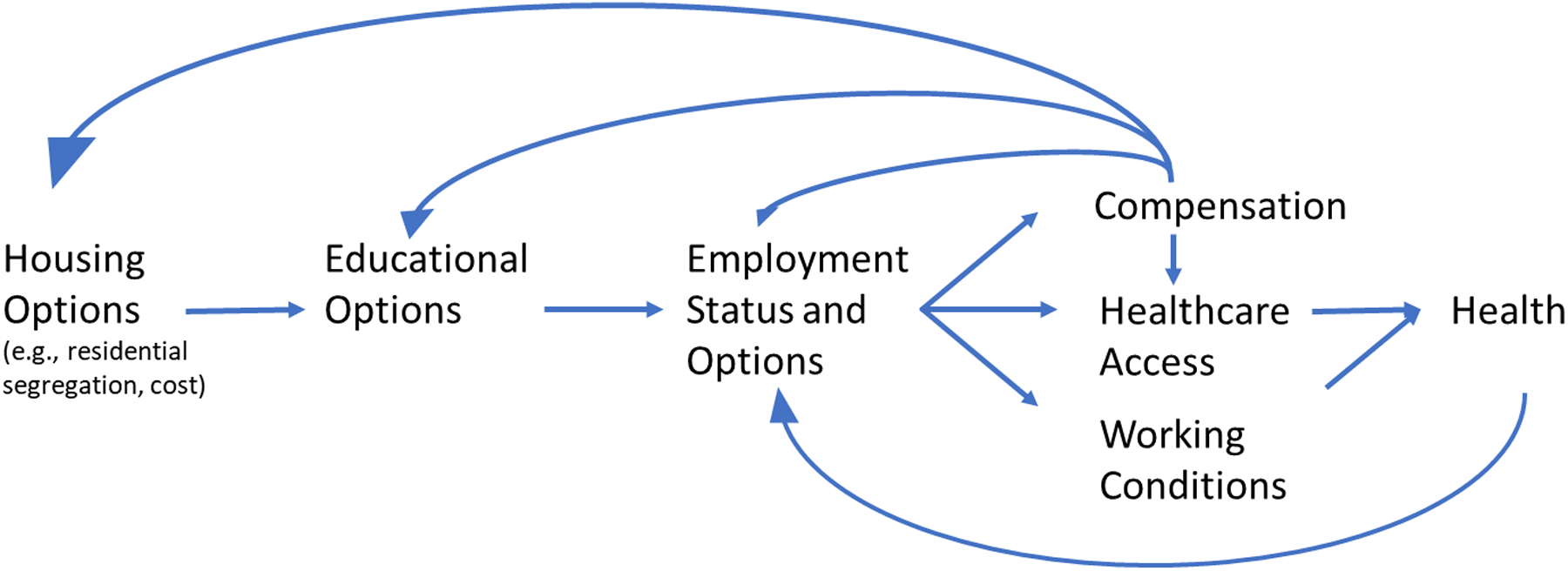
Description:To the Editor: We write to augment a discussion point from our article recently published in AJIM, "Employment Status, Unemployment Duration, and Health-Related Metrics among U.S. Adults of Prime Working Age: Behavioral Risk Factor Surveillance System, 2018-2019." In that discussion, we noted that "Decoupling these observed associations between unemployment and the elevated prevalence of multiple adverse health outcomes will require addressing 1) social and economic factors contributing to unemployment; 2) job and income insecurity; and 3) healthcare access, which in the U.S. is related to employment both directly (through employer-based coverage) and indirectly (through income)." We have developed a visual representation of selected pathways through which work functions as a key social determinant of health (SDOH) in the United States. While the article focused on employment status, SDOH such as housing and education often also constrain the type of work a person can obtain. For example, we noted that "residential segregation affects access to high-quality primary and secondary education, and thus higher education, which in turn influences employment options, and attendant wages and stability." In addition, employment status and type of work affect health conditions and outcomes both directly, through working conditions, and indirectly, through compensation (salary/wages, health insurance coverage, etc.). As shown, multiple feedback loops reinforce these relations. The diagram is high-level and not comprehensive: only selected SDOH are shown; many other inputs constraining education, housing, and employment choices (including other institutionalized modes of discrimination) are not shown; lesser directional indicators are omitted in the interest of legibility; and numerous pertinent characteristics of work are omitted. However, unlike most pictorial representations of SDOH, this diagram highlights the centrality of work as a SDOH and the mutually-reinforcing pathways that complicate the path to health equity. Description provided by NIOSH
-
Subjects:
-
Keywords:
-
Source:Am J Ind Med 2022 Aug; 65(8):697-698
-
ISSN:0271-3586
-
Pubmed ID:35612358
-
Pubmed Central ID:PMC9283259
-
Document Type:
-
Funding:
-
Genre:
-
Place as Subject:
-
CIO:
-
Division:
-
Topic:
-
Location:
-
Pages in Document:3 pdf pages
-
Volume:65
-
Issue:8
-
NIOSHTIC Number:nn:20065306
-
Contact Point Address:Sharon Silver, MS, MA, National Institute for Occupational Safetyand Health, Division of Field Studies and Engineering, MS R-17, 1150 Tusculum Ave. Cincinnati, OH 45226, USA
-
Email:ssilver@cdc.gov
-
Federal Fiscal Year:2022
-
Peer Reviewed:False
-
Download URL:
-
File Type:
 [PDF - 139.81 KB]
 -
Collection(s):
-
Main Document Checksum:urn:sha-512:0425449377a950eec24a9ac4c7d23796036882cb76ad941be6b6b4db82048bba61481daa2a197603a4e69b1f76f15b2a5a7d02aa7b2279872c9e6e1ec54af5e3
Supporting Files


File Language:
English
 Was this page helpful?
 Found an issue?

CDC STACKS serves as an archival repository of CDC-published products including
scientific findings, journal articles, guidelines, recommendations, or other public health information authored or
co-authored by CDC or funded partners.
As a repository, CDC STACKS retains documents in their original published format to ensure public access to scientific information.
As a repository, CDC STACKS retains documents in their original published format to ensure public access to scientific information.
You May Also Like