



The Micro-Randomized Trial for Developing Digital Interventions: Experimental Design and Data Analysis Considerations
Supporting Files

-
2022/10/01
-
Available in CDC Stacks on December 06, 2022, 12:00 AM
File Language:
English
Details
-
Alternative Title:Psychol Methods
-
Personal Author:
-
Description:Just-in-time adaptive interventions (JITAIs) are time-varying adaptive interventions that use frequent opportunities for the intervention to be adapted-weekly, daily, or even many times a day. The microrandomized trial (MRT) has emerged for use in informing the construction of JITAIs. MRTs can be used to address research questions about whether and under what circumstances JITAI components are effective, with the ultimate objective of developing effective and efficient JITAI. The purpose of this article is to clarify why, when, and how to use MRTs; to highlight elements that must be considered when designing and implementing an MRT; and to review primary and secondary analyses methods for MRTs. We briefly review key elements of JITAIs and discuss a variety of considerations that go into planning and designing an MRT. We provide a definition of causal excursion effects suitable for use in primary and secondary analyses of MRT data to inform JITAI development. We review the weighted and centered least-squares (WCLS) estimator which provides consistent causal excursion effect estimators from MRT data. We describe how the WCLS estimator along with associated test statistics can be obtained using standard statistical software such as R (R Core Team, 2019). Throughout we illustrate the MRT design and analyses using the HeartSteps MRT, for developing a JITAI to increase physical activity among sedentary individuals. We supplement the HeartSteps MRT with two other MRTs, SARA and BariFit, each of which highlights different research questions that can be addressed using the MRT and experimental design considerations that might arise. (PsycInfo Database Record (c) 2022 APA, all rights reserved).
-
Subjects:
-
Source:Psychol Methods. 27(5):874-894
-
Pubmed ID:35025583
-
Pubmed Central ID:PMC9276848
-
Document Type:
-
Funding:U54 EB020404/EB/NIBIB NIH HHSUnited States/ ; P50 DA039838/DA/NIDA NIH HHSUnited States/ ; R01 AA023187/AA/NIAAA NIH HHSUnited States/ ; P41 EB028242/EB/NIBIB NIH HHSUnited States/ ; R01 DA039901/DA/NIDA NIH HHSUnited States/ ; U01 CA229437/CA/NCI NIH HHSUnited States/ ; NH/NIH HHSUnited States/ ; PCORI/Patient-Centered Outcomes Research InstituteUnited States/ ; CC/CDC HHSUnited States/
-
Genre:
-
Volume:27
-
Issue:5
-
Download URL:
-
File Type:
 [PDF - 612.09 KB]
 -
Collection(s):
-
Main Document Checksum:urn:sha-512:1c66de033f418a4e89fbb87ac2d7a20027082632aef0ccabca5761ca5569a0c2c273144ed229a434f97a87cde779d6a95499f61375e04cb0db16f8e6faba0eae
Supporting Files


File Language:
English
 Was this page helpful?
 Found an issue?

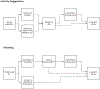

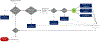
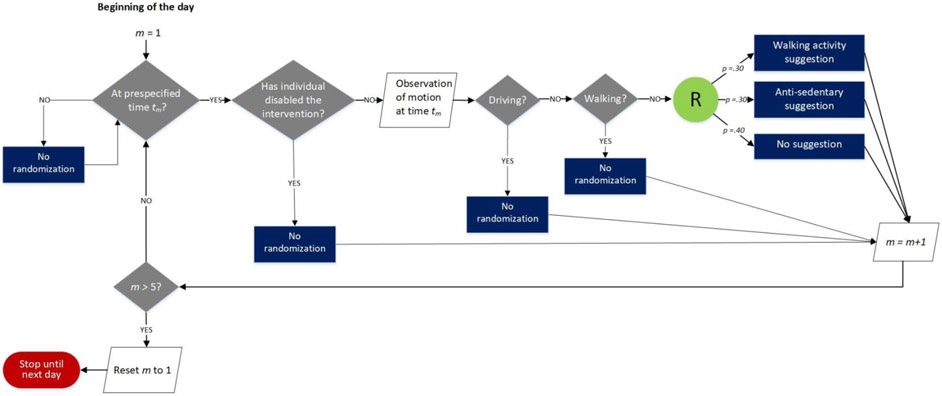
CDC STACKS serves as an archival repository of CDC-published products including
scientific findings, journal articles, guidelines, recommendations, or other public health information authored or
co-authored by CDC or funded partners.
As a repository, CDC STACKS retains documents in their original published format to ensure public access to scientific information.
As a repository, CDC STACKS retains documents in their original published format to ensure public access to scientific information.
You May Also Like
COLLECTION
CDC Public Access