



Intensity of end of life care for dual eligible beneficiaries with cancer and the impact of delivery system affiliation
Supporting Files

-
12 15 2021
-
Available in CDC Stacks on 2022-06-15T00:00:00Z
File Language:
English
Details
-
Alternative Title:Cancer
-
Personal Author:
-
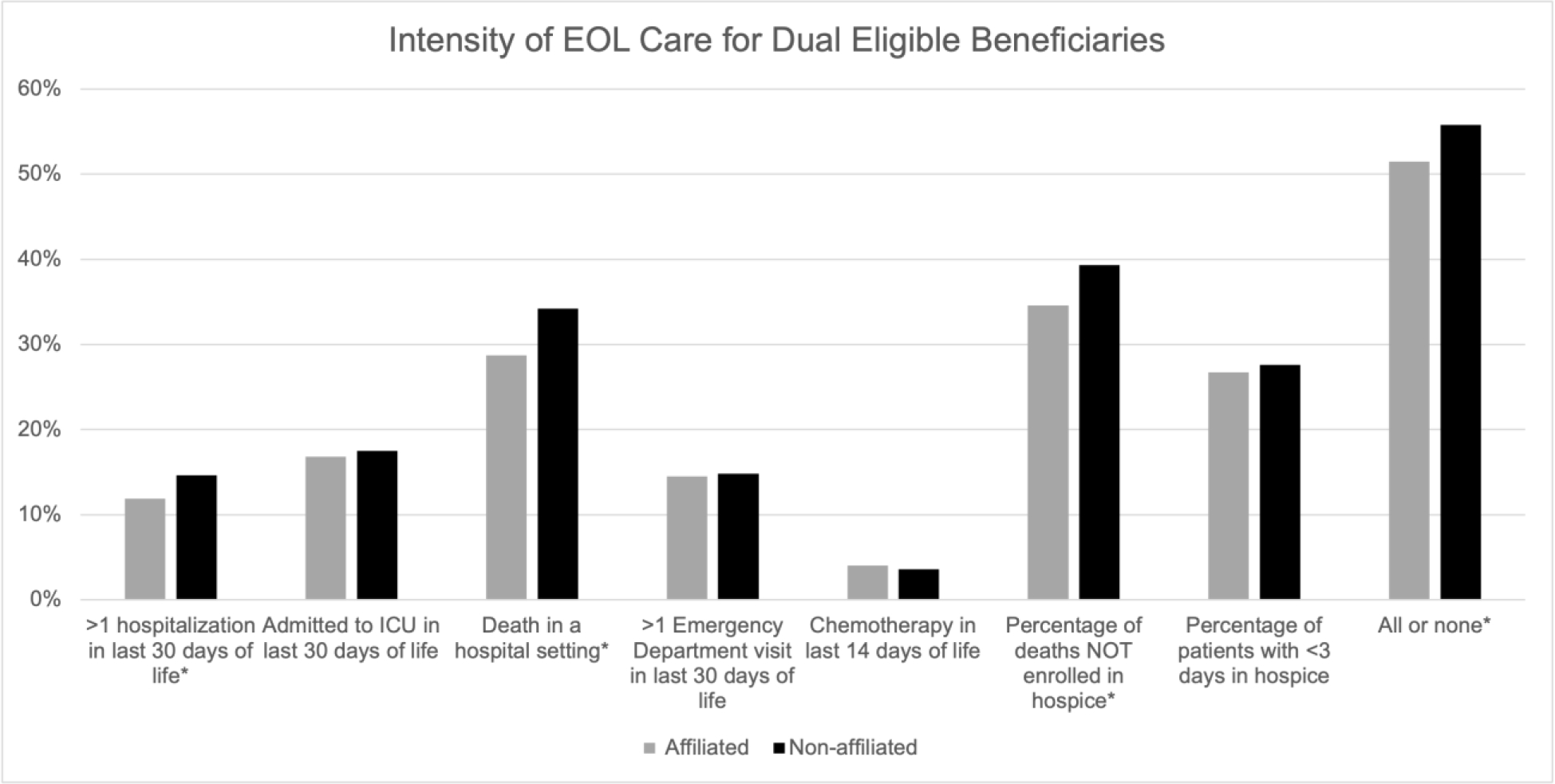
Description:Background: ; Dual eligible beneficiaries, who qualify for Medicare and Medicaid, are a vulnerable population with much to gain from efforts to improve quality. Integrated delivery networks (IDN) and cancer centers, with their emphasis on care coordination and communication, may improve quality of care for dual eligible patients with cancer at the end of life. ; Methods: ; We used Surveillance, Epidemiology and End Results registry data linked with Medicare claims to evaluate quality for beneficiaries who died from cancer and were diagnosed from 2009–2014. We evaluated high intensity care using seven end of life quality measures according to dual eligible status with multivariable logistic regression models. We used regression-based techniques to assess the effect of delivery system affiliation (i.e., cancer center or IDN versus no affiliation). ; Results: ; Among 100,549 beneficiaries who died during the study interval, 22% were dually eligible. We identified inferior outcomes for dual eligible beneficiaries compared to non-dual beneficiaries across nearly every quality measure assessed, including >1 hospitalization in last 30 days (12.6% vs 11.3%, p<0.001) and greater proportion of deaths occurring in a hospital setting (30.2% vs 26.2%, p<0.001). Receipt of care in an affiliated delivery system was associated with reduced deaths in a hospital setting and increased hospice utilization for dual eligible beneficiaries. ; Conclusions: ; Dual eligible status is associated with higher intensity care at the end of life. Delivery system affiliation has a modest impact on quality at the end of life, suggesting targeted efforts may be needed to optimize quality for this group of vulnerable patients.
-
Subjects:
-
Source:Cancer. 127(24):4628-4635
-
Pubmed ID:34428311
-
Pubmed Central ID:PMC9199351
-
Document Type:
-
Funding:HHSN261201000140C/CA/NCI NIH HHSUnited States/ ; P30 CA046592/CA/NCI NIH HHSUnited States/ ; R01CA174768/CA/NCI NIH HHSUnited States/ ; K08 CA237638/CA/NCI NIH HHSUnited States/ ; U58 DP003862/DP/NCCDPHP CDC HHSUnited States/ ; R01 CA174768/CA/NCI NIH HHSUnited States/ ; HHSN261201000035I/CA/NCI NIH HHSUnited States/ ; HHSN261201000035C/PC/NCI NIH HHSUnited States/ ; HHSN261201000034C/CA/NCI NIH HHSUnited States/
-
Place as Subject:
-
Volume:127
-
Issue:24
-
Download URL:
-
File Type:
 [PDF - 181.72 KB]
 -
Collection(s):
-
Main Document Checksum:urn:sha256:338dbc56e143522dcaa3037d9611d1a7a50299c6bacde81a5b0d3641f0800492
Supporting Files


File Language:
English
 Was this page helpful?
 Found an issue?

CDC STACKS serves as an archival repository of CDC-published products including
scientific findings, journal articles, guidelines, recommendations, or other public health information authored or
co-authored by CDC or funded partners.
As a repository, CDC STACKS retains documents in their original published format to ensure public access to scientific information.
As a repository, CDC STACKS retains documents in their original published format to ensure public access to scientific information.
You May Also Like
COLLECTION
CDC Public Access