



Work Around the Clock: How Work Hours Induce Social Jetlag and Sleep Deficiency
Supporting Files
Peer Reviewed

-
2022/06/01
-
Available in CDC Stacks on June 01, 2023, 12:00 AM
File Language:
English
Details
-
Journal Article:Clinics in Chest Medicine
-
Personal Author:
-
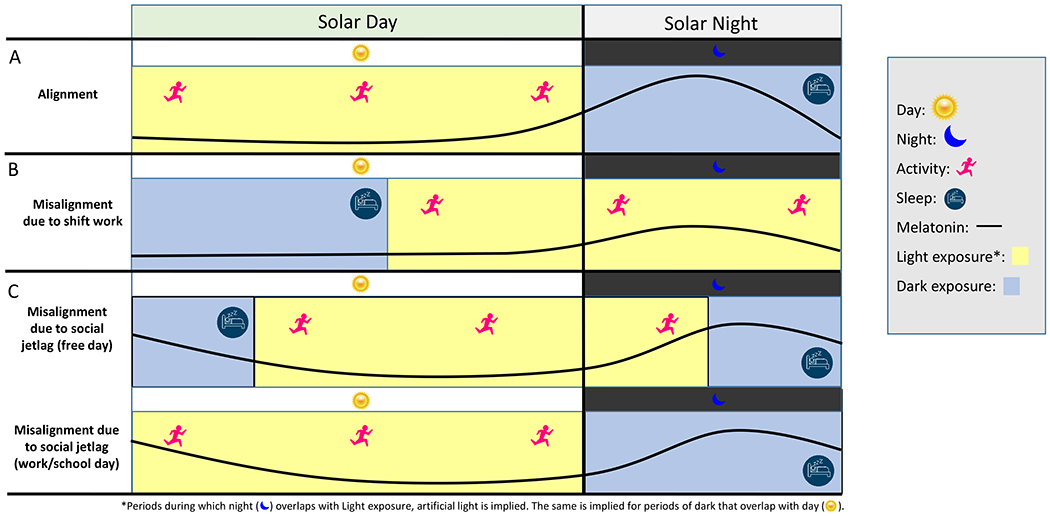
Description:As much as the understanding of human health and disease is predicated on behaviors and exposures during wakefulness, several decades of research have begun to uncover the importance of sleep and its impacts on physiology and pathology. From an evolutionary perspective, sleep places humans in a state of vulnerability, and yet this behavior is shared universally by mammals. However, it is now understood that sleep duration and timing are essential for optimal cognitive and physiologic functioning. Sleep and wakefulness are impacted by several external and internal factors, but none are more important than the endogenous circadian system. The term circadian is derived from Latin meaning "about a day" and the circadian "clock" is an endogenous, self-sustaining, biologic time-keeping system with a period of approximately 24 hours in humans. This system is extremely precise, with a standard deviation of 12 minutes within mice models and 8 minutes in humans, yet entrainable to external and behavioral stimuli known as "zeitgebers" (ie, time givers). Mechanistically, the precision of the circadian clock is established by a transcriptional autoregualtory loop that exists centrally within the suprachiasmatic nucleus of the hypothalamus, and in peripheral tissues. The suprachiasmatic nucleus further supports the system's pliability by modulating the pineal gland's secretion of the hormone melatonin in response to changes in light-timing exposure. Circadian "rhythms" are the physiologic outputs of the circadian clock, such as the circadian-based variations in hormone secretion, enzyme activity, and organ function, among others. In the laboratory, the circadian clock is measured via oscillations in these physiologic processes (ie, core body temperature, cortisol, or melatonin concentrations). Much of what is known about the circadian clock and its impacts on physiology has come from studies where the clock is desynchronized from confounding behaviors (ie, sleep, wakefulness, eating, and physical activity) and from external stimuli (eg, light exposure), which can influence physiologic rhythms. This desynchronization is also understood as circadian misalignment, a behavioral pattern in which sleep and activity occur during conflicting circadian phases (eg, sleeping during the day, eating and activity during the night). Circadian misalignment can also be observed naturally in individuals experiencing irregular sleep either resulting from endogenous factors, such as sleep disorders, or from exogenous factors, such as work and social schedules. We review the fundamental relationships between the circadian timing system and biologic processes, considering how common practices, such as shift work and variations in sleep timing on work/school versus work/school-free days (ie, social jetlag), disrupt circadian alignment and predispose individuals to cardiovascular, metabolic, and pulmonary disease. Description provided by NIOSH
-
Subjects:
-
Keywords:
- Total Worker Health; TWH; Sleep deprivation; Circadian rhythms; Cognitive function; Physiological effects; Shift workers; Chronic diseases; Metabolic effects; Mental health;
- Author Keywords: Shift work; Circadian misalignment; Chronic disease; Sleep hygiene; Sleep and circadian medicine; Chronotherapy
-
Source:Clin Chest Med 2022 Jun; 43(2):249-259
-
ISSN:0272-5231
-
Pubmed ID:35659023
-
Pubmed Central ID:PMC9172912
-
Document Type:
-
Funding:
-
Genre:
-
Place as Subject:
-
CIO:
-
Topic:
-
Location:
-
Pages in Document:20 pdf pages
-
Volume:43
-
Issue:2
-
NIOSHTIC Number:nn:20065756
-
Contact Point Address:Andrew W. McHill PhD, Sleep, Chronobiology, and Health Laboratory, School of Nursing, Oregon Health & Science University, 3455 SW US Veterans Hospital Road, Mailcode: SN-ORD, Portland, OR 97239
-
Email:mchill@ohsu.edu
-
Federal Fiscal Year:2022
-
Performing Organization:Oregon Health & Science University, Portland
-
Peer Reviewed:True
-
Download URL:
-
File Type:
 [PDF - 601.07 KB]
 -
Collection(s):
-
Main Document Checksum:urn:sha-512:b56e567d82ebf1443bc76ec1503c29950ccd9b0052c2cda6d7ef3d671a1d1f95a09fa36a521a7160097dae487a1a1b4cb779600a18a1f584f3aba94fc16549b0
Supporting Files


File Language:
English
 Was this page helpful?
 Found an issue?




CDC STACKS serves as an archival repository of CDC-published products including
scientific findings, journal articles, guidelines, recommendations, or other public health information authored or
co-authored by CDC or funded partners.
As a repository, CDC STACKS retains documents in their original published format to ensure public access to scientific information.
As a repository, CDC STACKS retains documents in their original published format to ensure public access to scientific information.
You May Also Like