



Interferon-Gamma Release Assays and Pediatric Public Health Tuberculosis Screening: The San Francisco Program Experience 2005 to 2008
Supporting Files

-
6 2016 ; 6-2016
-
Available in CDC Stacks on June 01, 2022, 12:00 AM
File Language:
English
Details
-
Alternative Title:J Pediatric Infect Dis Soc
-
Personal Author:
-
Description:Background.
Interferon-gamma release assay utilization in pediatric tuberculosis (TB) screening is limited by a paucity of longitudinal experience, particularly in low-TB burden populations.
Methods.
We conducted a retrospective review of QuantiFERON (QFT)-TB Gold results in San Francisco children from 2005 to 2008. Concordance with the tuberculin skin test (TST) was analyzed for a subset of children. Progression to active disease was determined through San Francisco and California TB registry matches.
Results.
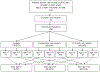
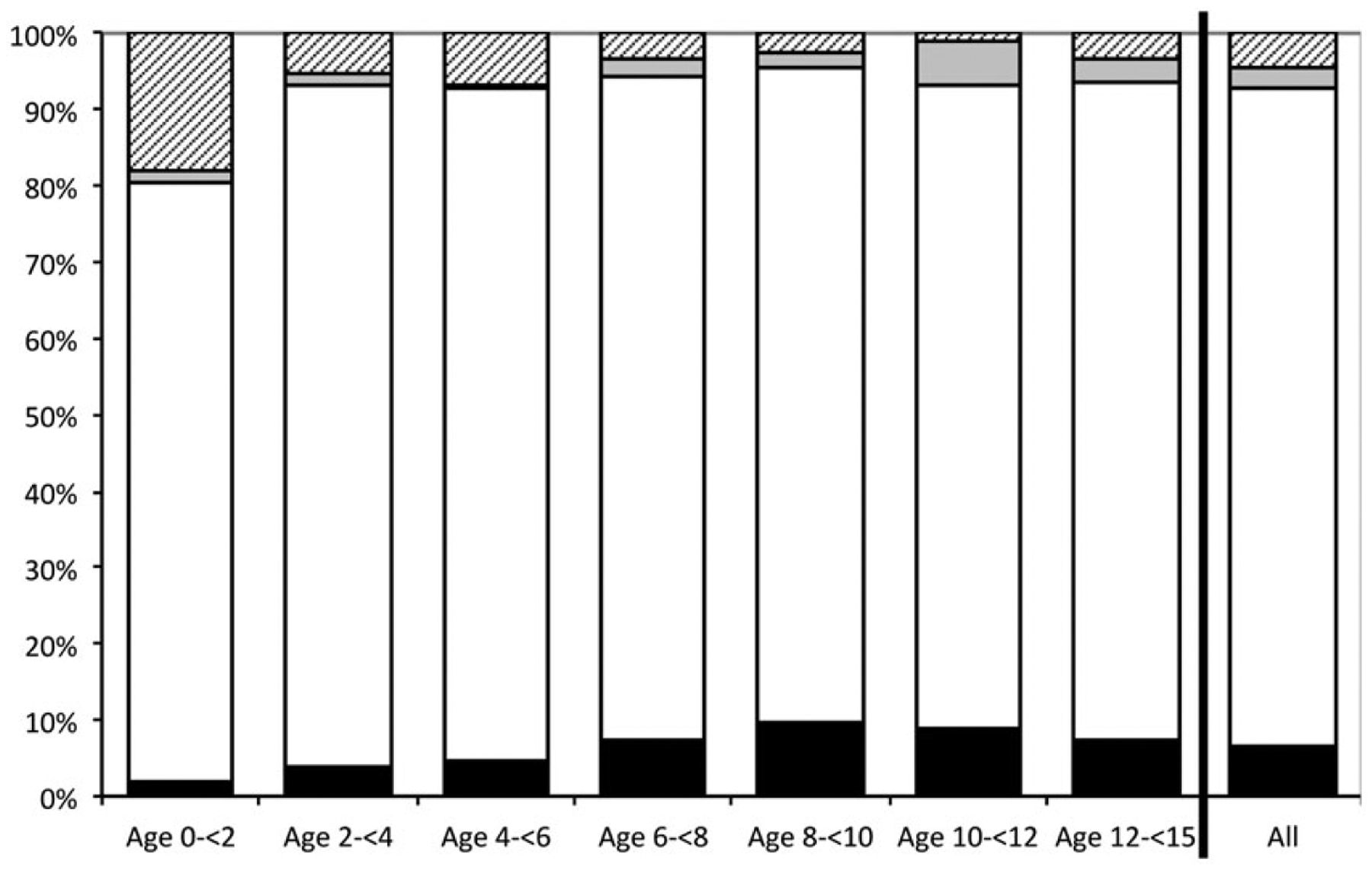
Of 1092 children <15 years of age, 853 (78%) were foreign-born, and 136 (12%) were exposed to active TB cases (contacts). QuantiFERON tests were positive in 72 of 1092 (7%) children; 15 of 136 (11%) recent contacts; 53 of 807 (7%) foreign-born noncontacts; and 4 of 149 (3%) US-born noncontacts. QuantiFERON-negative/TST-positive discordance was seen more often in foreign-born/bacille Calmette-Guerin (BCG)-vaccinated children <5 years of age (52 of 56, 93%) compared to those ≥ 5 years of age (90 of 123, 73%; P = .003). Foreign-born, BCG-vaccinated children were more than twice as likely to have a discordant (79%) result as US-born, non-BCG-vaccinated children (37%; P < .0001). During 5587 person-years of follow-up of untreated children, including 146 TST-positive/QFT-negative children, no cases of active TB were identified, consistent with a negative predictive value of 100%.
Conclusions.
Our experience supports the use of QFT to evaluate latent TB infection in children, particularly young BCG-vaccinated children. The proportion of QFT-positive results correlated with risk of exposure, and none of the untreated QFT-negative children developed TB. The low QFT-positive rate highlights the need for more selective testing based on current epidemiology and TB exposure risk. -
Subjects:
-
Keywords:
-
Source:J Pediatric Infect Dis Soc. 5(2):122-130
-
Pubmed ID:27199468
-
Pubmed Central ID:PMC9158372
-
Document Type:
-
Funding:
-
Volume:5
-
Issue:2
-
Download URL:
-
File Type:
 [PDF - 679.71 KB]
 -
Collection(s):
-
Main Document Checksum:urn:sha-512:1b67996d7984e17f034c92b373fad3c0a8195615409331124a58fc9f252c8398d1f5e3a18786c15cbd344d79ad2bfc22d457df313f1de3986bd3ff5cd3d69e96
Supporting Files


File Language:
English
 Was this page helpful?
 Found an issue?



CDC STACKS serves as an archival repository of CDC-published products including
scientific findings, journal articles, guidelines, recommendations, or other public health information authored or
co-authored by CDC or funded partners.
As a repository, CDC STACKS retains documents in their original published format to ensure public access to scientific information.
As a repository, CDC STACKS retains documents in their original published format to ensure public access to scientific information.
You May Also Like
COLLECTION
CDC Public Access