


Evaluation of percentage-based radon testing requirements for federally funded multi-family housing projects
Supporting Files

-
4 2019
File Language:
English
Details
-
Alternative Title:J Occup Environ Hyg
-
Personal Author:
-
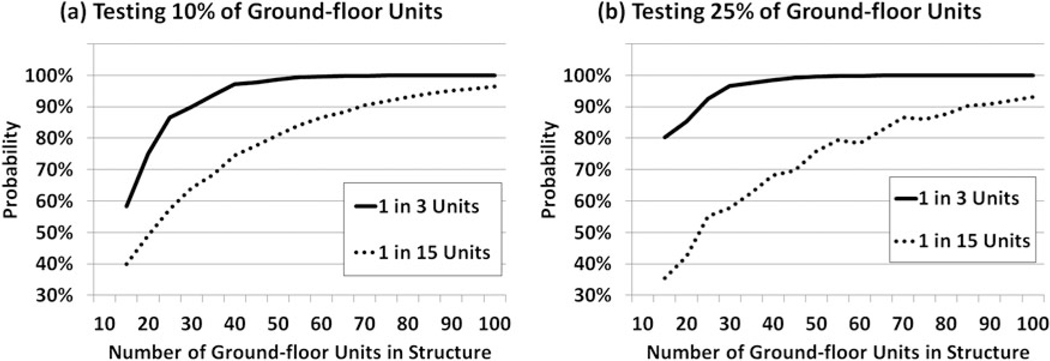
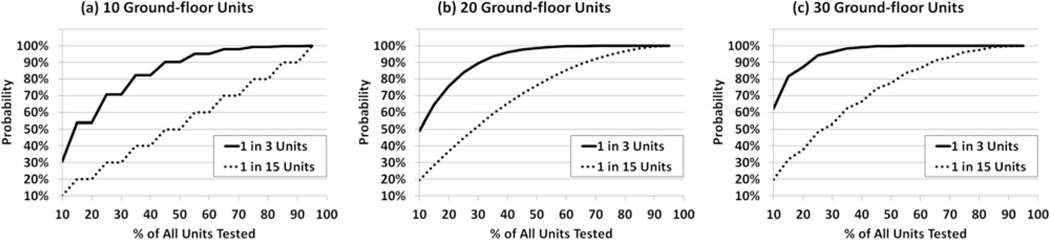
Description:Radon is a leading cause of lung cancer. Recommendations for radon testing in multi-family housing focus on testing a percentage of all units. There is considerable variability among recommendations as well as their implementation. I used the hypergeometric distribution to determine the probability of identifying one or more units with radon at or above 4.0 pCi/L for two prevalences (1:15, the U.S. average) and 1:3 (for states with many homes with radon ≥4.0 pCi/L) using two approaches. First, the distribution was used to evaluate the probability of finding one or more units with radon at or above 4.0 pCi/L when: (1) testing 10% or 25% of a range of ground-floor units; or (2) testing a varying percentage of units in 10-, 20-, or 30- ground-floor unit buildings. Second, the method was used to determine the number of units to be tested to identify one or more units with radon at or above 4.0 pCi/L with 95% probability, given a range of total ground-floor units. Analyses identified that testing 10% or 25% of ground-floor units had low probability of identifying at least one unit with radon at or above 4.0 pCi/L, especially at low prevalence. At low prevalence (1:15), at least 10 units need to be tested in structures with 20 or fewer total units; at high prevalence (1:3), at least 5 units need to be tested in units with structures having 10 or fewer units to achieve 95% probability of identifying at least one unit with radon at or above 4.0 pCi/L. These findings indicate that recommendations for radon testing in multi-family housing may be improved by applying a well-established and more rigorous statistical approach than percentage-based testing to more accurately characterize exposure to radon in multi-family housing units, which could improve lung cancer prevention efforts.
-
Subjects:
-
Source:J Occup Environ Hyg. 16(4):302-307
-
Pubmed ID:30620246
-
Pubmed Central ID:PMC9153856
-
Document Type:
-
Funding:
-
Place as Subject:
-
Volume:16
-
Issue:4
-
Collection(s):
-
Main Document Checksum:urn:sha256:449e071c292021391a66c7beaa3c132c6e4d898b64ea83cbe93cf562e73a88b8
-
Download URL:
-
File Type:
 [PDF
- 673.16 KB
]
[PDF
- 673.16 KB
]
Supporting Files


File Language:
English
ON THIS PAGE

CDC STACKS serves as an archival repository of CDC-published products including
scientific findings,
journal articles, guidelines, recommendations, or other public health information authored or
co-authored by CDC or funded partners.
As a repository, CDC STACKS retains documents in their original published format to ensure public access to scientific information.
As a repository, CDC STACKS retains documents in their original published format to ensure public access to scientific information.
You May Also Like
COLLECTION
CDC Public Access