



COVID-19 Vaccination Coverage, by Race and Ethnicity — National Immunization Survey Adult COVID Module, United States, December 2020–November 2021
Supporting Files
Public Domain

-
6 10 2022
File Language:
English
Details
-
Journal Article:Morbidity and Mortality Weekly Report (MMWR)
-
Personal Author:Kriss, Jennifer L. ; Hung, Mei-Chuan ; Srivastav, Anup ; Black, Carla L. ; Lindley, Megan C. ; Lee, James T. ; Koppaka, Ram ; Tsai, Yuping ; Lu, Peng-Jun ; Yankey, David ; Elam-Evans, Laurie D. ; Singleton, James A.
-
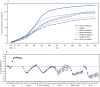
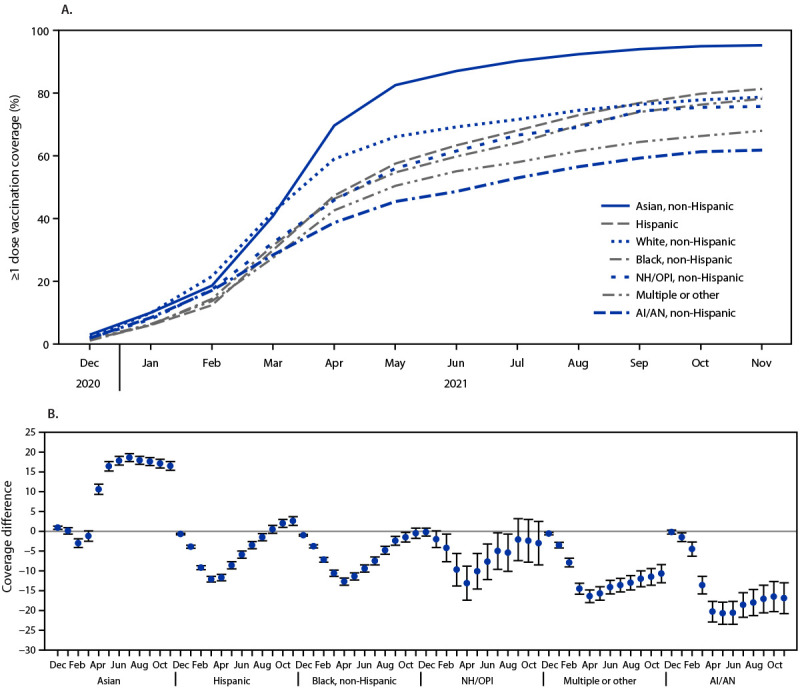
Description:Some racial and ethnic minority groups have experienced disproportionately higher rates of COVID-19-related illness and Mortality (1,2). Vaccination is highly effective in preventing severe COVID-19 illness and death (3), and equitable vaccination can reduce COVID-19-related disparities. CDC analyzed data from the National Immunization Survey Adult COVID Module (NIS-ACM), a random-digit-dialed cellular telephone survey of adults aged ≥18 years, to assess disparities in COVID-19 vaccination coverage by race and ethnicity among U.S. adults during December 2020-November 2021. Asian and non-Hispanic White (White) adults had the highest ≥1-dose COVID-19 vaccination coverage by the end of April 2021 (69.6% and 59.0%, respectively); ≥1-dose coverage was lower among Hispanic (47.3%), non-Hispanic Black or African American (Black) (46.3%), Native Hawaiian or other Pacific Islander (NH/OPI) (45.9%), multiple or other race (42.6%), and American Indian or Alaska Native (AI/AN) (38.7%) adults. By the end of November 2021, national ≥1-dose COVID-19 vaccination coverage was similar for Black (78.2%), Hispanic (81.3%), NH/OPI (75.7%), and White adults (78.7%); however, coverage remained lower for AI/AN (61.8%) and multiple or other race (68.0%) adults. Booster doses of COVID-19 vaccine are now recommended for all adults (4), but disparities in booster dose coverage among the fully vaccinated have become apparent (5). Tailored efforts including community partnerships and trusted sources of information could be used to increase vaccination coverage among the groups with identified persistent disparities and can help achieve vaccination equity and prevent new disparities by race and ethnicity in booster dose coverage.
-
Subjects:
-
Source:MMWR Morbidity Mortal Weekly Rep. 71(23):757-763
-
Series:
-
DOI:
-
ISSN:0149-2195 (print) ; 1545-861X (digital)
-
Pubmed ID:35679179
-
Pubmed Central ID:PMC9181054
-
Document Type:
-
Place as Subject:
-
Pages in Document:7 pdf pages
-
Volume:71
-
Issue:23
-
Download URL:
-
File Type:
 [PDF - 171.42 KB]
 -
Collection(s):
-
Main Document Checksum:urn:sha-512:e0729753b56e0aae2e50526c9d25dfcfa1ca89a20dc4a3cd5ec9f8c2e33d6ace0b43fdcf8ff71dcd182318ee82cbdc4c2dc6daf51421e90ed07ea48fa12992b5
Supporting Files


File Language:
English
 Was this page helpful?
 Found an issue?

CDC STACKS serves as an archival repository of CDC-published products including
scientific findings, journal articles, guidelines, recommendations, or other public health information authored or
co-authored by CDC or funded partners.
As a repository, CDC STACKS retains documents in their original published format to ensure public access to scientific information.
As a repository, CDC STACKS retains documents in their original published format to ensure public access to scientific information.
You May Also Like
COLLECTION
Morbidity and Mortality Weekly Report (MMWR)