



Hospitalization of Infants and Children Aged 0–4 Years with Laboratory-Confirmed COVID-19 — COVID-NET, 14 States, March 2020–February 2022
Supporting Files
Public Domain

-
3 18 2022
File Language:
English
Details
-
Journal Article:Morbidity and Mortality Weekly Report (MMWR)
-
Personal Author:Marks, Kristin J. ; Whitaker, Michael ; Agathis, Nickolas T. ; Anglin, Onika ; Milucky, Jennifer ; Patel, Kadam ; Pham, Huong ; Kirley, Pam Daily ; Kawasaki, Breanna ; Meek, James ; Anderson, Evan J. ; Weigel, Andy ; Kim, Sue ; Lynfield, Ruth ; Ropp, Susan L. ; Spina, Nancy L. ; Bennett, Nancy M. ; Shiltz, Eli ; Sutton, Melissa ; Talbot, H. Keipp ; Price, Andrea ; Taylor, Christopher A. ; Havers, Fiona P. ; Roland, Jeremy ; Surgnier, Jordan ; Lyons, Carol ; Openo, Kyle ; Teno, Kenzie ; Kohrman, Alexander ; Bye, Erica ; Cline, Cory ; Muse, Alison ; Cafferky, Virginia ; Billing, Laurie ; Abdullah, Nasreen ; Schaffner, William ; McCaffrey, Keegan
-
Corporate Authors:
-
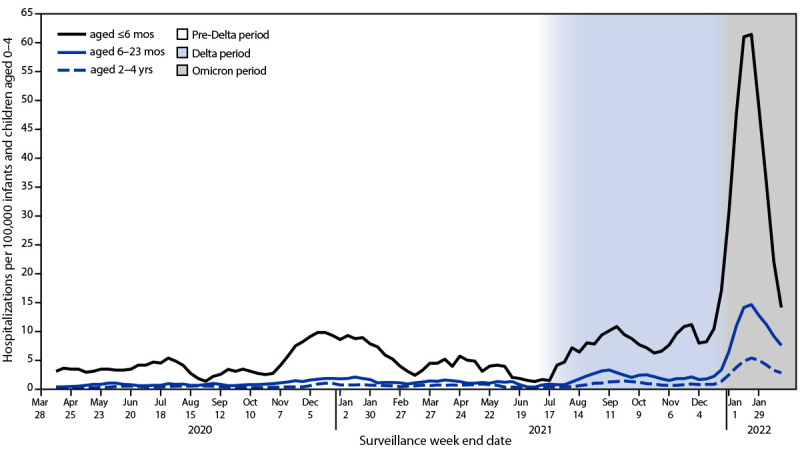
Description:The B.1.1.529 (Omicron) Variants of SARS-CoV-2, the Virus that causes COVID-19, has been the predominant circulating Variants in the U.S. since late December 2021.* Coinciding with increased Omicron circulation, COVID-19-associated hospitalization rates increased rapidly among infants and children aged 0-4 years, a group not yet eligible for vaccination (1). CoronaVirus Disease 19-Associated Hospitalization Surveillance Network (COVID-NET)| data were analyzed to describe COVID-19-associated hospitalizations among U.S. infants and children aged 0-4 years since March 2020. During the period of Omicron predominance (December 19, 2021-February 19, 2022), weekly COVID-19-associated hospitalization rates per 100,000 infants and children aged 0-4 years peaked at 14.5 (week ending January 8, 2022); this Omicron-predominant period peak was approximately five times that during the period of SARS-CoV-2 B.1.617.2 (Delta) predominance (June 27-December 18, 2021, which peaked the week ending September 11, 2021).| During Omicron predominance, 63% of hospitalized infants and children had no underlying medical conditions; infants aged <6 months accounted for 44% of hospitalizations, although no differences were observed in indicators of severity by age. Strategies to prevent COVID-19 among infants and young children are important and include vaccination among currently eligible populations (2) such as pregnant women (3), family members, and caregivers of infants and young children (4).
-
Subjects:
-
Source:MMWR Morbidity Mortal Weekly Rep. 71(11):429-436
-
Series:
-
DOI:
-
ISSN:0149-2195 (print) ; 1545-861X (digital)
-
Pubmed ID:35298458
-
Pubmed Central ID:PMC8942304
-
Document Type:
-
Place as Subject:
-
Pages in Document:8 pdf pages
-
Volume:71
-
Issue:11
-
Download URL:
-
File Type:
 [PDF - 184.02 KB]
 -
Collection(s):
-
Main Document Checksum:urn:sha-512:ce7012f792aa686423eb499a63f3b9f573f295c4fc288cf21ebafaf38425af84ca553147850686dc5f45d8174f37b4a9ac665aafe969665daa4b9a424c34762c
Supporting Files


File Language:
English
 Was this page helpful?
 Found an issue?


CDC STACKS serves as an archival repository of CDC-published products including
scientific findings, journal articles, guidelines, recommendations, or other public health information authored or
co-authored by CDC or funded partners.
As a repository, CDC STACKS retains documents in their original published format to ensure public access to scientific information.
As a repository, CDC STACKS retains documents in their original published format to ensure public access to scientific information.
You May Also Like
COLLECTION
Morbidity and Mortality Weekly Report (MMWR)