



SARS-CoV-2 B.1.1.529 (Omicron) Variant Transmission Within Households — Four U.S. Jurisdictions, November 2021–February 2022
Supporting Files
Public Domain

-
3 04 2022
File Language:
English
Details
-
Journal Article:Morbidity and Mortality Weekly Report (MMWR)
-
Personal Author:Baker, Julia M. ; Nakayama, Jasmine Y. ; O’Hegarty, Michelle ; McGowan, Andrea ; Teran, Richard A. ; Bart, Stephen M. ; Mosack, Katie ; Roberts, Nicole ; Campos, Brooke ; Paegle, Alina ; McGee, John ; Herrera, Robert ; English, Kayla ; Barrios, Carla ; Davis, Alexandria ; Roloff, Christine ; Sosa, Lynn E. ; Brockmeyer, Jessica ; Page, Lindsey ; Bauer, Amy ; Weiner, Joshua J. ; Khubbar, Manjeet ; Bhattacharyya, Sanjib ; Kirking, Hannah L. ; Tate, Jacqueline E.
-
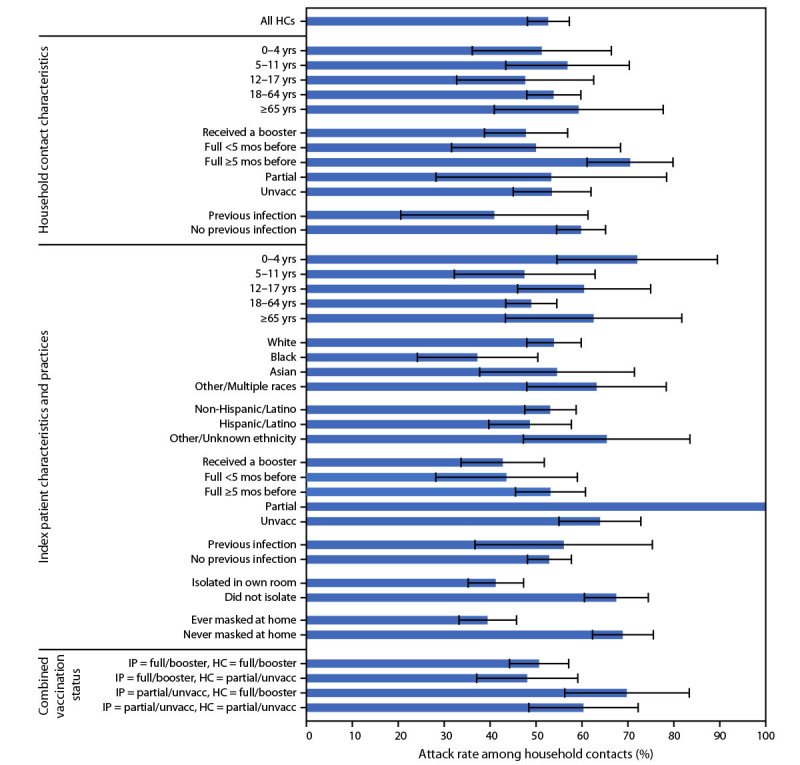
Description:The B.1.1.529 (Omicron) Variants, first detected in November 2021, was responsible for a surge in U.S. infections with SARS-CoV-2, the Virus that causes COVID-19, during December 2021-January 2022 (1). To investigate the effectiveness of Prevention strategies in household settings, CDC partnered with four U.S. jurisdictions to describe Omicron household Transmission during November 2021-February 2022. Persons with sequence-confirmed Omicron infection and their household contacts were interviewed. Omicron Transmission occurred in 124 (67.8%) of 183 households. Among 431 household contacts, 227 were classified as having a case of COVID-19 (attack rate AR = 52.7%).| The ARs among household contacts of index patients who had received a COVID-19 booster dose, of fully vaccinated index patients who completed their COVID-19 primary series within the previous 5 months, and of unvaccinated index patients were 42.7% (47 of 110), 43.6% (17 of 39), and 63.9% (69 of 108), respectively. The AR was lower among household contacts of index patients who isolated (41.2%, 99 of 240) compared with those of index patients who did not isolate (67.5%, 112 of 166) (p-value <0.01). Similarly, the AR was lower among household contacts of index patients who ever wore a mask at home during their potentially infectious period (39.5%, 88 of 223) compared with those of index patients who never wore a mask at home (68.9%, 124 of 180) (p-value <0.01). Multicomponent COVID-19 Prevention strategies, including up-to-date vaccination, isolation of infected persons, and mask use at home, are critical to reducing Omicron Transmission in household settings.
-
Subjects:
-
Source:MMWR Morbidity Mortal Weekly Rep. 71(9):341-346
-
Series:
-
DOI:
-
ISSN:0149-2195 (print) ; 1545-861X (digital)
-
Pubmed ID:35238860
-
Pubmed Central ID:PMC8893332
-
Document Type:
-
Place as Subject:
-
Pages in Document:6 pdf pages
-
Volume:71
-
Issue:9
-
Download URL:
-
File Type:
 [PDF - 166.18 KB]
 -
Collection(s):
-
Main Document Checksum:urn:sha-512:4a3f9297abf9251a272fd1d4f8847dc42a484f57f86d3d0f01c49d03c060269bb3d3660e2f091038b4215118bcff60f56ef6627fb91c9b96d1a31363e255993f
Supporting Files


File Language:
English
 Was this page helpful?
 Found an issue?

CDC STACKS serves as an archival repository of CDC-published products including
scientific findings, journal articles, guidelines, recommendations, or other public health information authored or
co-authored by CDC or funded partners.
As a repository, CDC STACKS retains documents in their original published format to ensure public access to scientific information.
As a repository, CDC STACKS retains documents in their original published format to ensure public access to scientific information.
You May Also Like
COLLECTION
Morbidity and Mortality Weekly Report (MMWR)