



Azithromycin and Ciprofloxacin Treatment Outcomes During an Outbreak of Multidrug-Resistant Shigella sonnei Infections in a Retirement Community—Vermont, 2018
Supporting Files

-
2 11 2022 ; 2-11-
-
Available in CDC Stacks on 2023-02-11T00:00:00Z
File Language:
English
Details
-
Alternative Title:Clin Infect Dis
-
Personal Author:Gharpure, Radhika
 ;
Friedman, Cindy R.
;
Fialkowski, Veronica
;
Collins, Jennifer P.
;
Strysko, Jonathan
;
Marsh, Zachary A.
;
Chen, Jessica C.
;
Meservey, Elizabeth H.
;
Adediran, Azizat A.
;
Schroeder, Morgan N.
;
Wadhwa, Ashutosh
;
Fullerton, Kathleen E.
;
Francois Watkins, Louise
;
Friedman, Cindy R.
;
Fialkowski, Veronica
;
Collins, Jennifer P.
;
Strysko, Jonathan
;
Marsh, Zachary A.
;
Chen, Jessica C.
;
Meservey, Elizabeth H.
;
Adediran, Azizat A.
;
Schroeder, Morgan N.
;
Wadhwa, Ashutosh
;
Fullerton, Kathleen E.
;
Francois Watkins, Louise
-
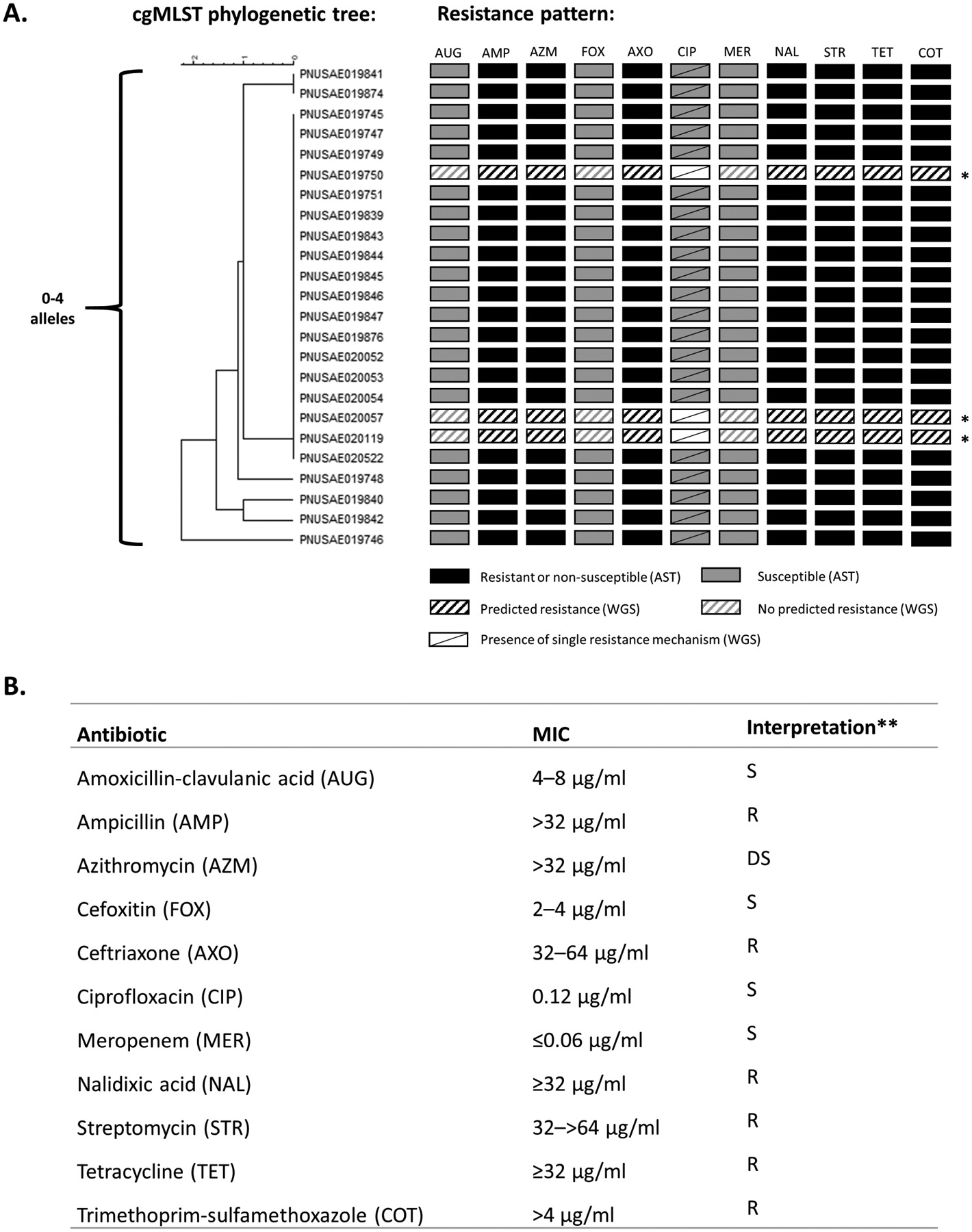
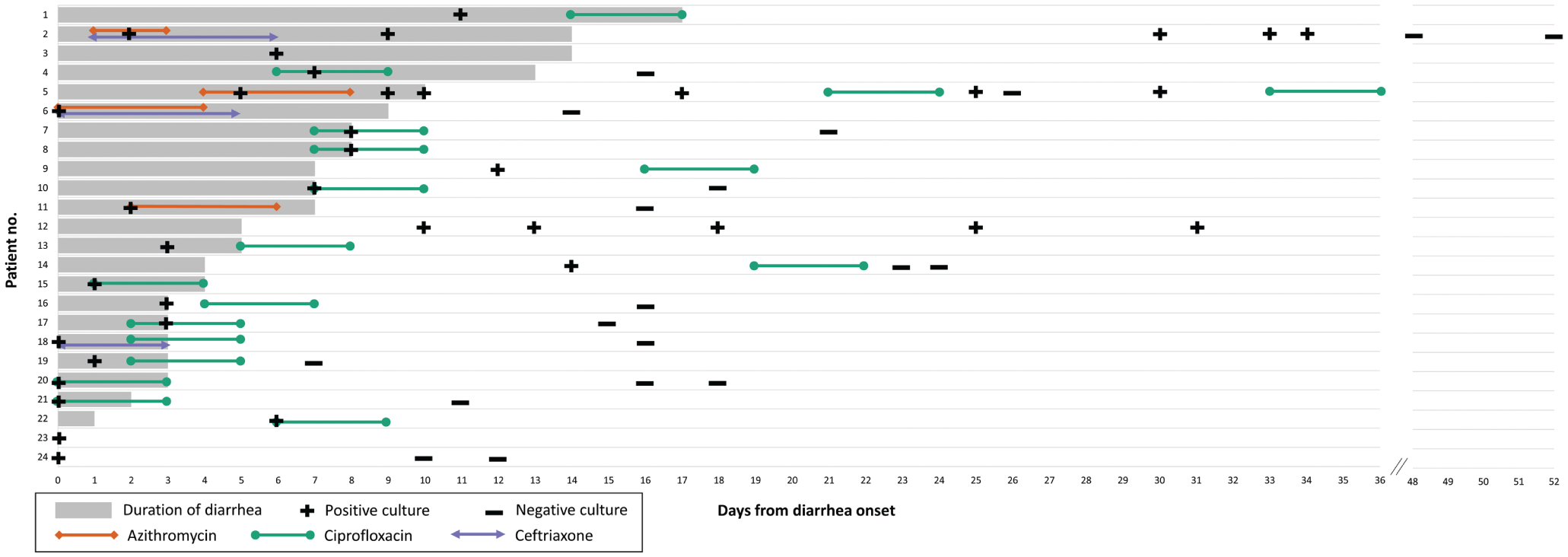
Description:Background. ; In 2018, the Centers for Disease Control and Prevention and the Vermont Department of Health investigated an outbreak of multidrug-resistant Shigella sonnei infections in a retirement community that offered a continuum of care from independent living through skilled nursing care. The investigation identified 24 culture-confirmed cases. Isolates were resistant to trimethoprim-sulfamethoxazole, ampicillin, and ceftriaxone, and had decreased susceptibility to azithromycin and ciprofloxacin. ; Methods. ; To evaluate clinical and microbiologic response, we reviewed inpatient and outpatient medical records for treatment outcomes among the 24 patients with culture-confirmed S. sonnei infection. We defined clinical failure as diarrhea (≥3 loose stools per day) for ≥1 day after treatment finished, and microbiologic failure as a stool culture that yielded S. sonnei after treatment finished. We used broth microdilution to perform antimicrobial susceptibility testing, and whole genome sequencing to identify resistance mechanisms. ; Results. ; Isolates contained macrolide resistance genes mph(A) and erm(B) and had azithromycin minimum inhibitory concentrations above the Clinical and Laboratory Standards Institute epidemiological cutoff value of ≤16 μg/mL. Among 24 patients with culture-confirmed Shigella infection, 4 were treated with azithromycin; all had clinical treatment failure and 2 also had microbiologic treatment failure. Isolates were susceptible to ciprofloxacin but contained a gyrA mutation; 2 patients failed treatment with ciprofloxacin. ; Conclusions. ; These azithromycin treatment failures demonstrate the importance of clinical breakpoints to aid clinicians in identifying alternative treatment options for resistant strains. Additionally, these treatment failures highlight a need for comprehensive susceptibility testing and systematic outcome studies, particularly given the emergence of multidrug-resistant Shigella among an expanding range of patient populations.
-
Subjects:
-
Keywords:
-
Source:Clin Infect Dis. 74(3):455-460
-
Pubmed ID:33993224
-
Pubmed Central ID:PMC8963682
-
Document Type:
-
Funding:
-
Volume:74
-
Issue:3
-
Download URL:
-
File Type:
 [PDF - 440.90 KB]
 -
Collection(s):
-
Main Document Checksum:urn:sha-512:a6a1b574cd59fda2bcf37760115fb52906e106496b2758852d58446255b5c9a55641ef4176a6012f9da44024d0779e2908768bd5265f5a126abc2d69a1601593
Supporting Files


File Language:
English
 Was this page helpful?
 Found an issue?


CDC STACKS serves as an archival repository of CDC-published products including
scientific findings, journal articles, guidelines, recommendations, or other public health information authored or
co-authored by CDC or funded partners.
As a repository, CDC STACKS retains documents in their original published format to ensure public access to scientific information.
As a repository, CDC STACKS retains documents in their original published format to ensure public access to scientific information.
You May Also Like
COLLECTION
CDC Public Access