


The occupational health effects of responding to a natural gas pipeline explosion among emergency first responders — Lincoln County, Kentucky, 2019
Supporting Files

-
10 2022
-
File Language:
English
Details
-
Alternative Title:Disaster Med Public Health Prep
-
Personal Author:
-
Description:Objective:
Assess occupational health effects one month after responding to a natural gas pipeline explosion.
Methods:
First responders to a pipeline explosion in Kentucky were interviewed about pre- and post-response health symptoms, post-response healthcare, and physical exertion and personal protective equipment (PPE) use during the response. Logistic regression was used to examine associations between several risk factors and development of post-response symptoms.
Results:
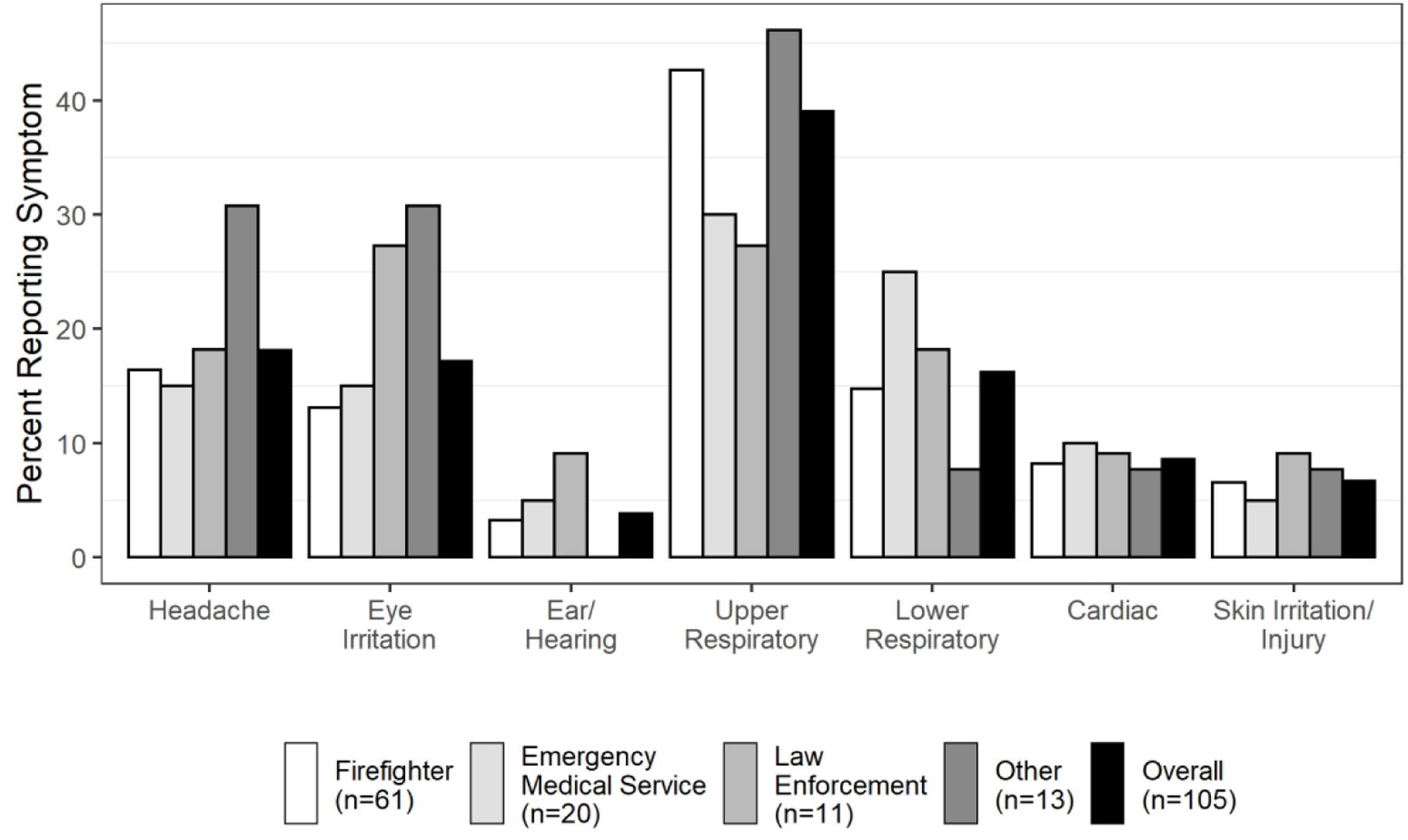
Among 173 first responders involved, 105 (firefighters [58%], emergency medical services [19%], law enforcement [10%], and others [12%]) were interviewed. Half (53%) reported at least one new or worsening symptom, including upper respiratory symptoms (39%), headache (18%), eye irritation (17%), and lower respiratory symptoms (16%). The majority (79%) of symptomatic responders did not seek post-response care. Compared with light-exertion responders, hard-exertion responders (48%) had significantly greater odds of upper respiratory symptoms (aOR: 2.99, 95% CI: 1.25–7.50). Forty-four percent of responders and 77% of non-firefighter responders reported not using any PPE.
Conclusions:
Upper respiratory symptoms were common among first responders of a natural gas pipeline explosion, and associated with hard-exertion activity. Emergency managers should ensure responders are trained in, equipped with, and properly use PPE during these incidents and encourage responders to seek post-response healthcare when needed.
-
Subjects:
-
Source:Disaster Med Public Health Prep. 16(5):1997-2004
-
Pubmed ID:34544524
-
Pubmed Central ID:PMC8934741
-
Document Type:
-
Funding:
-
Place as Subject:
-
Volume:16
-
Issue:5
-
Collection(s):
-
Main Document Checksum:urn:sha256:ba55d960df9efb9453f83bf9940623eea8c461eb074d90c85e6cb4cab88b1312
-
Download URL:
-
File Type:
 [PDF
- 258.02 KB
]
[PDF
- 258.02 KB
]
Supporting Files


File Language:
English
ON THIS PAGE

CDC STACKS serves as an archival repository of CDC-published products including
scientific findings,
journal articles, guidelines, recommendations, or other public health information authored or
co-authored by CDC or funded partners.
As a repository, CDC STACKS retains documents in their original published format to ensure public access to scientific information.
As a repository, CDC STACKS retains documents in their original published format to ensure public access to scientific information.
You May Also Like
COLLECTION
CDC Public Access