


Prenatal Exposure to a Mixture of Organochlorines and Metals and Internalizing Symptoms in Childhood and Adolescence
Supporting Files

-
2022/05/15
-

File Language:
English
Details
-
Journal Article:Environmental Research
-
Personal Author:
-
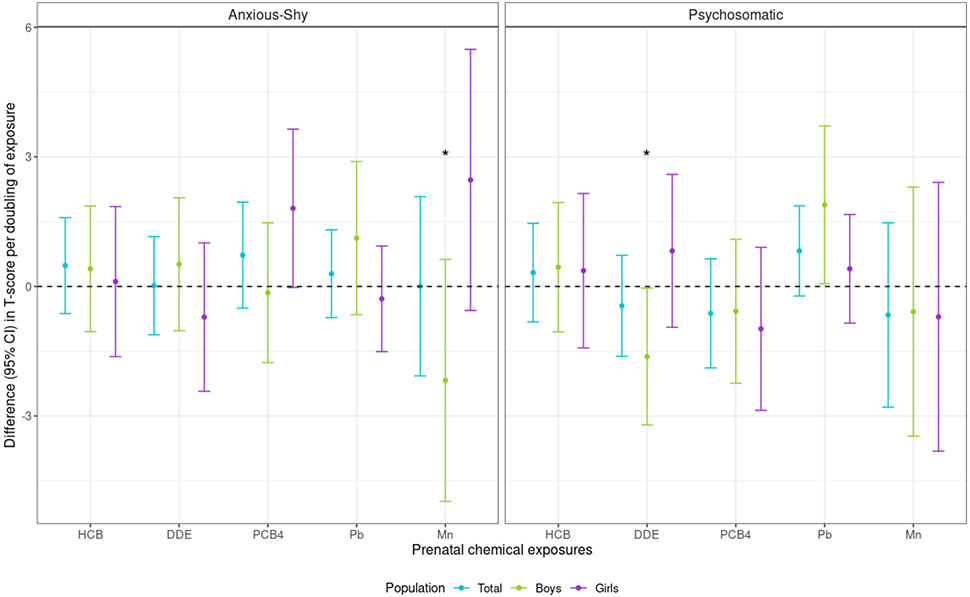
Description:Background: Although prenatal chemical exposures influence neurobehavior, joint exposures are not well explored as risk factors for internalizing disorders through adolescence. Objective: To evaluate associations of prenatal organochlorine and metal exposures, considered individually and as a mixture, with mid-childhood and adolescent internalizing symptoms. Methods: Participants were 468 children from a prospective cohort recruited at birth (1993-1998) in New Bedford, Massachusetts. Organochlorines (hexachlorobenzene, p,p'-dichlorodiphenyl dichloroethylene, polychlorinated biphenyls) and metals (lead, manganese) were analyzed in cord blood. Internalizing symptoms (anxiety, depressive, somatic) were assessed via multiple informants on the Conners' Rating Scale (CRS) at 8-years and Behavior Assessment System for Children, Second Edition (BASC-2) at 15-years; higher T-scores indicate greater symptoms. Overall and sex-specific covariate-adjusted associations were evaluated using Bayesian Kernel Machine Regression (BKMR) and five-chemical linear regression models. Results: The cohort was socioeconomically diverse (35% household income <$20,000; 55% maternal ≤ high school education at birth). Most chemical concentrations were consistent with background levels [e.g., median (range) cord blood lead: 1.1 (0-9.4) µg/dL]. BKMR suggested linear associations and no interactions between chemicals. The overall mixture was positively associated with Conners' Parent Rating Scale (CPRS) and BASC-2 Self Report of Personality (SRP) anxiety and depressive symptoms, and negatively with somatic symptoms. Prenatal lead was positively associated with adolescent anxiety symptoms [1.56 (95% CI: 0.50, 2.61) BASC-2 SRP Anxiety score increase per doubling lead]. For CRPS and BASC-2 SRP, a doubling of cord blood manganese was positively associated with internalizing symptoms for girls [e.g., 3.26 (95% CI: 0.27, 6.25) BASC-2 SRP Depression score increase], but not boys. Organochlorine exposures were not adversely associated with internalizing symptoms. Discussion: Low-level prenatal lead exposure was positively associated with adolescent anxiety symptoms, and prenatal manganese exposure was positively associated with internalizing symptoms for girls from mid-childhood through adolescence. In utero neurotoxicant metal exposures may contribute to the emergence of anxiety and depression. [Description provided by NIOSH]
-
Subjects:
-
Keywords:
-
Source:Environ Res 2022 May; 208:112701
-
ISSN:0013-9351
-
Pubmed ID:35016863
-
Pubmed Central ID:PMC8917058
-
Document Type:
-
Funding:
-
Genre:
-
Place as Subject:
-
CIO:
-
Topic:
-
Location:
-
Pages in Document:30 pdf pages
-
Volume:208
-
NIOSHTIC Number:nn:20065510
-
Contact Point Address:Lisa B. Rokoff, Department of Environmental Health, Harvard T.H. Chan School of Public Health 665 Huntington Avenue, SPH-1 Room 1406, Boston, MA, 02115, USA
-
Email:lrokoff@mail.harvard.edu
-
CAS Registry Number:
-
Federal Fiscal Year:2022
-
Performing Organization:Harvard School of Public Health
-
Peer Reviewed:True
-
Collection(s):
-
Main Document Checksum:urn:sha-512:5888ecd6834c596e2242b38217e179e9a49bb77f998f7c6a7f6b403b7fb23e359d83595a1dde9656f57c61ad453ba749f255e819deca267dc6cd89fcb7449da5
-
Download URL:
-
File Type:
 [PDF
- 1.29 MB
]
[PDF
- 1.29 MB
]

Supporting Files


File Language:
English
ON THIS PAGE






CDC STACKS serves as an archival repository of CDC-published products including
scientific findings,
journal articles, guidelines, recommendations, or other public health information authored or
co-authored by CDC or funded partners.
As a repository, CDC STACKS retains documents in their original published format to ensure public access to scientific information.
As a repository, CDC STACKS retains documents in their original published format to ensure public access to scientific information.
You May Also Like