



Progress Toward Rubella and Congenital Rubella Syndrome Control and Elimination — Worldwide, 2012–2020
Supporting Files
Public Domain

-
2 11 2022
File Language:
English
Details
-
Journal Article:Morbidity and Mortality Weekly Report (MMWR)
-
Personal Author:
-
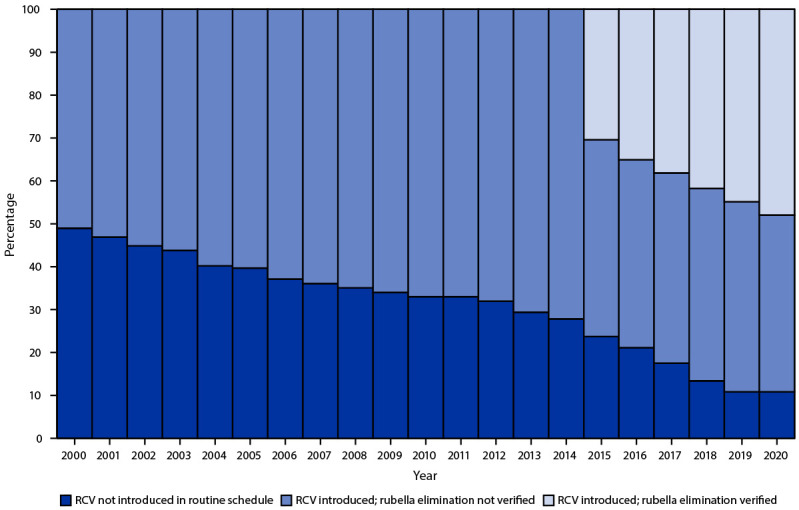
Description:Rubella Virus is a leading cause of vaccine-preventable birth defects and can cause epidemics. Although rubella Virus infection usually produces a mild febrile rash illness in children and adults, infection during pregnancy, especially during the first trimester, can result in miscarriage, fetal death, stillbirth, or an infant born with a constellation of birth defects known as Congenital rubella syndrome (CRS). A single dose of rubella-containing vaccine (RCV) can provide lifelong protection against rubella (1). The Global Vaccine Action Plan 2011-2020 (GVAP) included a target to achieve elimination of rubella in at least five of the six World Health Organization (WHO) regions* by 2020 (2), and WHO recommends capitalizing on the accelerated measles elimination activities as an opportunity to introduce RCV (1). This report updates a previous report (3) and summarizes global progress toward control and elimination of rubella and CRS from 2012, when accelerated rubella control activities were initiated, through 2020. Among 194 WHO Member States, the number with RCV in their immunization schedules has increased from 132 (68%) in 2012 to 173 (89%) in 2020; 70% of the world's infants were vaccinated against rubella in 2020. Reported rubella cases declined by 48%, from 94,277 in 2012 to 49,136 in 2019, and decreased further to 10,194 in 2020. Rubella elimination has been verified in 93 (48%) of 194 countries including the entire Region of the Americas (AMR). To increase the equity of protection and make further progress to eliminate rubella, it is important that the 21 countries that have not yet done so should introduce RCV. Likewise, countries that have introduced RCV can achieve and maintain rubella elimination with high vaccination coverage and Surveillance for rubella and CRS. Four of six WHO regions have established rubella elimination goals; the two WHO regions that have not yet established an elimination goal (the African AFR and Eastern Mediterranean EMR regions) have expressed a commitment to rubella elimination and should consider establishing a goal.
-
Subjects:
-
Source:MMWR Morbidity Mortal Weekly Rep. 71(6):196-201
-
Series:
-
DOI:
-
ISSN:0149-2195 (print) ; 1545-861X (digital)
-
Pubmed ID:35143468
-
Pubmed Central ID:PMC8830626
-
Document Type:
-
Pages in Document:6 pdf pages
-
Volume:71
-
Issue:6
-
Download URL:
-
File Type:
 [PDF - 164.57 KB]
 -
Collection(s):
-
Main Document Checksum:urn:sha-512:7fa878a00d9cea4f8e9fdab5bbd014aab1fc21a517d3e425f13857e5772015a60f24505959c03368b10d563aa82e4c875a9dd66918f9e24e6b7b3859c68b9781
Supporting Files


File Language:
English
 Was this page helpful?
 Found an issue?

CDC STACKS serves as an archival repository of CDC-published products including
scientific findings, journal articles, guidelines, recommendations, or other public health information authored or
co-authored by CDC or funded partners.
As a repository, CDC STACKS retains documents in their original published format to ensure public access to scientific information.
As a repository, CDC STACKS retains documents in their original published format to ensure public access to scientific information.
You May Also Like
COLLECTION
Morbidity and Mortality Weekly Report (MMWR)