



Resting state functional connectivity predicts STN DBS clinical response
Supporting Files

-
3 2021 ; 3-2021
-
Available in CDC Stacks on March 01, 2022, 12:00 AM
File Language:
English
Details
-
Alternative Title:Mov Disord
-
Personal Author:
-
Description:Background:
Deep brain stimulation of the subthalamic nucleus is a widely-used adjunctive therapy for motor symptoms of Parkinson disease, but with variable motor response. Predicting motor response remains difficult and novel approaches may improve surgical outcomes as well as understanding regarding pathophysiological mechanisms.
Objective:
To determine whether pre-operative resting state functional connectivity MRI predicts motor response from deep brain stimulation of the subthalamic nucleus.
Methods:
We collected preoperative resting-state functional MRI from 70 participants undergoing subthalamic nucleus deep brain stimulation. For this cohort, we analyzed strength of STN functional connectivity with seeds determined by stimulation-induced (ON/OFF) 15O H2O PET regional cerebral blood flow differences in a partially overlapping group (n = 42). We correlated STN-seed functional connectivity strength with postoperative motor outcomes and applied linear regression to predict motor outcomes.
Results:
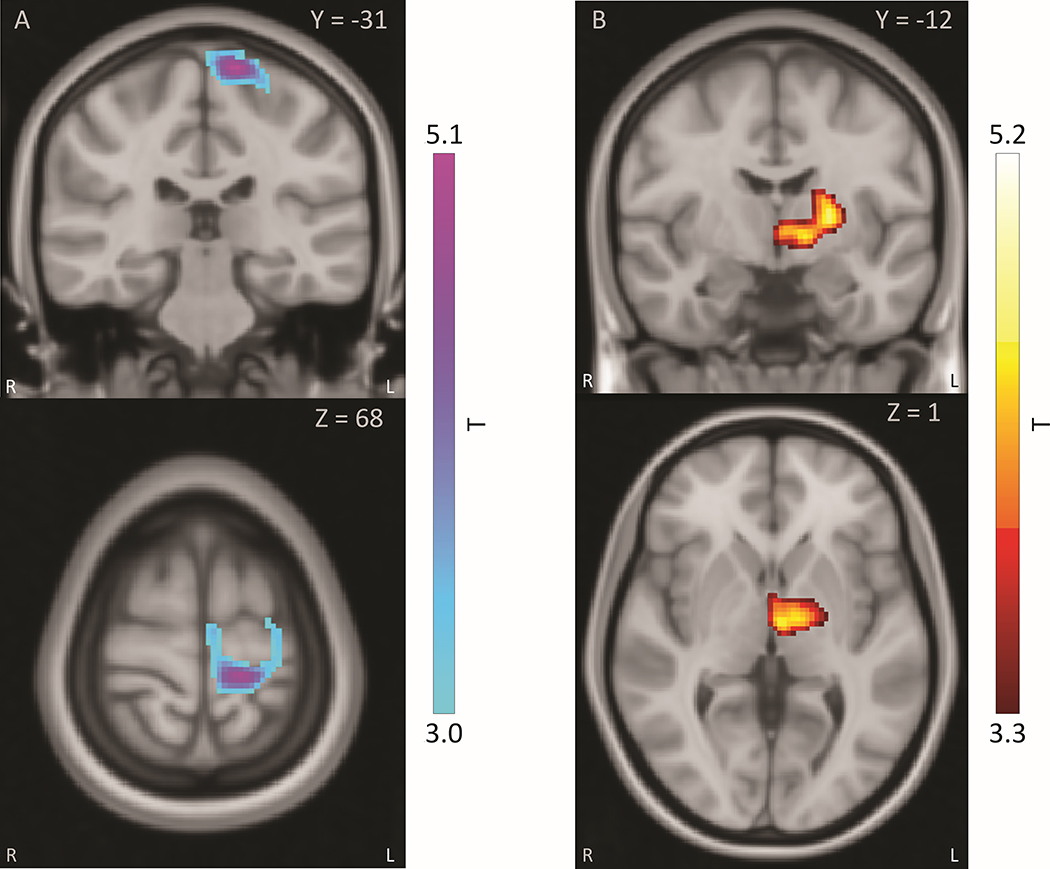
Preoperative functional connectivity between left subthalamic nucleus and ipsilateral internal globus pallidus correlated with postsurgical motor outcomes (r = −0.39, p = 0.0007), with stronger preoperative functional connectivity relating to greater improvement. Left pallidal-subthalamic nucleus connectivity also predicted motor response to DBS after controlling for covariates.
Interpretation:
Preoperative pallidal-subthalamic nucleus resting-state functional connectivity predicts motor benefit from deep brain stimulation, though this should be validated prospectively before clinical application. These observations suggest that integrity of pallidal-subthalamic nucleus circuits may be critical to motor benefits from deep brain stimulation. -
Subjects:
-
Keywords:
-
Source:Mov Disord. 36(3):662-671
-
Pubmed ID:33211330
-
Pubmed Central ID:PMC7987812
-
Document Type:
-
Funding:U19 NS110456/NS/NINDS NIH HHSUnited States/ ; R01 DK064832/DK/NIDDK NIH HHSUnited States/ ; U54 NS116025/NS/NINDS NIH HHSUnited States/ ; RF1 AG064937/AG/NIA NIH HHSUnited States/ ; R01 NS075321/NS/NINDS NIH HHSUnited States/ ; R01 NS075527/NS/NINDS NIH HHSUnited States/ ; K23 NS041248/NS/NINDS NIH HHSUnited States/ ; R01 NS097799/NS/NINDS NIH HHSUnited States/ ; P01 NS080675/NS/NINDS NIH HHSUnited States/ ; R01 HD085930/HD/NICHD NIH HHSUnited States/ ; RF1 NS075321/NS/NINDS NIH HHSUnited States/ ; R01 NS109487/NS/NINDS NIH HHSUnited States/ ; R01 NS107281/NS/NINDS NIH HHSUnited States/ ; R01 ES025991/ES/NIEHS NIH HHSUnited States/ ; R01 AG050263/AG/NIA NIH HHSUnited States/ ; F31 NS071639/NS/NINDS NIH HHSUnited States/ ; R01 NS058797/NS/NINDS NIH HHSUnited States/ ; C06 RR020092/RR/NCRR NIH HHSUnited States/ ; R01 EB009352/EB/NIBIB NIH HHSUnited States/ ; R01 NS103957/NS/NINDS NIH HHSUnited States/ ; P30 NS098577/NS/NINDS NIH HHSUnited States/ ; R01 NS041509/NS/NINDS NIH HHSUnited States/ ; U54 TR001456/TR/NCATS NIH HHSUnited States/ ; R01 HD070855/HD/NICHD NIH HHSUnited States/ ; P30 NS048056/NS/NINDS NIH HHSUnited States/ ; R01 NS097437/NS/NINDS NIH HHSUnited States/ ; R01 ES029524/ES/NIEHS NIH HHSUnited States/ ; U54 NS065701/NS/NINDS NIH HHSUnited States/ ; UL1 TR000448/TR/NCATS NIH HHSUnited States/ ; R21 AG063974/AG/NIA NIH HHSUnited States/ ; U24 CA204854/CA/NCI NIH HHSUnited States/ ; R61 AT010753/AT/NCCIH NIH HHSUnited States/ ; U10 NS077384/NS/NINDS NIH HHSUnited States/ ; UL1 TR002345/TR/NCATS NIH HHSUnited States/ ; UH2 TR002065/TR/NCATS NIH HHSUnited States/ ; R01 NS092865/NS/NINDS NIH HHSUnited States/ ; R01 OH011661/OH/NIOSH CDC HHSUnited States/ ; T32 EB021955/EB/NIBIB NIH HHSUnited States/
-
Volume:36
-
Issue:3
-
Download URL:
-
File Type:
 [PDF - 1.18 MB]
 -
Collection(s):
-
Main Document Checksum:urn:sha-512:9cede3022394dbb0979452b71015a9d9d9a4ebc1b10cce6d71e088ecb8d2b014f4218ca63aa51aa905777191776f41eed9f6750d70abb55dd4828a35534ccb8d
Supporting Files


File Language:
English
 Was this page helpful?
 Found an issue?





CDC STACKS serves as an archival repository of CDC-published products including
scientific findings, journal articles, guidelines, recommendations, or other public health information authored or
co-authored by CDC or funded partners.
As a repository, CDC STACKS retains documents in their original published format to ensure public access to scientific information.
As a repository, CDC STACKS retains documents in their original published format to ensure public access to scientific information.
You May Also Like
COLLECTION
CDC Public Access