



Patient-reported neurocognitive symptoms influence instrumental activities of daily living in sickle cell disease
Supporting Files

-
11 01 2021 ; 11-01-
-
Available in CDC Stacks on November 01, 2022, 12:00 AM
File Language:
English
Details
-
Alternative Title:Am J Hematol
-
Personal Author:
-
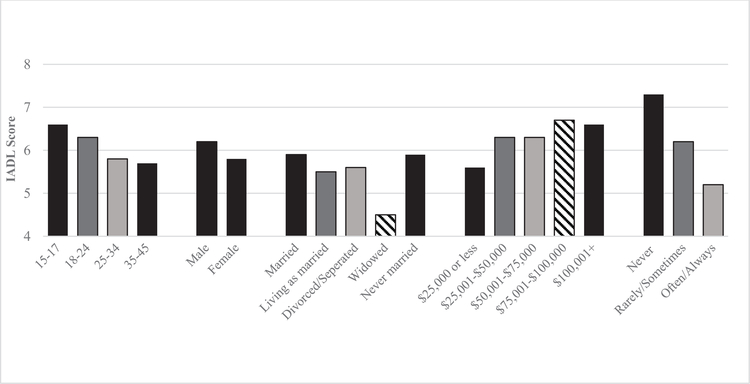
Description:Individuals with sickle cell disease (SCD) experience neurocognitive decline, low medication adherence, increased unemployment, and difficulty with instrumental activities of daily living (IADL). The relationship between self-perceived cognitive difficulties and IADLs, including employment, school enrollment, independence, engagement in leisure activities, and medication adherence is unknown. We hypothesized that self-reported difficulties across neurocognitive areas would predict lower IADL skills. Adolescent and adult participants of the multi-site Sickle Cell Disease Implementation Consortium (SCDIC) (n = 2436) completed patient-reported outcome (PRO) measures of attention, executive functioning, processing speed, learning, and comprehension. Cognitive symptoms were analyzed as predictors in multivariable modeling. Outcome variables included 1) an IADL composite that consisted of employment, participation in school, reliance on others, and leisure pursuits, and 2) hydroxyurea adherence. Participants reported cognitive difficulty across areas of attention (55%), executive functioning (51%), processing speed (57%), and reading comprehension (65%). Executive dysfunction (p < 0.001) and sometimes or often experiencing learning difficulties (p < 0.001 and p = 0.04) and poor comprehension (p = 0.000 and p = 0.001), controlled for age (p < 0.001), pain (p < 0.001), and hydroxyurea use (p = 0.001), were associated with poor IADL skills. Executive functioning difficulties (p = 0.021), controlled for age (p = 0.013 for ages 25-34), genotype (p = 0.001), and hemoglobin (p = 0.004), predicted hydroxyurea non-adherence. Analysis of PRO measures indicated that cognitive dysfunction is prevalent in adolescents and adults with SCD. Cognitive dysfunction translated into clinically meaningful outcomes. PRO of cognitive symptoms can be used as an important adjunct clinical tool to monitor symptoms that impact functional skills, including engagement in societal activities and medication adherence.
-
Subjects:
-
Keywords:
-
Source:Am J Hematol. 96(11):1396-1406
-
Pubmed ID:34350622
-
Pubmed Central ID:PMC8855994
-
Document Type:
-
Funding:U24 HL133948/HL/NHLBI NIH HHSUnited States/ ; U01 HL134042/HL/NHLBI NIH HHSUnited States/ ; U01 HL133994/HL/NHLBI NIH HHSUnited States/ ; U01 HL133964/HL/NHLBI NIH HHSUnited States/ ; U01 HL134007/HL/NHLBI NIH HHSUnited States/ ; U01 HL134004/HL/NHLBI NIH HHSUnited States/ ; U01 HL133990/HL/NHLBI NIH HHSUnited States/ ; U01 HL133997/HL/NHLBI NIH HHSUnited States/ ; U18 DD000015/DD/NCBDD CDC HHSUnited States/ ; U01 HL133996/HL/NHLBI NIH HHSUnited States/ ; K01 HL125495/HL/NHLBI NIH HHSUnited States/
-
Volume:96
-
Issue:11
-
Download URL:
-
File Type:
 [PDF - 456.14 KB]
 -
Collection(s):
-
Main Document Checksum:urn:sha-512:9ce02b961616e515187840a44e2b369323655d5c57078a5f65c5ccc13f85ea03cb67aac3e9343cd91afd6290a7311a435eb8bd66e8a5b8c0cde4c3743c917acb
Supporting Files


File Language:
English
 Was this page helpful?
 Found an issue?


CDC STACKS serves as an archival repository of CDC-published products including
scientific findings, journal articles, guidelines, recommendations, or other public health information authored or
co-authored by CDC or funded partners.
As a repository, CDC STACKS retains documents in their original published format to ensure public access to scientific information.
As a repository, CDC STACKS retains documents in their original published format to ensure public access to scientific information.
You May Also Like
COLLECTION
CDC Public Access