


Autoimmune conditions in the World Trade Center general responder cohort: A nested case-control and standardized incidence ratio analysis
Supporting Files

-
2 2022
-
File Language:
English
Details
-
Alternative Title:Am J Ind Med
-
Personal Author:Sacks, Henry S. ; Smirnoff, Margaret ; Carson, Deborah ; Cooney, Michael L. ; Shapiro, Moshe Z. ; Hahn, Christopher J. ; Dasaro, Christopher R. ; Crowson, Cynthia ; Tassiulas, Ioannis ; Hirten, Robert P. ; Cohen, Benjamin L. ; Haber, Richard S. ; Davies, Terry F. ; Simpson, David M. ; Crane, Michael A. ; Harrison, Denise J. ; Luft, Benjamin J. ; Moline, Jacqueline M. ; Udasin, Iris G. ; Todd, Andrew C. ; Sloan, Nancy L. ; Teitelbaum, Susan L.
-
Description:Background:
The World Trade Center (WTC) general responder cohort (GRC) was exposed to environmental toxins possibly associated with increased risk of developing autoimmune conditions.
Objectives:
Two study designs were used to assess incidence and risks of autoimmune conditions in the GRC.
Methods:
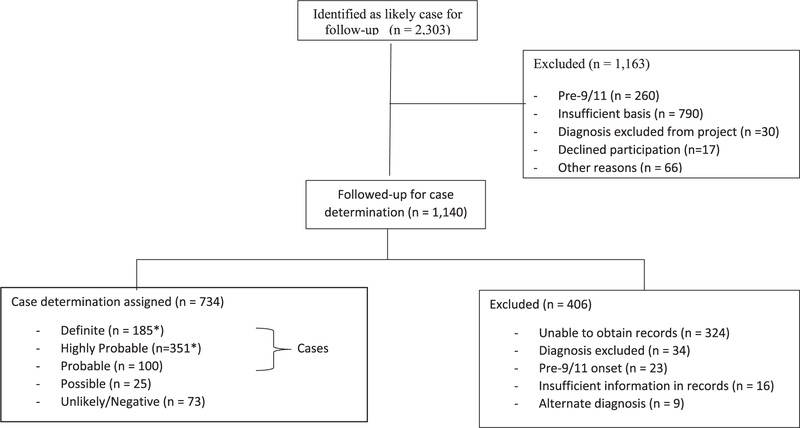
Three clinically trained professionals established the status of possible GRC cases of autoimmune disorders adhering to diagnostic criteria, supplemented, as needed, by specialists’ review of consenting responders’ medical records. Nested case-control analyses using conditional logistic regression estimated the risk associated with high WTC exposure (being in the 9/11/2001 dust cloud or ≥median days' response worked) compared with low WTC exposure (all other GRC members'). Four controls were matched to each case on age at case diagnosis (±2 years), sex, race/ethnicity, and year of program enrollment. Sex-specific and sensitivity analyses were performed. GRC age- and sex-adjusted standardized incidence ratios (SIRs) were compared with the Rochester Epidemiology Project (REP). Complete REP inpatient and outpatient medical records were reviewed by specialists. Conditions meeting standardized criteria on ≥2 visits were classified as REP confirmed cases.
Results:
Six hundred and twenty-eight responders were diagnosed with autoimmune conditions between 2002 and 2017. In the nested case-control analyses, high WTC exposure was not associated with autoimmune domains and conditions (rheumatologic domain odds ratio [OR] = 1.03, 95% confidence interval [CI] = 0.77, 1.37; rheumatoid arthritis OR = 1.12, 95% CI = 0.70, 1.77). GRC members had lower SIR than REP. Women's risks were generally greater than men's.
Conclusions:
The study found no statistically significant increased risk of autoimmune conditions with WTC exposures.
-
Subjects:
-
Source:Am J Ind Med. 65(2):117-131
-
Pubmed ID:34825393
-
Pubmed Central ID:PMC8851411
-
Document Type:
-
Funding:U10 OH008239/OH/NIOSH CDC HHSUnited States/ ; HHSD200201139377C/ImCDC/Intramural CDC HHSUnited States/ ; U10 OH008223/OH/NIOSH CDC HHSUnited States/ ; HHSD200200200384C/ImCDC/Intramural CDC HHSUnited States/ ; HHSD200201139388C/ImCDC/Intramural CDC HHSUnited States/ ; HHSD200201139384C/ImCDC/Intramural CDC HHSUnited States/ ; U10 OH008225/OH/NIOSH CDC HHSUnited States/ ; 200-2011-39356/61/77/84/85/88/OH/NIOSH CDC HHSUnited States/ ; U10 OH008232/OH/NIOSH CDC HHSUnited States/ ; HHSD200201139361C/ImCDC/Intramural CDC HHSUnited States/ ; 200-2017-93325/OH/NIOSH CDC HHSUnited States/ ; HHSD200201139385C/ImCDC/Intramural CDC HHSUnited States/ ; U10 OH008216/OH/NIOSH CDC HHSUnited States/ ; U10-OH008216/23/25/32/39/75/OH/NIOSH CDC HHSUnited States/ ; HHSD200201793325C/ImCDC/Intramural CDC HHSUnited States/ ; HHSD200201139356C/ImCDC/Intramural CDC HHSUnited States/ ; 200-2002-00384/OH/NIOSH CDC HHSUnited States/
-
Place as Subject:
-
Volume:65
-
Issue:2
-
Collection(s):
-
Main Document Checksum:urn:sha256:4806f0b44416f6e963ffda06f28fd3fffcdb904a1fd12bbfca1c57f833e6b113
-
Download URL:
-
File Type:
 [PDF
- 237.11 KB
]
[PDF
- 237.11 KB
]
Supporting Files


File Language:
English
ON THIS PAGE

CDC STACKS serves as an archival repository of CDC-published products including
scientific findings,
journal articles, guidelines, recommendations, or other public health information authored or
co-authored by CDC or funded partners.
As a repository, CDC STACKS retains documents in their original published format to ensure public access to scientific information.
As a repository, CDC STACKS retains documents in their original published format to ensure public access to scientific information.
You May Also Like
COLLECTION
CDC Public Access