


Impact of healthcare services on thyroid cancer incidence among World Trade Center-exposed rescue and recovery workers
Supporting Files

-
10 2021
-
File Language:
English
Details
-
Alternative Title:Am J Ind Med
-
Personal Author:Goldfarb, David G. ; Colbeth, Hilary L. ; Skerker, Molly ; Webber, Mayris P. ; Prezant, David J. ; Dasaro, Christopher R. ; Todd, Andrew C. ; Kristjansson, Dana ; Li, Jiehui ; Brackbill, Robert M. ; Farfel, Mark R. ; Cone, James E. ; Yung, Janette ; Kahn, Amy R. ; Qiao, Baozhen ; Schymura, Maria J. ; Boffetta, Paolo ; Hall, Charles B. ; Zeig-Owens, Rachel
-
Description:Background:
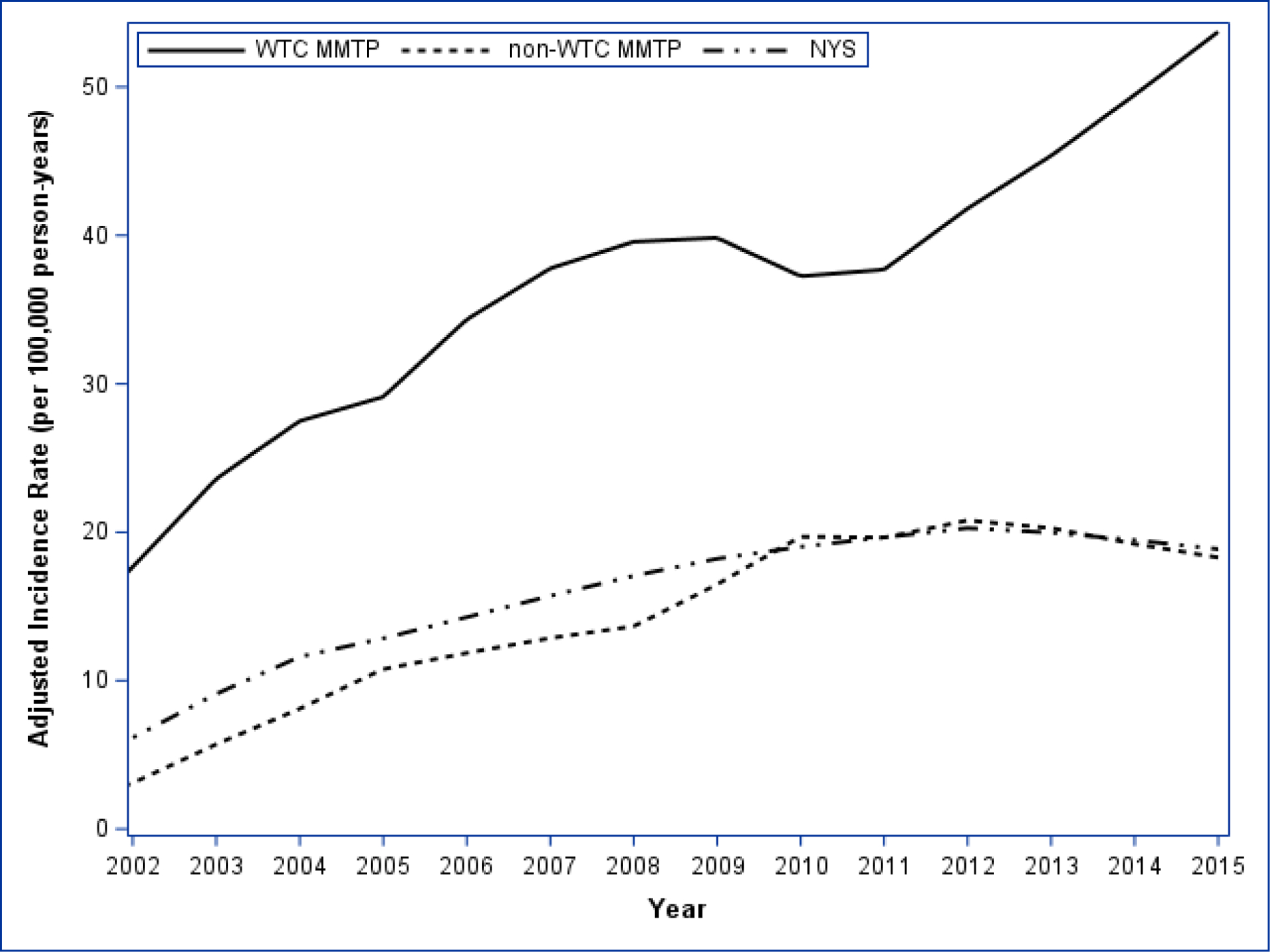
A recent study of World Trade Center (WTC)-exposed firefighters and emergency medical service workers demonstrated that elevated thyroid cancer incidence may be attributable to frequent medical testing, resulting in the identification of asymptomatic tumors. We expand on that study by comparing the incidence of thyroid cancer among three groups: WTC-exposed rescue/recovery workers enrolled in a New York State (NYS) WTC-medical monitoring and treatment program (MMTP); WTC-exposed rescue/recovery workers not enrolled in an MMTP (non-MMTP); and the NYS population.
Methods:
Person-time began on 9/12/2001 or at enrollment in a WTC cohort and ended at death or on 12/31/2015. Cancer data were obtained through linkages with 13 state cancer registries. We used Poisson regression to estimate rate ratios (RRs) and 95% confidence intervals (CIs) for MMTP and non-MMTP participants. NYS rates were used as the reference. To estimate potential changes over time in WTC-associated risk, change points in RRs were estimated using profile likelihood.
Results:
The thyroid cancer incidence rate among MMTP participants was more than twice that of NYS population rates (RR = 2.31; 95% CI = 2.00–2.68). Non-MMTP participants had a risk similar to NYS (RR = 0.96; 95% CI = 0.72–1.28). We observed no change points in the follow-up period.
Conclusion:
Our findings support the hypothesis that no-cost screening (a benefit provided by WTC-MMTPs) is associated with elevated identification of thyroid cancer. Given the high survival rate for thyroid cancer, it is important to weigh the costs and benefits of treatment, as many of these cancers were asymptomatic and may have been detected incidentally.
-
Subjects:
-
Source:Am J Ind Med. 64(10):861-872
-
Pubmed ID:34275137
-
Pubmed Central ID:PMC8796202
-
Document Type:
-
Funding:HHSN261201800032C/CA/NCI NIH HHSUnited States/ ; HHSN261201800009C/CA/NCI NIH HHSUnited States/ ; U01 OH011931/OH/NIOSH CDC HHSUnited States/ ; U01OH011315/OH/NIOSH CDC HHSUnited States/ ; U01 OH011302/OH/NIOSH CDC HHSUnited States/ ; 200-2017-93326/OH/NIOSH CDC HHSUnited States/ ; HHSN261201800015I/CA/NCI NIH HHSUnited States/ ; U50/ATU272750/TS/ATSDR CDC HHSUnited States/ ; 200-2011-39378/OH/NIOSH CDC HHSUnited States/ ; HHSN261201800032I/CA/NCI NIH HHSUnited States/ ; 200-2011-39383; 200-2017-93325/OH/NIOSH CDC HHSUnited States/ ; HHSN261201800015C/CA/NCI NIH HHSUnited States/ ; P30 CA013330/CA/NCI NIH HHSUnited States/ ; 75N91018D00005 (Task Order 75N91018F00001)/CA/NCI NIH HHSUnited States/ ; NU58DP006344/DP/NCCDPHP CDC HHSUnited States/ ; U01 OH011869/OH/NIOSH CDC HHSUnited States/ ; U01 OH011480/OH/NIOSH CDC HHSUnited States/ ; U50OH009739/ACL/ACL HHSUnited States/ ; U01 OH011932/OH/NIOSH CDC HHSUnited States/ ; U01OH011315/ACL/ACL HHSUnited States/ ; U50 OH009739/OH/NIOSH CDC HHSUnited States/ ; U01 OH011681/OH/NIOSH CDC HHSUnited States/ ; 6NU58DP006309/CC/CDC HHSUnited States/ ; HHSN261201800009I/CA/NCI NIH HHSUnited States/ ; U01 OH011315/OH/NIOSH CDC HHSUnited States/
-
Volume:64
-
Issue:10
-
Collection(s):
-
Main Document Checksum:urn:sha256:dca7ef46569f531f4625e0c84647f8467a1843231c81b62c71882283a0b39109
-
Download URL:
-
File Type:
 [PDF
- 310.61 KB
]
[PDF
- 310.61 KB
]
Supporting Files


File Language:
English
ON THIS PAGE


CDC STACKS serves as an archival repository of CDC-published products including
scientific findings,
journal articles, guidelines, recommendations, or other public health information authored or
co-authored by CDC or funded partners.
As a repository, CDC STACKS retains documents in their original published format to ensure public access to scientific information.
As a repository, CDC STACKS retains documents in their original published format to ensure public access to scientific information.
You May Also Like
COLLECTION
CDC Public Access