



Clinical, diagnostic, and epidemiological features of a community-wide outbreak of canine leptospirosis in a low-prevalence region (Maricopa County, Arizona)
Supporting Files

-
3 15 2021
-
Available in CDC Stacks on 2022-03-15T00:00:00Z
File Language:
English
Details
-
Alternative Title:J Am Vet Med Assoc
-
Personal Author:Iverson, Sally Ann ; Levy, Craig ; Yaglom, Hayley D. ; Venkat, Heather L. ; Artus, Aileen ; Galloway, Renee ; Guagliardo, Sarah Anne J. ; Reynolds, Laura ; Kretschmer, Melissa JoAnne ; LaFerla Jenni, Margaret E. ; Woodward, Peter ; Reindel, Alison A. ; Tarrant, Sheena ; Sylvester, Tammy ; Klein, Ronald ; Mundschenk, Peter ; Sunenshine, Rebecca ; Schafer, Ilana J.
-
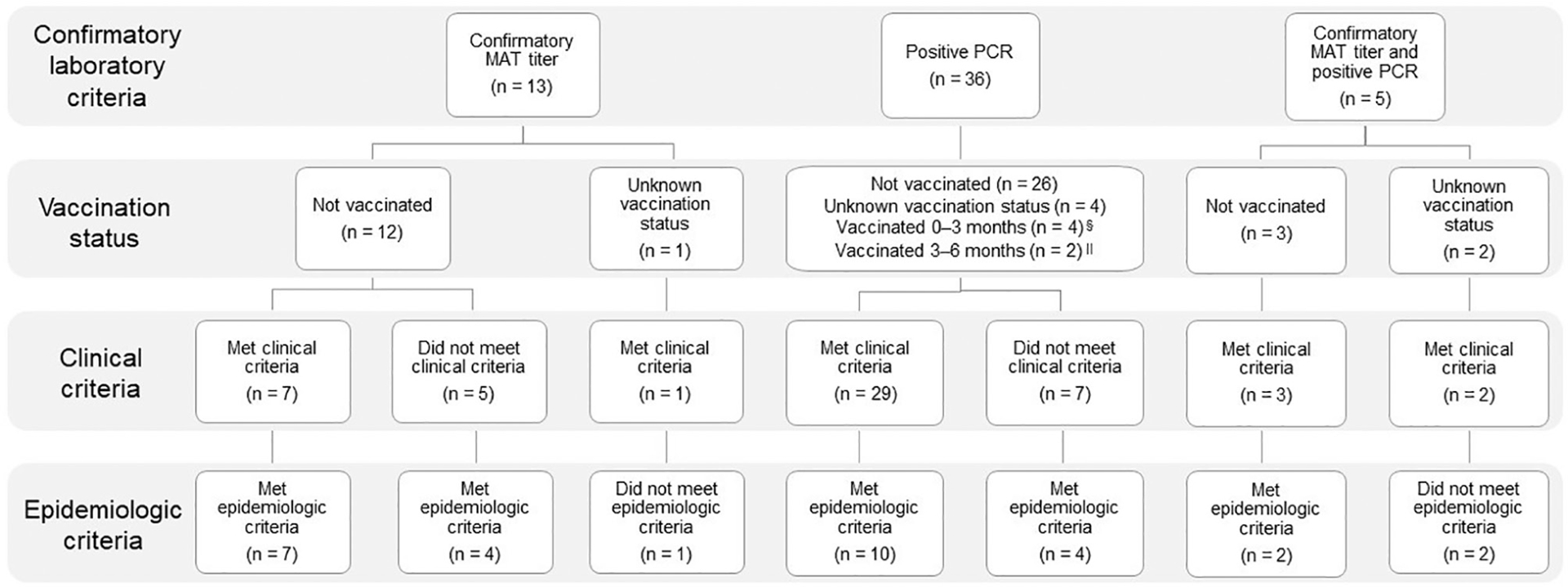
Description:OBJECTIVE ; To describe clinical, diagnostic, and epidemiological features of an outbreak of leptospirosis in dogs in Maricopa County, Ariz, from January 2016 through June 2017. ; ANIMALS ; 71 case and 281 control dogs. ; PROCEDURES ; Cases were classified as confirmed, probable, suspect, or not a case on the basis of medical record data that fulfilled clinical, diagnostic, and epidemiological criteria. Potential exposures were assessed by owner survey. For the case-control investigation, control dogs were recruited through owner completion of a July 2017 survey. Summary statistics and ORs for case dog lifestyle factors were reported. ; RESULTS ; 54 dogs were classified as confirmed and 17 as probable cases. For 4 dogs of a household cluster (5 confirmed and 3 probable), the highest microscopic agglutination titer was for serovar Djasiman (Leptospira kirschneri detected by PCR assay), and for 13 dogs of a community outbreak (49 confirmed and 14 probable cases), the highest titer was for serovar Canicola (Leptospira interrogans detected by PCR assay). The 44 case dogs included in the case-control investigation were 7.7 (95% CI, 3.5 to 16.7) and 2.9 times (95% CI, 1.3 to 6.6) as likely as control dogs to have visited dog daycare or to have been kenneled overnight at a boarding facility, respectively, 30 days prior to the onset of clinical signs or diagnosis. ; CONCLUSIONS AND CLINICAL RELEVANCE ; Diagnostic and epidemiological findings indicated 2 outbreaks. Transmission where dogs congregated likely propagated the community outbreak. Outbreaks of leptospiral infections can occur in regions of low prevalence, and a dog’s exposure to areas where dogs congregate should be considered when making Leptospira vaccination recommendations.
-
Subjects:
-
Source:J Am Vet Med Assoc. 258(6):616-629
-
Pubmed ID:33683958
-
Pubmed Central ID:PMC8786034
-
Document Type:
-
Funding:
-
Place as Subject:
-
Volume:258
-
Issue:6
-
Download URL:
-
File Type:
 [PDF - 630.62 KB]
 -
Collection(s):
-
Main Document Checksum:urn:sha256:ced48fdac8cf3d560a0f96523ddaa1461e793b1be089c13c1e03b1a655ccc4ff
Supporting Files


File Language:
English
 Was this page helpful?
 Found an issue?



CDC STACKS serves as an archival repository of CDC-published products including
scientific findings, journal articles, guidelines, recommendations, or other public health information authored or
co-authored by CDC or funded partners.
As a repository, CDC STACKS retains documents in their original published format to ensure public access to scientific information.
As a repository, CDC STACKS retains documents in their original published format to ensure public access to scientific information.
You May Also Like
COLLECTION
CDC Public Access