



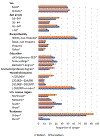
Purpose-Based Walking Trips by Duration, Distance, and Select Characteristics, 2017 National Household Travel Survey
Supporting Files

-
8 01 2021 ; 8-01-
-
Available in CDC Stacks on 2022-08-01T00:00:00Z
File Language:
English
Details
-
Alternative Title:J Phys Act Health
-
Personal Author:
-
Description:Background: ; New or enhanced activity-friendly routes to everyday destinations is an evidence-based approach for increasing physical activity. Although national estimates for some infrastructure features surrounding where one lives and the types of nearby destinations are available, less is known about the places where individuals walk. ; Methods: ; A total of 5 types of walking trips (N = 54,034) were defined by whether they began or ended at home (home based HB) and trip purpose (HB work, HB shopping, HB social/recreation, HB other, and not HB trip) (2017 National Household Travel Survey). Differences and trends by subgroups in the proportion of each purpose-oriented trip were tested using pairwise comparisons and polynomial contrasts. ; Results: ; About 14% of U.S. adults reported ≥1 walking trip on a given day. About 64% of trips were HB trips. There were few differences in prevalence for each purpose by subgroup. For example, prevalence of trips that were not HB decreased significantly with increasing age and increased with increasing education and household income. ; Conclusions: ; Given age-related and socioeconomic differences in walking trips by purpose, planners and other professionals may want to consider trip origin and destination purposes when prioritizing investments for the creation of activity-friendly routes to everyday destinations where people live, work, and play.
-
Subjects:
-
Keywords:
-
Source:J Phys Act Health. 18(Suppl 1):S86-S93
-
Pubmed ID:34465646
-
Pubmed Central ID:PMC8743872
-
Document Type:
-
Funding:
-
Volume:18
-
Download URL:
-
File Type:
 [PDF - 379.72 KB]
 -
Collection(s):
-
Main Document Checksum:urn:sha256:6a0d11e3f72210c068a86b3ea45e61fd658c01683159ad8a56ef458c9e2781c0
Supporting Files


File Language:
English
 Was this page helpful?
 Found an issue?



CDC STACKS serves as an archival repository of CDC-published products including
scientific findings, journal articles, guidelines, recommendations, or other public health information authored or
co-authored by CDC or funded partners.
As a repository, CDC STACKS retains documents in their original published format to ensure public access to scientific information.
As a repository, CDC STACKS retains documents in their original published format to ensure public access to scientific information.
You May Also Like
COLLECTION
CDC Public Access